Work process
Cognitive Structuralism and ANDRBEL Research Program
AndrBel's Theory of Cognitive Structuralism for publication in The Journal for Artistic Research (JAR) / Internationally, the Research Catalogue (RC)
Cognitive Structuralism
Toward an Artistic Research Framework on Perception and Structural Reality
Contemporary Conceptual Painting
Artistic Research
* AndrBel's Theory of Cognitive Structuralism for publication in The Journal for Artistic Research (JAR) / Internationally, the Research Catalogue (RC)
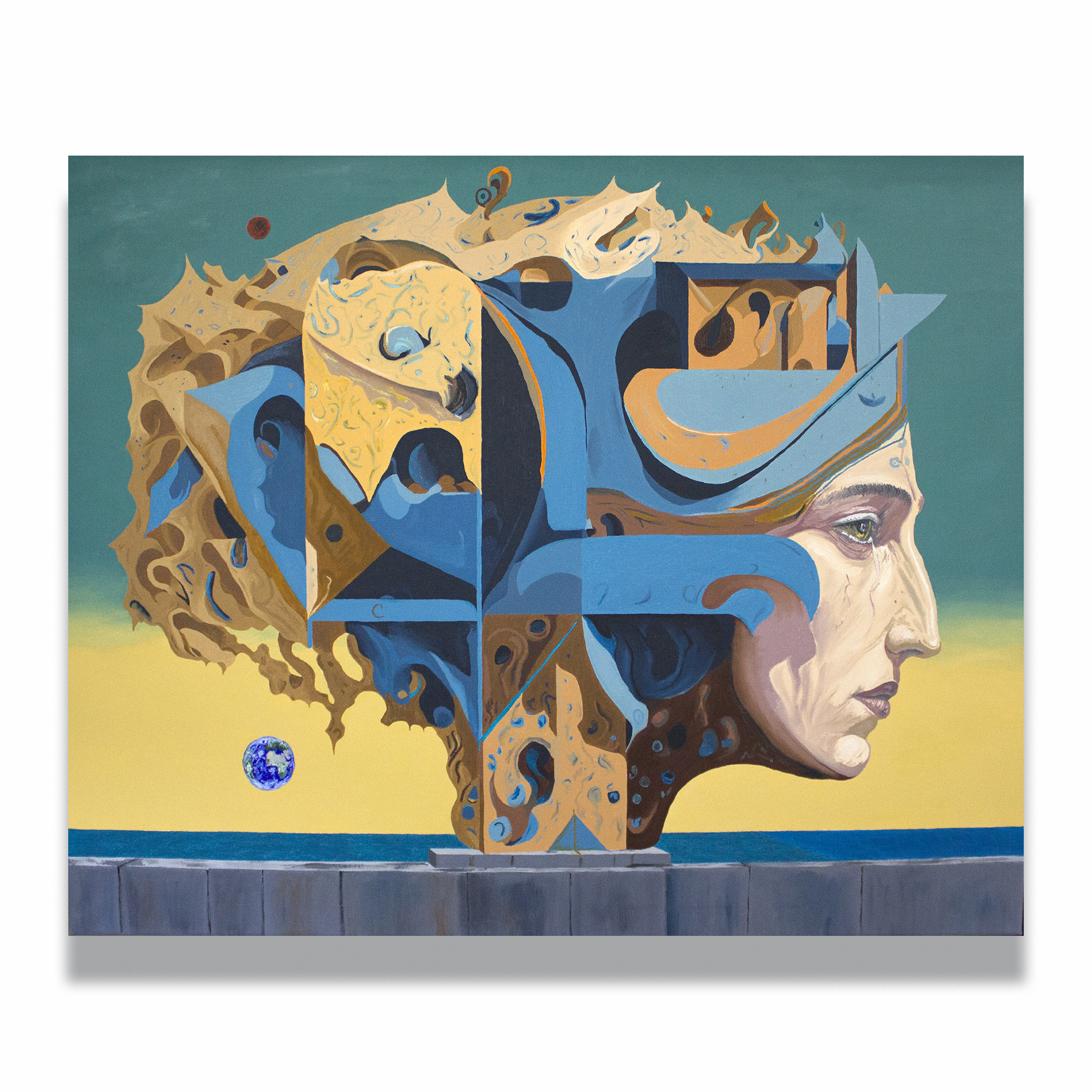
"Painting is not an image of reality.It is a structural model of thinking through which reality becomes visible." — AndrBel
Part I — Research Question
Introduction: Why Investigate Perception Through Painting?
This raises a fundamental question for artistic practice:
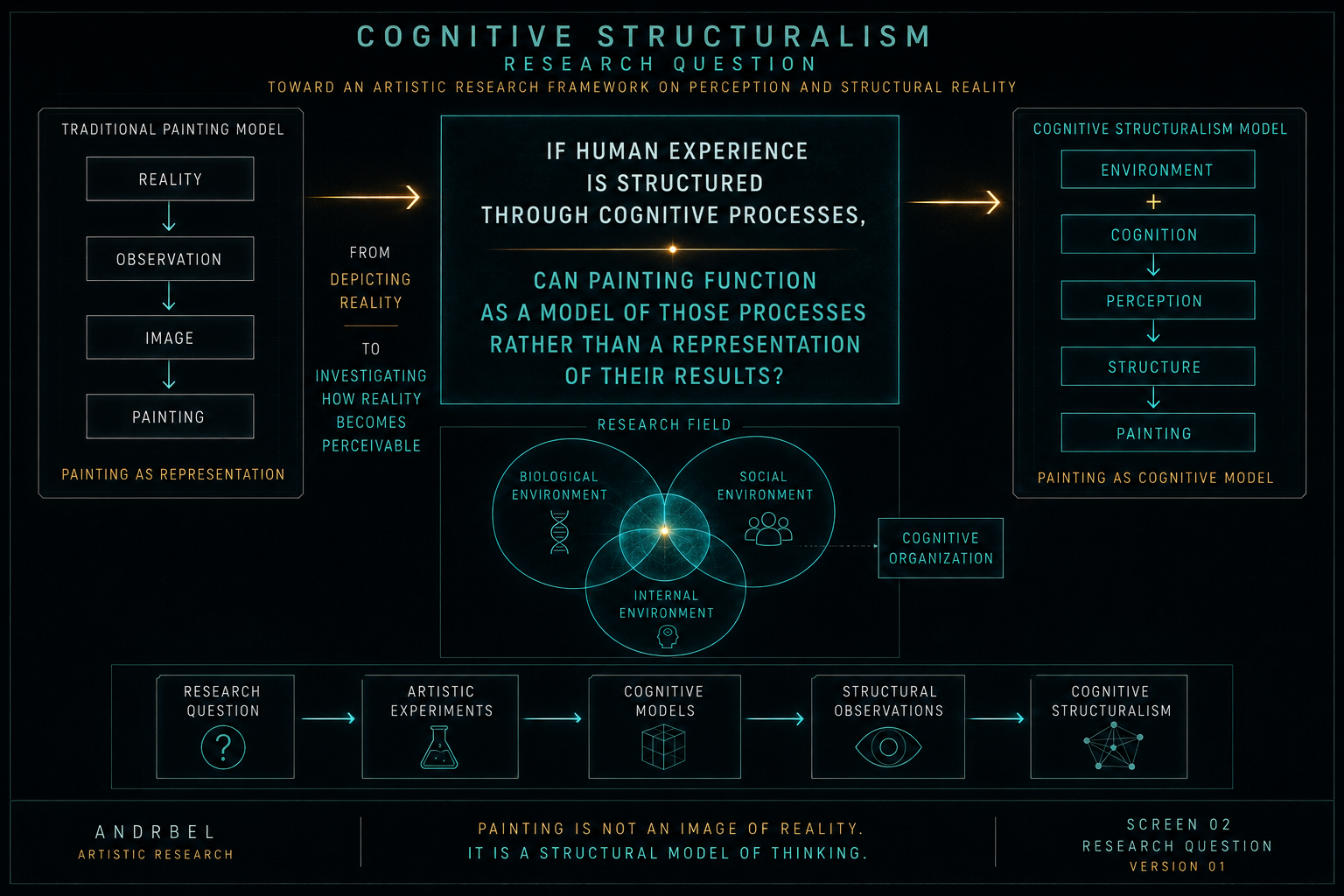
If human experience is structured through cognitive processes, can painting function as a model of those processes rather than as a representation of their results?
The question shifts the role of painting.
Instead of asking:
What does the painting depict?
another possibility emerges:
What cognitive structures does the painting reveal?
Within this perspective, painting becomes more than an image. It becomes a potential site of investigation into the mechanisms through which perception, meaning, and reality are constructed.
The present research emerges from this shift.
Rather than treating painting as a representation of reality, the research investigates whether painting can operate as a structural model of cognition itself.
The Central Research Question
Can painting function as a cognitive structure through which the processes of perception and reality formation become materially observable?
This question does not seek to explain cognition scientifically.
Nor does it attempt to propose a universal theory of consciousness.
Instead, it approaches cognition as a field of artistic inquiry.
The research examines whether visual structures, spatial relationships, geometry, color interactions, and compositional systems can be used to investigate how perception emerges and how experienced reality becomes organized.
In this context, painting is approached as an experimental environment rather than a representational surface.
Secondary Research Questions
1. Perception and Structure
- Does perception emerge through identifiable structural relationships rather than through isolated sensory events?
2. Reality and Cognition
- To what extent is experienced reality constructed through cognitive organization rather than directly received from the external world?
3. Geometry and Thought
- Can geometry function not merely as visual language, but as a structural analogue of cognitive organization?
4. Painting as Research
- Can painting itself operate as a research method?
5. Cognitive Structures and Artistic Form
- What forms emerge when the artwork is treated as a cognitive structure rather than as an image?
Research Position
Its objective is not to validate scientific hypotheses.
Nor is it to reduce artistic practice to cognitive science.
Instead, the research occupies a space between artistic production and conceptual inquiry.
The artworks developed throughout this investigation are treated as active components of the research process. They function neither as illustrations nor as final conclusions.
They operate as experimental structures through which questions about perception, cognition, and reality can be explored.
Within this framework, artistic practice becomes a method of investigation.
Painting becomes a cognitive experiment.
And the artwork becomes a material trace of that investigation.
Toward Cognitive Structuralism
Rather than beginning as a fixed theory, it developed gradually through the production of paintings, the observation of perceptual structures, and the search for a vocabulary capable of describing recurring relationships between cognition, environment, and visual form.
The following sections trace the development of this inquiry and propose Cognitive Structuralism as one possible artistic framework for investigating the structural relationship between perception and experienced reality.
Part II — Why Representation Became Insufficient
From Depicting Reality to Investigating Its Construction
Whether depicting religious narratives, historical events, landscapes, human figures, or abstract forms, the artwork has often been evaluated according to its relationship with something external to itself. Even when artistic movements challenged realism, the painting generally remained connected to the notion of image-making — an object that stands in place of something else.
Representation has therefore functioned as one of the central foundations of painting.
The artwork represents:
- an object,
- an event,
- an emotion,
- an idea,
- a symbolic system,
- or an imagined reality.
Yet throughout my own artistic practice, a persistent question began to emerge:
What if the most important subject of painting is not the world that is perceived, but the process through which perception itself becomes possible?
This question gradually revealed limitations within representation as an explanatory framework.
The issue was not that representation had become obsolete.
Rather, it became insufficient for addressing the problems that increasingly occupied my artistic research.
The Problem of the Observer
world
↓
observation
↓
image
Within this structure, the observer is often treated as a relatively stable entity receiving information from an external reality.
However, everyday experience suggests something more complex.
Different individuals can encounter the same event and construct radically different interpretations.
They may:
- perceive different meanings,
- remember different details,
- assign different values,
- construct different narratives,
- and ultimately experience different realities.
The question therefore arises:
If perception differs, what exactly is being represented?
Is the painting representing reality?
Or is it representing the observer's cognitive construction of reality?
The more this question was examined, the more attention shifted away from external objects and toward the structures through which those objects become meaningful.
Reality as Cognitive Construction
Perception actively organizes information.
Human beings do not simply receive reality.
They continuously construct models of reality.
Within this perspective, experience emerges through processes of:
- selection,
- interpretation,
- categorization,
- memory,
- expectation,
- and cognitive organization.
Reality becomes less a fixed external condition and more a dynamic interaction between environment and cognition.
This shift introduces a significant challenge for painting.
If reality is actively constructed, then representation may capture only the outcome of cognitive processes rather than the processes themselves.
The image may show what is perceived.
But it may not reveal how perception becomes structured.
This distinction became increasingly important within my practice.
Beyond the Image
The concern gradually moved away from:
- what is shown,
- who is depicted,
- what narrative is presented,
toward questions such as:
- How is perception organized?
- How does cognition construct meaning?
- How do environments influence experience?
- How do internal and external realities interact?
- How does consciousness generate structure?
The artwork can no longer function solely as an image.
Instead, it begins functioning as a system.
A structure.
An environment.
A field of relationships.
Meaning emerges not only through depicted content but through the organization of perceptual elements themselves.
The Limits of Representation
1. Representation Prioritizes Outcomes
Traditional images often present the result of perception.
They rarely reveal the mechanisms that generated it.
The viewer encounters the conclusion rather than the process.
2. Representation Assumes Stability
Representational systems frequently imply stable objects and stable meanings.
However, cognition is dynamic.
Perception changes continuously.
Meaning evolves through context, memory, and experience.
3. Representation Focuses on Objects
Cognitive processes are not objects.
They are relationships, interactions, and structures.
Many aspects of cognition cannot be depicted directly because they do not possess fixed visual forms.
4. Representation Conceals Construction
Perhaps most importantly, representation can conceal the fact that reality itself is being constructed.
The image may appear natural, immediate, or self-evident.
The underlying cognitive architecture remains invisible.
Toward Structural Investigation
The central concern was no longer:
- How can reality be represented?
- How can the structures through which reality is constructed become visible?
The artwork becomes less concerned with depiction and more concerned with organization.
The painting investigates:
- relationships,
- systems,
- cognitive interactions,
- perceptual architectures,
- structural dynamics.
Geometry and Structural Thinking
Within many artistic traditions, geometry functions as composition, decoration, symbolism, or abstraction.
Within my practice, geometry gradually acquired a different role.
It became a tool for investigating structure itself.
The question was no longer:
- How can geometry organize a painting?
- Can geometry reveal how cognition organizes reality?
This distinction proved fundamental.
Geometry began functioning as a visual analogue of cognitive organization.
Not a style.
Not an aesthetic preference.
But a structural language.
A framework capable of expressing relationships that remain difficult to access through representation alone.
This development later became central to the Geometria system and, more broadly, to Cognitive Structuralism.
The Emergence of a Research Direction
It emerged gradually through years of artistic practice.
Individual paintings increasingly behaved less like images and more like cognitive structures.
Series such as:
- RELHI,
- MINDE,
- Persone diverse,
- Qubi,
- GOTER,
- Geometria,
- Sentimenti,
- Marmosa
Rather than functioning as separate themes, these systems gradually revealed themselves as interconnected investigations within a larger research framework.
A new question emerged:
- If paintings can function as cognitive structures, can artistic practice become a method for investigating how reality is cognitively constructed?
Transition to Part III
Instead, it generated a series of experiments, observations, visual systems, and conceptual structures.
Through these investigations, recurring patterns began to appear.
The relationship between cognition, environment, perception, and visual form became increasingly central.
The next section examines how these observations gradually evolved into the artistic research framework later termed:
Cognitive Structuralism.
Author's Note
Rather, it treats representation as only one possible function of painting.
The present investigation explores whether painting can also operate as:
- a cognitive structure,
- a perceptual model,
- a research method,
- and a material framework through which the construction of reality itself can be examined.
Part III — The Development of Cognitive Structuralism: From Artistic Practice to Research Framework
Introduction
It did not emerge from philosophy, psychology, cognitive science, or an attempt to construct a comprehensive explanatory model of human cognition.
Its origin was practical.
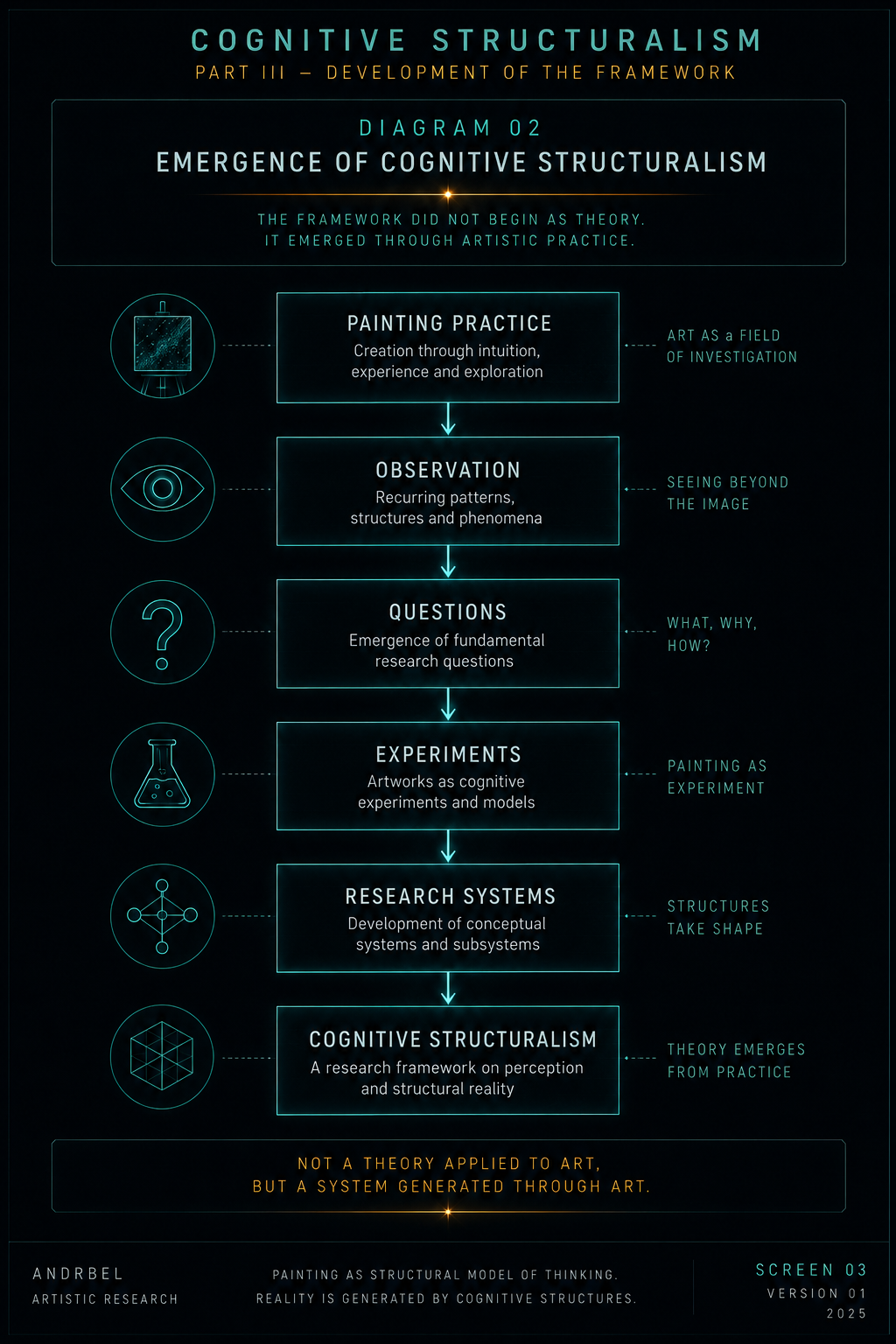
It emerged through artistic practice.
The framework developed gradually through painting, observation, reflection, and the recurring encounter with questions that could not be adequately addressed through conventional approaches to representation.
Rather than beginning with a theory and producing artworks from that theory, the process unfolded in the opposite direction.
The paintings came first.
The questions emerged from the paintings.
The framework developed later as an attempt to understand recurring structural relationships observed throughout the practice.
In this sense, Cognitive Structuralism should be understood not as a theory applied to art, but as a research framework generated through art.
Artistic Practice as Observation
These patterns did not initially present themselves as concepts.
They appeared as visual tendencies, recurring structures, compositional relationships, perceptual tensions, and persistent questions.
Some works seemed less concerned with depicting subjects than with organizing relationships.
Others appeared to investigate interactions between internal psychological states and external environments.
Certain paintings increasingly behaved like systems rather than images.
Questions began accumulating:
- Why do some visual structures produce stronger perceptual engagement than others?
- How do geometry and spatial organization influence interpretation?
- Why do different viewers construct different meanings from the same work?
- How do internal states influence perception?
- What role does memory play in visual experience?
- How does cognition organize complexity?
The artwork became less an endpoint and more an investigative instrument.
Painting became a method for exploring cognitive organization.
From Themes to Structures
Themes may include:
- identity,
- politics,
- memory,
- landscape,
- technology,
- narrative,
- social conditions.
The primary concern was not the topic itself but the structure through which the topic became perceptually accessible.
This distinction proved crucial.
For example:
The question was not simply:
What is identity?
but:
How is identity cognitively structured?
The question was not:
What is emotion?
but:
How do emotional structures influence perception?
The question was not:
What is reality?
but:
Through what cognitive processes does reality become experienced?
As these questions accumulated, the practice began moving from thematic investigation toward structural investigation.
The Emergence of Systems
Paintings that initially appeared independent gradually formed larger conceptual groupings.
These groupings were not created through predetermined planning.
They emerged through observation of recurring concerns.
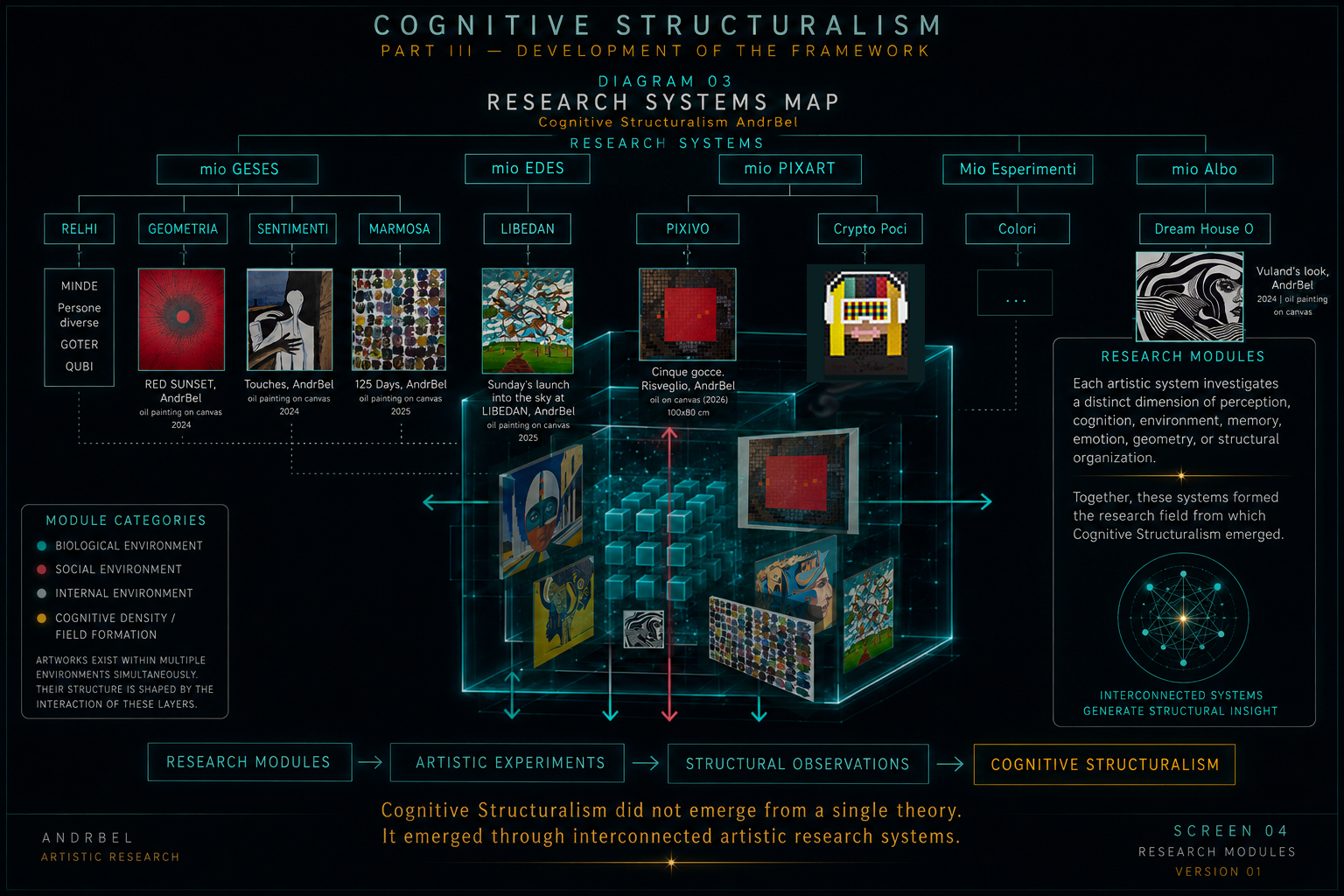
Over time, several research systems began to crystallize.
These systems later became identified as:
- RELHI
- MINDE
- Persone diverse
- Qubi
- GOTER
- Geometria
- Sentimenti
- Marmosa
At first they functioned simply as practical ways of organizing bodies of work.
Eventually it became clear that each system was investigating a distinct dimension of cognition and perception.
The series were no longer merely collections of paintings.
They became research modules.
RELHI: Human–Environment Structures
RELHI investigates the structural relationship between human beings and their environments.
The environment is understood broadly.
It includes:
- physical environments,
- social environments,
- perceptual environments,
- psychological environments,
- conceptual environments.
Instead, the person and the environment continuously shape one another.
Perception emerges through this interaction.
Reality becomes a dynamic structure rather than a fixed condition.
RELHI therefore became one of the foundational research systems through which Cognitive Structuralism developed.
MINDE: Internal Cognitive Space
Many artistic traditions depict psychological states.
MINDE approaches them differently.
Rather than illustrating emotions or thoughts, the series investigates the structures through which internal cognitive experience becomes organized.
Questions include:
- How does internal perception acquire form?
- Can consciousness possess architecture?
- Can mental processes be investigated spatially?
- Can paintings function as models of internal cognition?
Geometria: The Architecture of Cognition
As discussed in the previous section, geometry gradually shifted from compositional tool to research instrument.
The system investigates whether geometry can function as a visual analogue of cognitive organization.
Within Geometria:
Geometry is not decoration.
It is not abstraction for its own sake.
It functions as:
- structural logic,
- perceptual architecture,
- cognitive organization.
Repeatedly, geometric structures appeared capable of expressing relationships that remained inaccessible through representation alone.
This observation would later become one of the central foundations of the framework.
Sentimenti and Emotional Structures
Traditional approaches often separate emotion from cognition.
However, observation suggested that emotional states actively influence perception.
Emotion appeared less as a reaction and more as a cognitive condition.
The Sentimenti system investigates emotional structures as active components of perception and decision-making.
Rather than depicting emotion, the work explores:
- emotional fields,
- perceptual tension,
- cognitive-emotional interaction,
- emotional organization of experience.
Marmosa and Cognitive Color Systems
Color was approached not merely as visual sensation but as a structural component of cognition.
The system explores how chromatic relationships participate in the organization of perception.
Particular attention is given to:
- color interaction,
- perceptual rhythm,
- cognitive differentiation,
- chromatic structures of experience.
From Series to Research Modules
The series were not independent projects.
They were investigating different dimensions of a larger phenomenon.
Each system focused on a specific aspect:
System Research Focus RELHI Human–environment interaction MINDE Internal cognition Persone diverse Cognitive variability and identity Qubi Environment of consciousness GOTER Consciousness of environment Geometria Structural cognition Sentimenti Emotional-cognitive dynamics Marmosa Chromatic cognition
Together they formed a larger research architecture.
This realization marked a decisive transition.
The work was no longer understood as a collection of series.
It became a research framework.
The Emergence of mio GESES
This led to the development of:
mio GESES
mio GESES functions as a meta-framework connecting multiple research modules into a larger generative system.
It provides a structure through which relationships between:
- perception,
- cognition,
- environment,
- emotion,
- geometry,
- identity,
- memory,
The emergence of mio GESES represented a critical shift.
The research moved from individual investigations toward systemic inquiry.
The artwork became a node within a larger cognitive architecture.
The Need for a New Vocabulary
Many recurring phenomena could not be described adequately through conventional concepts such as:
- abstraction,
- expression,
- symbolism,
- representation,
- conceptual art.
Among them:
- Cognitive Structure
- Structural Reality
- Shared Reality
- Individual Reality
- Cognitive Wave
- Peak of Cognitive Waves (PCW)
- Cognitive Wave Burst (CWB)
They emerged from attempts to describe recurring observations encountered throughout artistic practice.
Language followed practice.
The framework did not begin with vocabulary.
Vocabulary emerged from the need to articulate experience.
From Practice to Framework
The various systems, observations, visual structures, and conceptual models appeared connected through
a common concern:
- How does cognition structure perception and experienced reality?
The framework later termed Cognitive Structuralism emerged as an attempt to organize these investigations within a coherent research structure.
Importantly, Cognitive Structuralism was not conceived as a finished theory.
It remains an evolving framework.
Its purpose is not to explain cognition definitively.
Its purpose is to create conditions through which cognition, perception, and reality construction can be investigated through artistic practice.
Part IV — Artistic Experiments: Painting as Cognitive Model
Introduction
- How can painting function as a research method?
In artistic production, the artwork is often understood as the outcome of a creative process.
In artistic research, the artwork may also function as a tool of investigation.
The artwork becomes part of the research process itself.
Within Cognitive Structuralism, paintings are not approached primarily as illustrations of ideas, nor as visual confirmations of theoretical concepts.
Instead, they operate as experimental structures through which questions concerning perception, cognition, environment, and reality can be investigated.
This shift transforms the role of the artwork.
The painting becomes:
- a cognitive experiment,
- a perceptual model,
- a structural investigation,
- a materialized research process.
What Constitutes an Artistic Experiment?
Artistic research operates differently.
The objective is not replication or verification.
Instead, artistic experiments create conditions through which phenomena can become observable.
Within Cognitive Structuralism, artistic experiments are structured around questions rather than conclusions.
The purpose of the artwork is not to prove a theory.
The purpose is to investigate relationships.
Examples include:
- relationships between perception and structure,
- relationships between cognition and geometry,
- relationships between emotion and interpretation,
- relationships between individual and collective reality,
- relationships between internal and external environments.
- Each painting therefore becomes an experimental field.
Painting as Cognitive Model
This statement requires clarification.
A cognitive model, in this context, is not a scientific simulation of the brain.
Nor is it a psychological diagram.
Instead, a cognitive model refers to:
a visual structure designed to investigate how cognition organizes experience.
The painting does not represent cognition.
It performs cognition structurally.
Relationships between forms, colors, geometries, figures, spatial tensions, and perceptual ambiguities generate conditions through which cognitive organization becomes visible.
The artwork becomes:
cognition
↓
structural organization
↓
painting
rather than:
subject
↓
representation
↓
painting
This distinction lies at the core of Cognitive Structuralism.
Experiment 01 — RELHI and Human–Environment Interaction
Traditional portraiture often isolates the figure from broader perceptual systems.
Within RELHI, the figure and environment are treated as structurally interconnected.
The research question became:
- How does the environment participate in the construction of perception and identity?
- individual,
- environment,
- structure,
- perception.
Rather, perception develops through continuous interaction between the individual and surrounding systems.
The experiment therefore shifted attention from:
"the person"
to
"the structure connecting person and environment."
This observation later became fundamental to the Cognitive Structuralism framework.
Experiment 02 — MINDE and Internal Cognitive Space
- Can internal cognition be investigated as a structured environment?
However, depiction alone proved insufficient.
The research gradually moved toward investigating the architecture of internal experience.
The objective was not to illustrate thought.
Instead, the paintings explored:
- internal spatiality,
- cognitive density,
- perceptual isolation,
- structural relationships within consciousness.
MINDE therefore became an experimental field for examining:
consciousness as structure rather than content.
Case Studies - Painting as Research Objects
Case Study 01
Incompatible VENUS
Research Question
Can incompatibility function as a structural condition of consciousness rather than as a social or psychological conflict?
Context
Within many cultural narratives, incompatibility is understood as opposition, conflict, or failure of integration.
However, throughout the development of Cognitive Structuralism, a different possibility emerged.
The question became whether incompatibility might operate not as a disruption of structure but as a structure itself.
Rather than asking:
Why are certain elements incompatible?
the investigation shifted toward:
How does cognition organize incompatible realities simultaneously?
This question became central to the development of Incompatible VENUS.
Artistic Experiment
The painting was developed through the interaction of figurative and structural elements.
The figure does not function as a portrait.
Nor does it represent a specific individual.
Instead, the figure operates as a cognitive field through which multiple incompatible structures coexist.
Several tensions were intentionally maintained rather than resolved:
- human and geometric
- emotional and structural
- internal and external
- stability and transformation
- recognition and ambiguity
Observation
During the development of the painting, incompatibility repeatedly appeared not as fragmentation but as organization.
The coexistence of conflicting structures generated a new perceptual condition.
The work suggested that cognition may not always seek resolution.
Certain cognitive structures appear capable of maintaining contradiction without collapse.
Research Outcome
The painting contributed to a broader hypothesis within Cognitive Structuralism:
Incompatibility may function as a structural state of cognition rather than as evidence of dysfunction.
The artwork therefore became a model for investigating how multiple realities can coexist within a single perceptual structure.
Position Within Cognitive Structuralism
Within the framework, Incompatible VENUS investigates:
- structural contradiction
- cognitive coexistence
- perceptual ambiguity
- unstable identity structures
Case Study 02
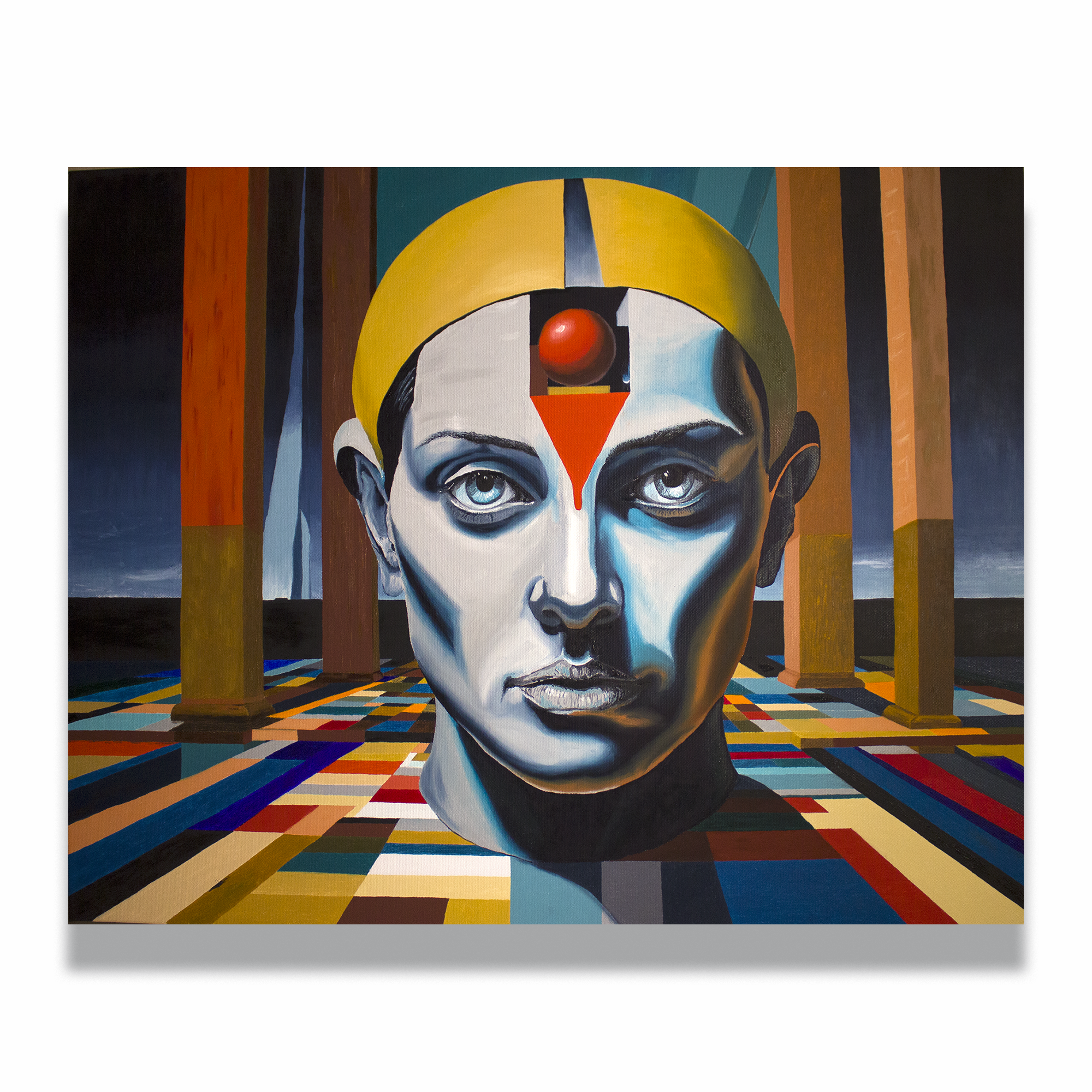
Teorema irrisolto
Context
Traditional interpretation often assumes that artworks communicate meaning.
The viewer searches for:
- narrative
- symbolism
- message
- intention
The artwork might function not as a solution but as a question.
This possibility became central to Teorema irrisolto.
The title itself ("Unsolved Theorem") reflects this condition.
The painting does not seek closure.
It investigates the cognitive state produced by unresolved structures.
Artistic Experiment
The work was developed through the deliberate maintenance of uncertainty.
Instead of organizing visual elements toward a single interpretation, the painting preserves multiple potential readings.
The structure remains open.
Relationships between forms, space, geometry, and perception resist final stabilization.
The painting therefore operates less as an image and more as an epistemological field.
Observation
A recurring observation emerged during the development of the work.
The absence of resolution appeared to increase cognitive engagement.
Rather than reducing meaning, uncertainty generated further interpretative activity.
The painting behaved similarly to an unsolved problem.
Meaning remained in motion.
Interpretation became part of the work itself.
Research Outcome
The experiment suggested that painting may function as an epistemological structure.
Rather than delivering knowledge, the artwork can generate conditions through which knowledge is continuously negotiated.
This observation contributed directly to a central proposition within Cognitive Structuralism:
Meaning does not necessarily reside within the artwork.
Meaning emerges through interaction between structure and cognition.
Position Within Cognitive Structuralism
Within the broader framework, Teorema irrisolto investigates:
- epistemological uncertainty
- cognitive openness
- perceptual instability
- unresolved meaning structures
Experiment 03 — Geometria and Structural Cognition
The initial question appeared deceptively simple:
- Why do certain geometric relationships produce strong perceptual effects?
Geometric systems appeared capable of organizing perception itself.
The research shifted toward a new question:
- Can geometry function as an analogue of cognitive organization?
The investigation focused on:
- spatial relationships,
- structural repetition,
- perceptual rhythm,
- organizational logic,
- visual hierarchy.
This led to one of the central propositions of the framework:
Geometry is not a style.
Geometry is a structural language through which cognition becomes visible.
Case Study 03
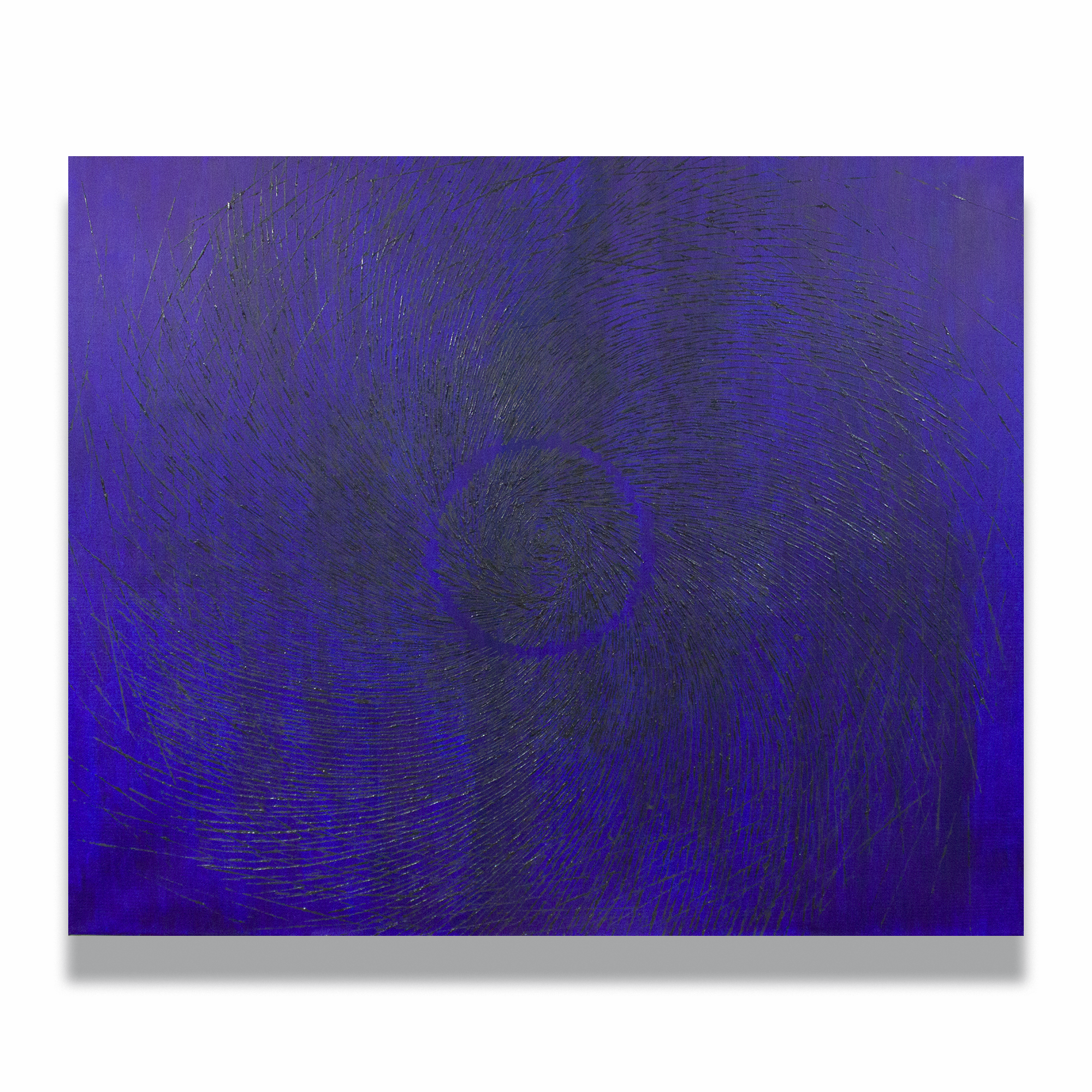
NIGHT STORM (Geometria)
Research Question
Can geometry function as a cognitive architecture rather than a visual language?
Context
Geometry has traditionally occupied multiple roles within painting.
It may function as:
- composition,
- abstraction,
- symbolism,
- ornament,
- spatial organization.
The investigation was not concerned with what geometry represents.
Instead, the question became:
Can geometry reveal the structural organization through which cognition itself operates?
This question led to the development of a series of experiments within the Geometria system, including NIGHT STORM.
Artistic Experiment
The work was developed through the interaction of geometric structures, spatial tensions, directional movement, and perceptual rhythm.
The objective was not to create an abstract composition.
Instead, the painting was approached as a structural environment.
Geometric forms were treated as cognitive agents capable of organizing perception.
The investigation focused on:
- hierarchy,
- repetition,
- structural density,
- directional flow,
- spatial cognition,
- perceptual navigation.
Observation
During the development of the work, geometry increasingly behaved as an organizational system.
The viewer does not merely observe geometric forms.
The viewer navigates them.
Attention is directed, interrupted, accelerated, and reorganized by structural relationships within the painting.
The work suggested that geometry may operate similarly to cognition itself:
not as content,
but as a framework through which content becomes organized.
Research Outcome
The experiment contributed to one of the central propositions of Cognitive Structuralism:
Geometry is not a style.
Geometry is a structural architecture of cognition.
The painting therefore functions as a model for investigating how perception becomes organized through structural relationships.
Position Within Cognitive Structuralism
NIGHT STORM investigates:
- structural cognition,
- perceptual architecture,
- geometric organization,
- spatial information systems,
- non-representational cognitive structures.
Experiment 04 — Sentimenti and Emotional-Cognitive Fields
The research question became:
- Can emotions be understood as active cognitive structures rather than subjective reactions?
- attention,
- interpretation,
- memory,
- perceptual emphasis,
- decision-making.
The resulting works investigated:
- emotional fields,
- perceptual tension,
- cognitive-emotional interactions,
- dynamic relationships between feeling and interpretation.
Emotion became understood as a structural component of cognition.
Experiment 05 — Marmosa and Chromatic Cognition
However, within Marmosa, color became an object of investigation rather than a compositional tool.
The research question became:
- How do chromatic systems participate in cognitive organization?
- color interactions,
- perceptual differentiation,
- chromatic hierarchy,
- structural rhythm.
This suggested that chromatic systems themselves may function as cognitive structures.
Marmosa therefore expanded the framework beyond form and geometry toward perceptual cognition through color.
From Experiments to Patterns
Collectively, they revealed recurring patterns.
Across multiple experiments, several observations repeatedly emerged:
Observation 1
Perception behaves structurally.
It does not emerge as isolated sensory information.
It emerges through relationships.
Observation 2
Meaning is constructed rather than received.
Interpretation depends on organizational processes.
Observation 3
Environment participates in cognition.
Perception cannot be separated from context.
Observation 4
Geometry functions as a cognitive framework.
Structural organization influences interpretation.
Observation 5
The observer actively reconstructs reality.
The artwork does not contain fixed meaning.
Meaning emerges through interaction.
The Role of Cognitive Waves
Ideas rarely emerged suddenly.
Instead, they appeared to develop through accumulation.
Information gathered across:
- observations,
- experiences,
- environments,
- conversations,
- visual encounters,
- emotional states,
This observation eventually contributed to the development of the Cognitive Waves model.
The model proposes that cognitive information accumulates through interacting waves.
When structural density reaches a critical condition, a process occurs that is described within the framework as:
- Cognitive Wave (CW)
- Peak of Cognitive Waves (PCW)
- Cognitive Wave Burst (CWB)
Instead, it produces unresolved structural material requiring further organization.
Painting becomes one method through which this organization occurs.
Painting as Structural Fixation
The artwork consistently functioned as a stabilization mechanism.
The painting captured:
- a perceptual structure,
- a cognitive configuration,
- a temporary organization of reality.
experience
↓
cognitive structures
↓
Cognitive Waves
↓
PCW
↓
CWB
↓
structural construction
↓
painting
The canvas therefore records neither reality nor imagination alone.
It records:
- a cognitive construction generated through interactions between perception, cognition, environment, and time.
Research Outcome
Instead, they support a broader observation:
Paintings can function as cognitive models through which structures of perception and reality formation become investigable.
This proposition remains open.
It continues to evolve through artistic practice.
However, it provides the methodological foundation upon which Cognitive Structuralism is built.
The artwork is not simply the result of research.
The artwork becomes one of the primary methods through which research occurs.
Transition to Part V
However, an important question remains unresolved:
- If cognition structures perception, how does cognition organize reality itself?
The next section therefore introduces one of the central theoretical components of the framework:
Part V — Shared Reality and Individual Reality Cognitive Models, Perceptual Overlap, and the Construction of Reality
SUGGESTED CITATION
AndrBel. “Cognitive Structuralism: Toward an Artistic Research Framework on Perception and Structural Reality.” Research Catalogue, 2025.
Cognitive Structuralism is an artistic research framework developed by AndrBel.All diagrams, conceptual systems, visual structures, and written materials presented in this exposition form part of an ongoing artistic research practice.© AndrBel, 2025–Present
This paper is published within the ARTHALL BEL4224 institutional research framework.
The concepts presented, including Artist Legacy Infrastructure and related structural models, form part of the intellectual property of AndrBel and ARTHALL BEL4224.
Unauthorized commercial use, replication, or derivative development of these concepts is strictly prohibited.


Support independent artistic research in Cognitive Structuralism, conceptual painting, and long-term cultural infrastructure development.
[Support Research]
Cognitive Structuralism — AndrBel
Ongoing Artistic Research Framework
© AndrBel, 2025–Present
Cognitive Structuralism is an original conceptual and theoretical framework developed by AndrBel.
No part of this concept, including its terminology, structural models, or theoretical formulations, may be reproduced, distributed, or adapted without prior written permission from the author.
This material is protected as intellectual property within the AndrBel artistic and research practice.
This publication is part of the ARTHALL BEL4224 Research Program.
No part of this publication may be reproduced, distributed, or transmitted in any form or by any means without prior written permission from the author and ARTHALL BEL4224, except in the case of brief quotations for academic or curatorial purposes.