Work process
Cognitive Structuralism and ANDRBEL Research Program
AndrBel's Theory of Cognitive Structuralism for publication in The Journal for Artistic Research (JAR) / Internationally, the Research Catalogue (RC)
Cognitive Structuralism
Toward an Artistic Research Framework on Perception and Structural Reality
Contemporary Conceptual Painting
Artistic Research
* AndrBel's Theory of Cognitive Structuralism for publication in The Journal for Artistic Research (JAR) / Internationally, the Research Catalogue (RC)
"Painting is not an image of reality.It is a structural model of thinking through which reality becomes visible." — AndrBel
page 2
Case Study 04
Fox Hunting (2024)

Context
The title Fox Hunting initially suggests a familiar narrative structure:
hunter and hunted.
Pursuer and pursued.
Observer and observed.
However, within the framework of Cognitive Structuralism, the work investigates a different possibility.
The act of pursuit may not be directed toward an external object.
Instead, pursuit may reveal a structural relationship within cognition itself.
The work emerged from the question:
- What if the hunter and the hunted are manifestations of the same cognitive structure?
Developed within the RELHI system, the painting explores bipolar cognitive positioning.
The work constructs a perceptual environment in which opposing perspectives coexist.
Rather than presenting a linear narrative, the composition creates a structural tension between:
- self and other,
- observer and participant,
- pursuit and escape,
- recognition and avoidance.
The viewer is unable to occupy a single perspective.
Instead, cognition oscillates between opposing perceptual roles.
Observation
During the development of the work, an important pattern emerged.
The act of pursuit repeatedly transformed into a process of self-recognition.
The object being pursued gradually lost its independence and became structurally linked to the observer.
The work suggested that cognition frequently externalizes aspects of itself and then attempts to rediscover them through perception.
This dynamic created what may be described as:
- a bipolar cognitive structure.
Research Outcome
The experiment contributed to a broader observation within Cognitive Structuralism:
Recognition often occurs through structural opposition.
The self may become visible only through the construction of an apparent other.
The painting therefore functions as a model investigating how identity emerges through cognitive differentiation and perceptual tension.
Position Within Cognitive Structuralism
Within RELHI, Fox Hunting investigates:
- bipolar cognition,
- self-recognition,
- perceptual opposition,
- identity construction,
- human–environment interaction.
Part V — Shared Reality and Individual Reality
Cognitive Models, Perceptual Overlap, and the Construction of Reality
Introduction
If perception is cognitively structured, what exactly do humans mean when they speak of reality?
This question appears simple.
Yet it reveals a profound difficulty.
Human beings often speak about reality as though it exists as a singular, stable, and universally accessible condition.
In everyday life, phrases such as:
- "This is reality."
- "That is not real."
- "Everyone knows this."
However, observation suggests a more complex situation.
Different individuals often experience the same event differently.
They remember different details.
They assign different meanings.
They construct different narratives.
They inhabit different perceptual worlds.
This raises a fundamental research question:
- If cognition structures perception, can reality itself be understood as a cognitive construction?
Shared Reality Hypothesis
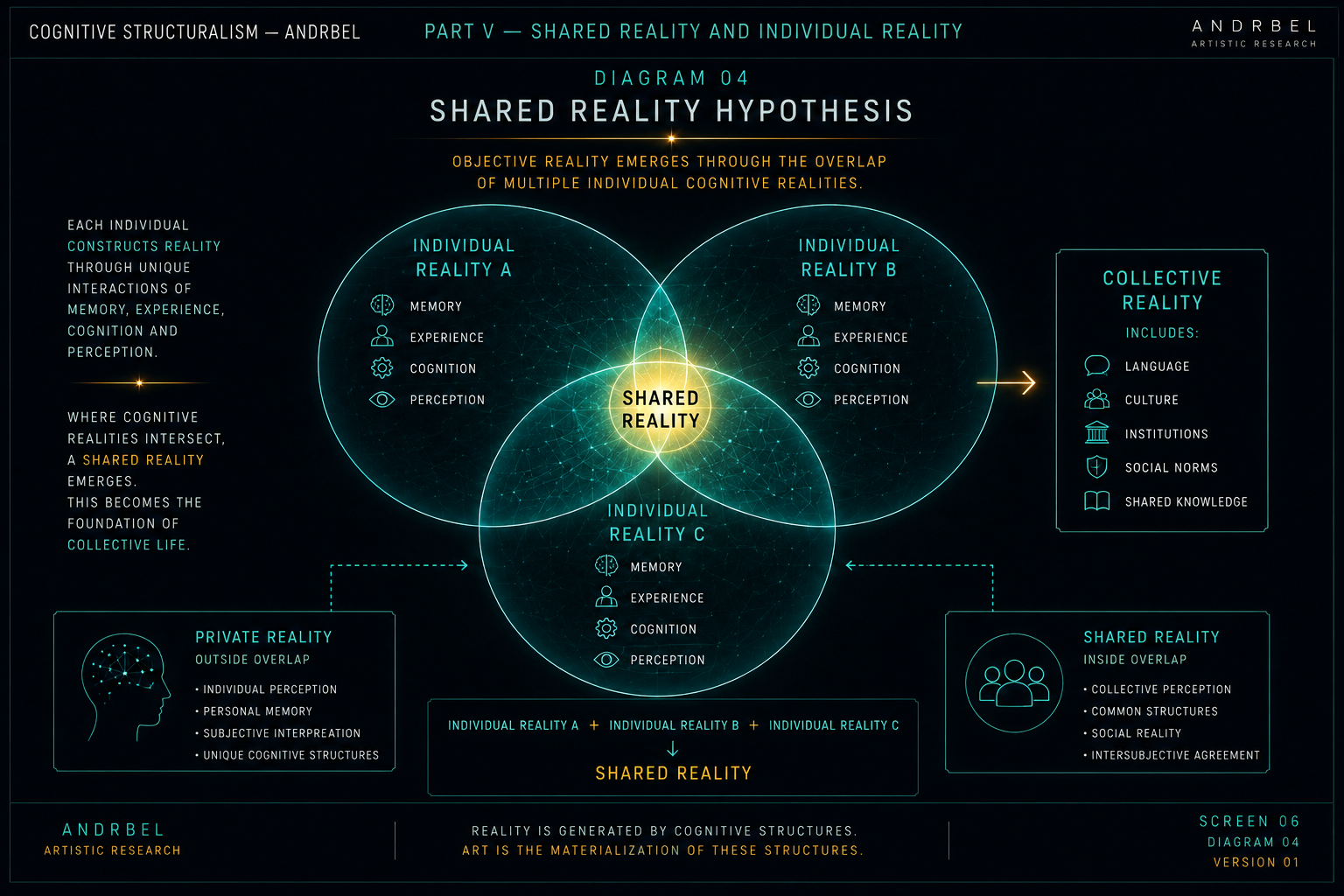
The Problem of a Single Reality
Reality
↓
Perception
↓
Interpretation
Within this model, reality exists first.
Perception simply receives information from it.
Interpretation occurs afterward.
However, many observations challenge this assumption.
The same environment may produce:
- different experiences,
- different memories,
- different emotional responses,
- different interpretations,
- different behavioral outcomes.
The evidence of lived experience suggests another possibility:
Perception does not merely observe reality.
Perception actively participates in constructing it.
Within this perspective, reality becomes inseparable from cognition.
Cognitive Models and Reality Construction
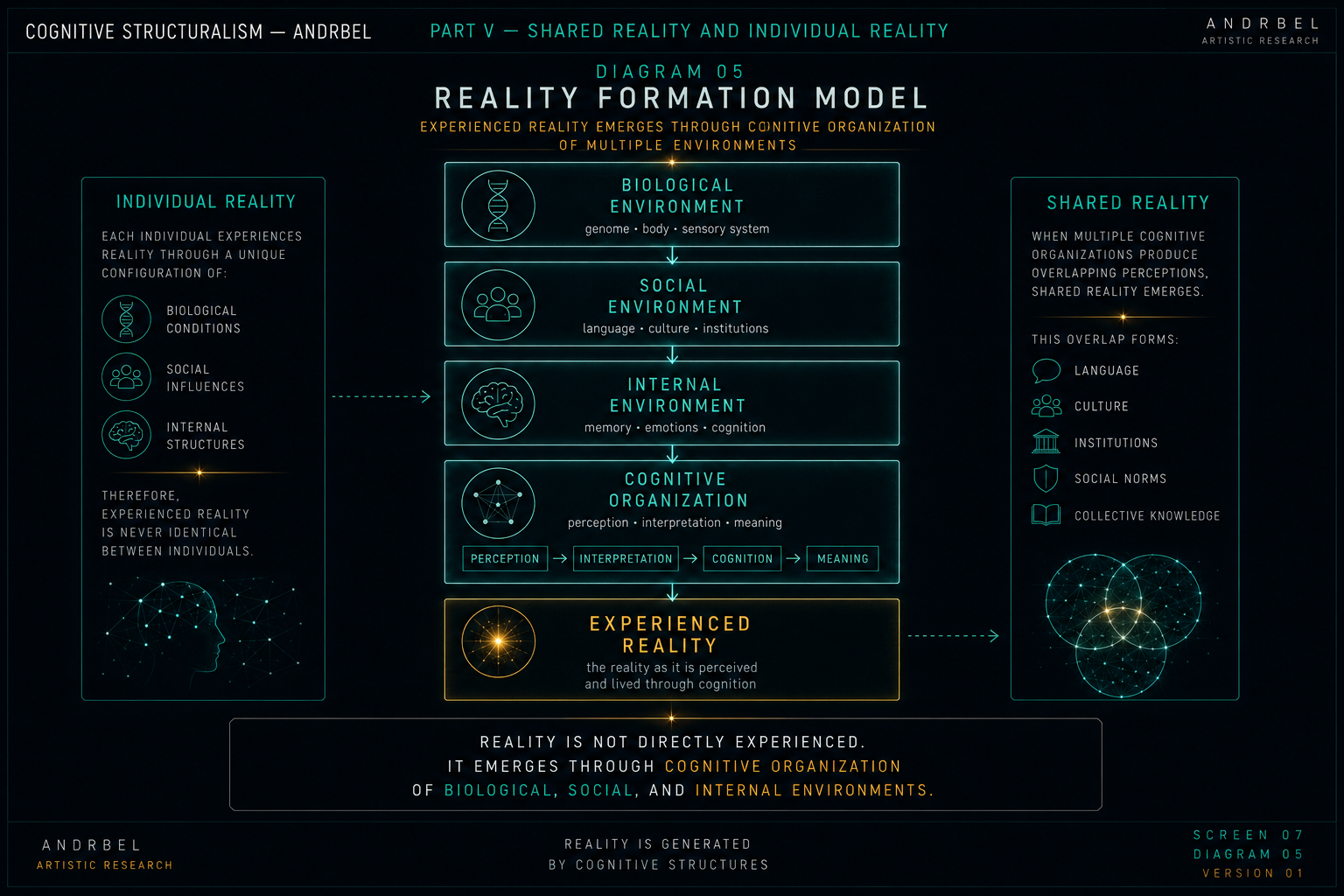
This model emerges through interactions between:
- biological conditions,
- social environments,
- internal structures,
- memory,
- perception,
- accumulated experience,
- emotional organization,
- cognitive interpretation.
No two individuals possess identical cognitive histories.
Therefore no two individuals construct reality in exactly the same way.
Each person develops:
- an individual cognitive reality.
Rather, it suggests that experience of those environments is always mediated through cognition.
Reality becomes:
Environment
+
Cognition
=
Experienced Reality
The resulting reality is not false.
Nor is it purely subjective fantasy.
It is a cognitively structured experience.
Shared Reality Hypothesis
What humans commonly describe as objective reality is the overlap of multiple individual cognitive realities.
This proposition forms the basis of the Shared Reality Hypothesis.
Within the framework:
Every individual constructs a reality.
When multiple cognitive models overlap, a shared perceptual field emerges.
This shared field becomes:
- language,
- culture,
- institutions,
- social norms,
- collective knowledge,
- historical narratives,
- scientific frameworks.
- reality itself.
- Shared Reality.
Collective Reality
- those aspects of experience that coincide across many cognitive models.
They create the possibility of communication.
Without such overlap:
- language would collapse,
- social organization would become impossible,
- shared meaning could not emerge.
It allows individuals to operate within common perceptual environments.
Examples include:
- physical objects,
- social conventions,
- cultural symbols,
- institutional systems,
- shared historical memory.
Individual Reality
Many remain unique to particular individuals.
These structures may include:
- memories,
- internal narratives,
- perceptual associations,
- emotional architectures,
- symbolic systems,
- imagined environments,
- subjective experiences.
Within Cognitive Structuralism, these structures form:
- Individual Reality.
It simply lacks sufficient overlap with other cognitive models to become collective.
This distinction is important.
Many phenomena often described as:
- imagination,
- intuition,
- private meaning,
- internal worlds,
A Model of Perceptual Overlap
Each individual develops a unique cognitive model.
These models partially intersect.
The intersection produces:
Individual Reality A
\
\
> Shared Reality
/
/
Individual Reality B
Expanding the model further:
N Individual Cognitive Models
↓
Perceptual Overlap
↓
Shared Reality
Within this framework:
Reality is not a singular object.
Reality is a dynamic structure generated through varying degrees of cognitive overlap.
The Role of Cognitive Density
Some shared structures become highly reinforced.
Language provides a useful example.
Millions of individuals participate in linguistic systems.
The resulting overlap generates strong perceptual stability.
Other structures remain weakly shared.
Some may exist only within a small number of cognitive models.
Others may remain entirely individual.
This creates a spectrum between:
Individual Reality
← →
Collective Reality
Rather than a binary distinction.
Reality as Dynamic Structure
Shared Reality is not fixed.
As cognitive models evolve, collective structures also evolve.
Changes in:
- culture,
- technology,
- knowledge,
- social organization,
- communication systems,
- modify patterns of overlap.
Similarly, Individual Reality remains fluid.
New experiences continuously reshape cognitive organization.
Reality becomes:
- a continuously evolving cognitive architecture.
Painting and Reality Construction
Traditional representation often assumes that the artwork depicts a reality that already exists.
Within Cognitive Structuralism, a different possibility emerges.
The painting may function as:
- a materialized cognitive reality.
It records:
- perceptual organization,
- structural relationships,
- cognitive interpretation,
- environmental interaction.
neither objective reality
nor subjective fantasy.
Instead, it becomes:
- a structural manifestation of experienced reality.
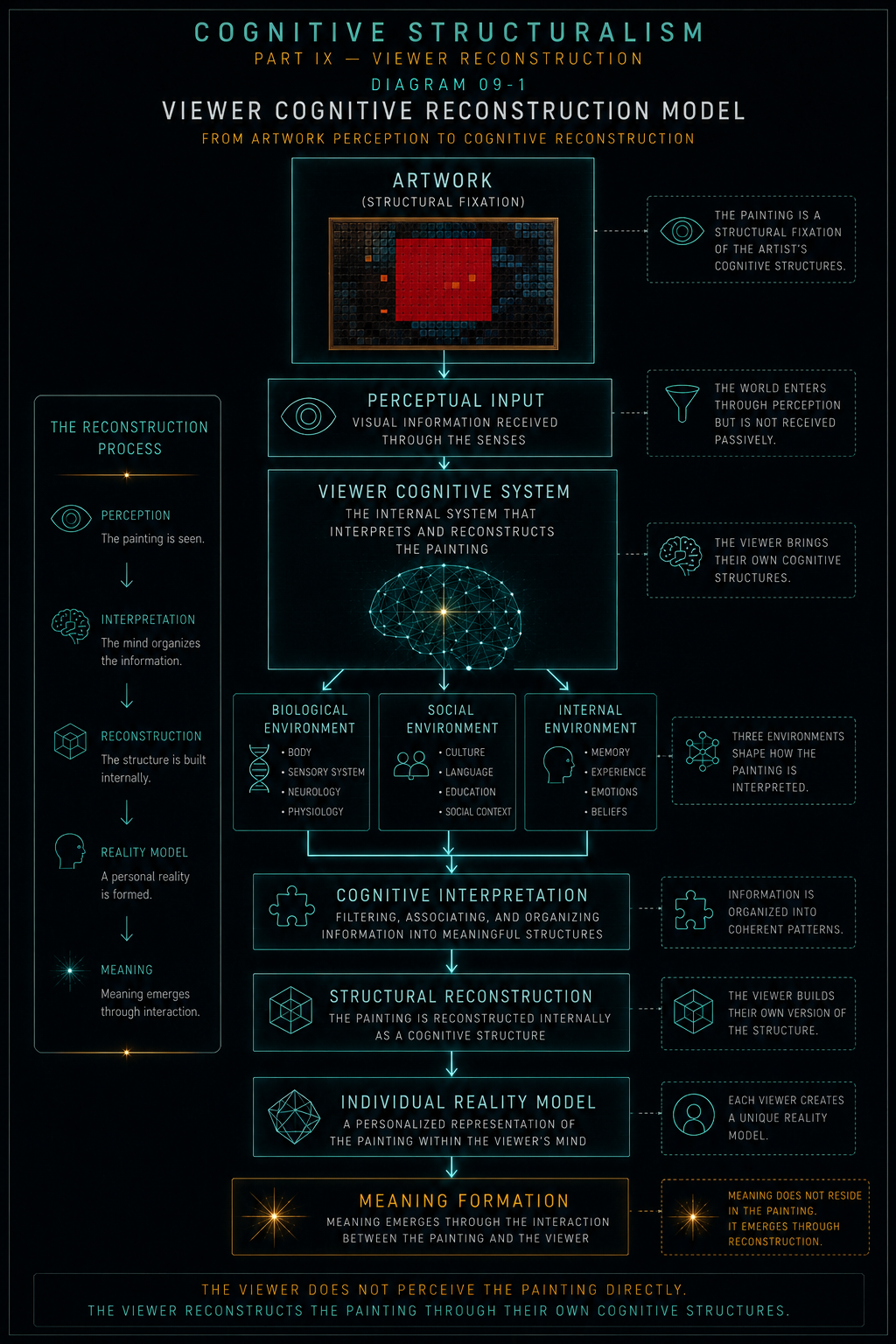
The Viewer and Reality Reconstruction
The viewer reconstructs it.
Each observer approaches the artwork through:
- memory,
- cognition,
- emotion,
- experience,
- biological conditions,
- social conditioning.
The painting becomes a meeting point between:
Artist Cognitive Structure
↓
Painting
↓
Viewer Cognitive Structure
Meaning emerges through interaction.
The artwork becomes a site where realities intersect.
Implications for Cognitive Structuralism
The objective of painting is no longer:
- representing reality.
- how realities are constructed.
This distinction fundamentally changes the role of artistic practice.
The artwork functions as:
- a cognitive model,
- a perceptual structure,
- an experimental environment,
- a site of reality construction.
Research Outcome
- Reality is not simply perceived.
- Reality is cognitively structured.
Individual reality emerges through structures that remain unique to particular cognitive systems.
Painting can function as a material model through which these relationships become observable.
The artwork therefore becomes:
- a structural interface between cognition and reality.
Transition to Part VI
However, an important question remains:
- Through what mechanisms are these cognitive structures organized?
Geometry seemed capable of organizing perception in ways that exceeded representation.
This observation led to one of the central propositions of the framework:
Geometry is not a style.
Geometry is the architecture of cognition.
The next section therefore examines the role of geometry as a structural system through which cognition, perception, and reality become organized.
Part VI — Geometry as the Architecture of Cognition
Structural Organization, Perceptual Systems, and Visual Thinking
Part VI — Geometry as the Architecture of Cognition
Structural Organization, Perceptual Systems, and Visual Thinking
Introduction
Whether working with figurative structures, environmental systems, perceptual fields, or abstract compositions, certain organizational principles repeatedly appeared.
Forms rarely existed in isolation.
Instead, they tended to organize themselves through relationships:
- proximity,
- hierarchy,
- repetition,
- orientation,
- symmetry,
- asymmetry,
- density,
- rhythm,
- spatial tension.
These relationships appeared independently of subject matter.
The observation suggested that cognition might not primarily operate through images.
Rather, cognition appeared to operate through structures.
This led to a central research question:
- Can geometry be understood as an architecture of cognition rather than merely a visual language?
Within Cognitive Structuralism, geometry gradually shifted from being treated as a compositional tool to being understood as a structural framework through which cognition organizes experience.
Beyond Geometry as Form
It has been associated with:
- composition,
- perspective,
- measurement,
- proportion,
- abstraction,
- symbolism,
- spatial organization.
Throughout art history, geometric systems have been used to structure visual representation.
Within Cognitive Structuralism, however, geometry is approached differently.
The primary question is not:
What does geometry represent?
but:
What organizational functions does geometry perform?
Geometry is therefore investigated not as an image but as a system.
The concern shifts from appearance to organization.
Structural Organization and Cognition
Perception does not encounter the world as an undifferentiated mass of information.
Instead, cognition continuously organizes incoming information into structures.
These structures include:
- boundaries,
- categories,
- relationships,
- hierarchies,
- sequences,
- patterns.
Without such organization, perception would become unstable.
Meaning emerges through structural arrangement.
Within Cognitive Structuralism, geometry functions as a visible manifestation of this organizational tendency.
Geometric relationships become perceptible traces of cognitive organization.
They provide a visual framework through which the structural activity of cognition can be investigated.
Geometry as Cognitive Architecture
Architecture does not determine specific content.
Instead, architecture determines how content can exist within a structure.
A building may contain different activities, people, and objects.
Yet all remain conditioned by the architecture within which they occur.
A similar relationship may exist between geometry and cognition.
Geometry provides organizational conditions through which perception becomes structured.
Within this framework:
- Geometry is not the content of cognition.
- Geometry is the architecture through which cognition organizes content.
Perceptual Navigation
It involves movement.
Attention moves.
Interpretation moves.
Memory moves.
Expectation moves.
The viewer continuously navigates visual environments.
This navigation often follows structural pathways.
Elements attract attention.
Other elements redirect it.
Some structures create stability.
Others generate uncertainty.
Geometric relationships influence these movements.
The viewer therefore does not simply observe geometry.
The viewer navigates geometry.
Within Cognitive Structuralism, geometric structures are understood as perceptual navigation systems.
They organize the movement of attention through visual space.
Geometria: Artistic Experiments in Structural Cognition
Initially, geometric structures appeared as compositional elements.
Over time they increasingly functioned as cognitive environments.
The research focus shifted toward questions such as:
- How does geometry organize perception?
- How does structural density affect attention?
- How do repetition and variation influence interpretation?
- How do spatial relationships generate meaning?
- Can geometry function as a perceptual system independent of representation?
The objective was not to create abstract images.
The objective was to investigate structural organization itself.
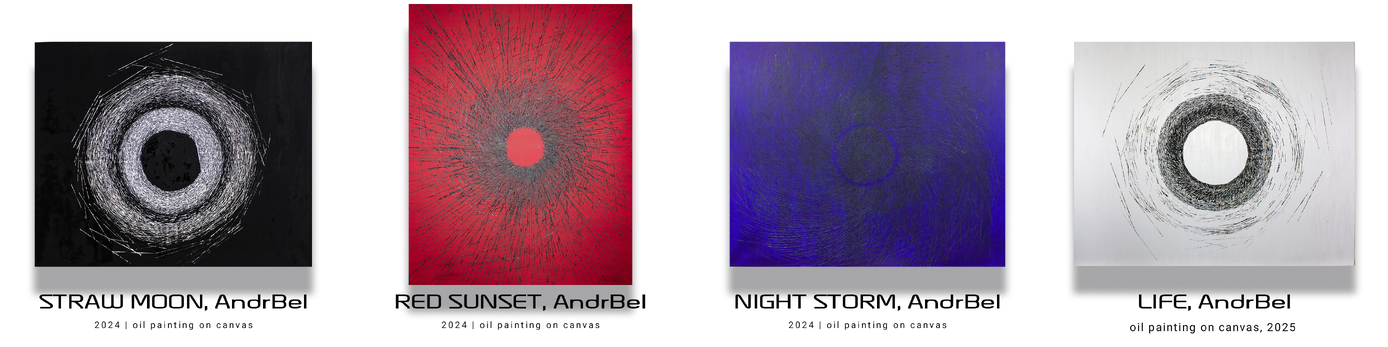
Works such as STRAW MOON, RED SUNSET, NIGHT STORM, and LIFE became experiments in cognitive architecture rather than exercises in abstraction.
Geometry and Shared Structures
If shared reality emerges through overlapping cognitive structures, then geometry may function as one of the most fundamental organizational systems available to cognition.
Unlike language, which varies across cultures, geometric relationships possess a remarkable degree of perceptual stability.
Humans across different environments can recognize:
- alignment,
- symmetry,
- direction,
- proportion,
- enclosure,
- continuity.
Rather, it suggests that geometry may provide one of the most stable organizational frameworks through which cognition constructs reality.
Geometry therefore becomes a bridge between individual cognition and shared perceptual organization.
Visual Thinking
Thinking is often described linguistically.
However, many cognitive processes appear to occur prior to language.
Relationships can be sensed before they are verbalized.
Structures can be recognized before they are named.
Patterns can be perceived before they are explained.
Geometry provides access to this pre-linguistic domain.
Through geometric organization, visual structures become capable of expressing relationships that may resist direct verbal description.
The painting therefore becomes a site of visual thinking.
Not because it communicates fixed meanings.
But because it enables structural cognition to become perceptible.
Geometry and the Construction of Meaning
Meaning also emerges through relationships.
A change in position can alter interpretation.
A change in proportion can alter emphasis.
A change in hierarchy can alter significance.
Geometric organization therefore participates directly in meaning formation.
Within Cognitive Structuralism:
- Meaning is not only represented through structure.
- Meaning emerges through structure.
Conclusion
It may be understood as a structural architecture through which cognition organizes perception, attention, relationships, and meaning.
Geometry does not merely describe reality.
It participates in the construction of experienced reality.
Within this framework:
Geometry is the architecture of cognition.
Painting therefore becomes a field in which this architecture can be materialized, observed, and investigated through visual form.
The exploration of geometry ultimately leads toward a broader question:
- How do cognitive structures accumulate, intensify, and generate new perceptual formations?
This question provides the transition to the next section:
Part VII — Cognitive Waves Model: Perceptual Accumulation, Structural Emergence, and Artistic Formation.
Part VII - Cognitive Waves Model
Perceptual Accumulation, Structural Emergence, and Artistic Formation
Introduction
New paintings rarely emerged from a single thought, image, or intention.
Instead, artistic ideas appeared to develop gradually through the accumulation of multiple perceptual experiences, memories, observations, emotions, environments, and cognitive interactions.
The process often seemed nonlinear.
Information gathered across different moments of time remained active within cognition, sometimes for days, months, or even years.
Eventually, previously unrelated structures appeared to converge, producing moments of intensified cognitive activity that frequently preceded the emergence of new artistic constructions.
These observations led to a central research question:
- How do cognitive structures accumulate, intensify, and eventually generate new perceptual forms?
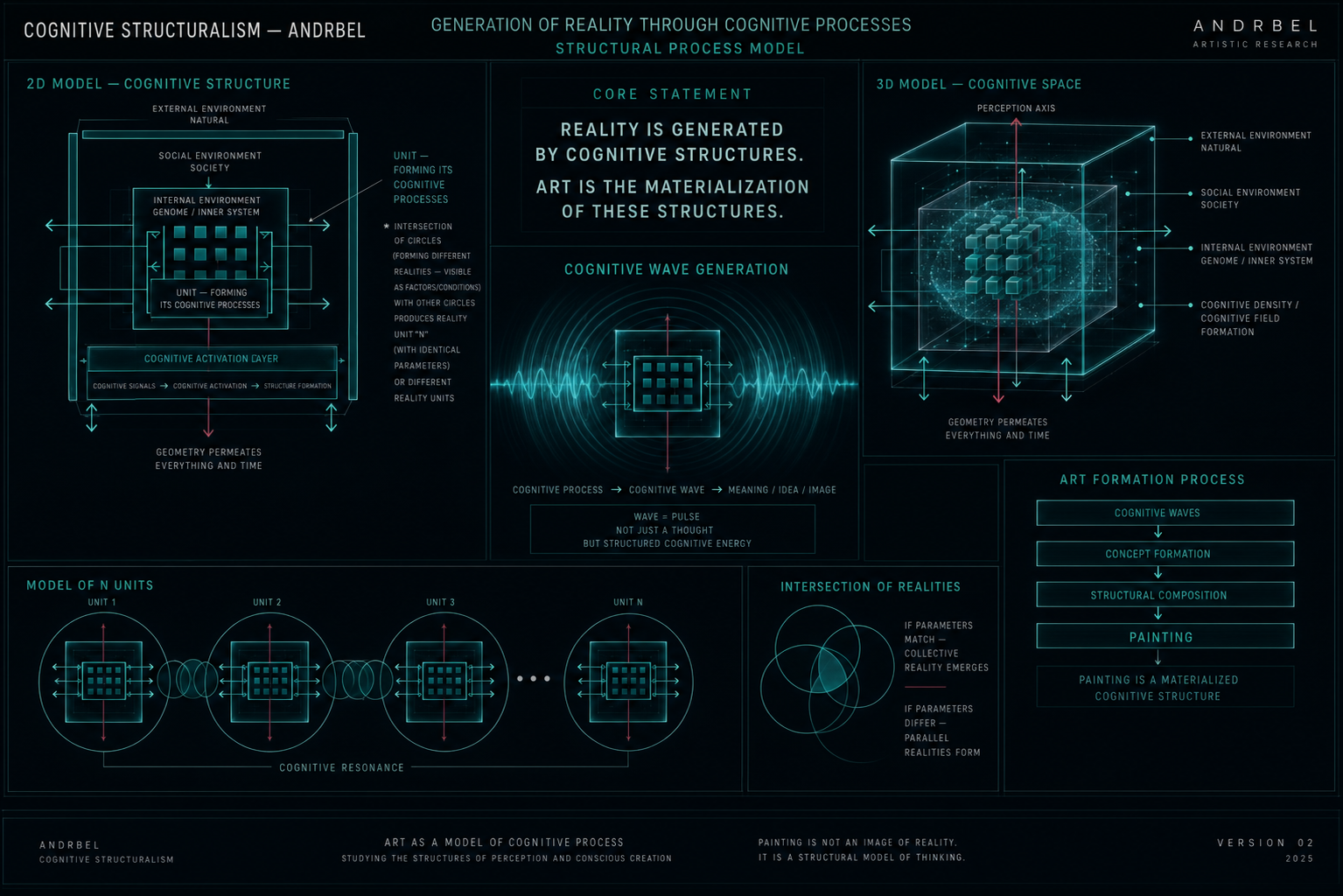
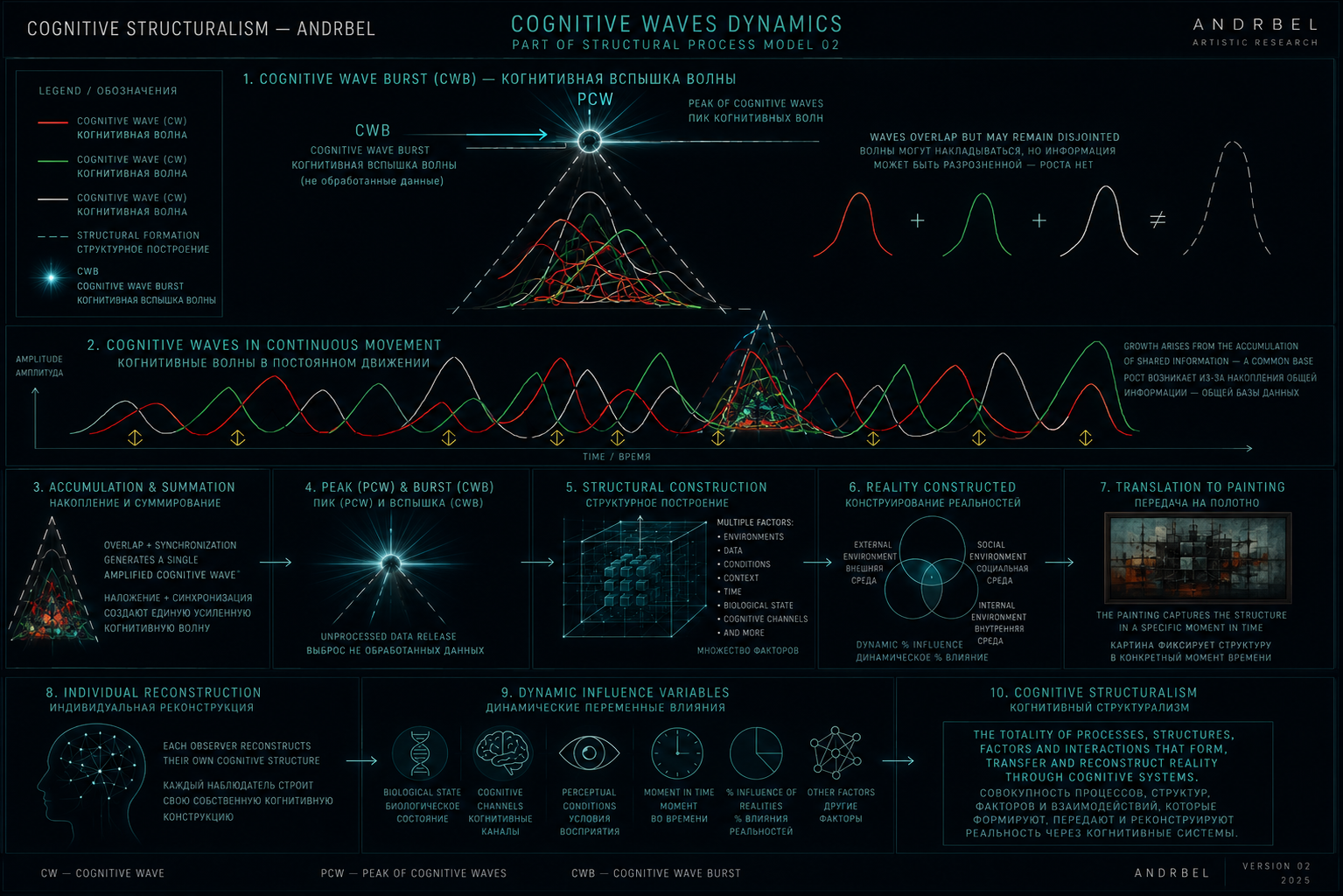
Section 1 Cognitive Waves (CW)
These interactions generate multiple cognitive activations.
Within the framework of Cognitive Structuralism, these activations are described as:
Cognitive Waves (CW)
A Cognitive Wave does not represent a single thought.
Rather, it refers to a dynamic cognitive movement generated through the interaction of experience, memory, perception, and environmental influence.
Multiple Cognitive Waves coexist simultaneously.
Some remain isolated.
Others begin interacting.
Section 2
Structural Accumulation
Cognitive Waves may intersect while remaining fragmented.
In such cases, information remains dispersed and no amplified structure emerges.
Growth occurs only when waves accumulate around shared perceptual structures, related experiences, or interconnected cognitive information.
This process generates structural amplification.
Section 3
Peak of Cognitive Waves (PCW)
The structure reaches a condition described within the framework as:
Peak of Cognitive Waves (PCW)
PCW represents a state of maximum cognitive concentration.
At this stage:
- perceptual tension increases
- structural density intensifies
- information accumulates
- cognitive pressure grows
Yet the information remains unresolved.
Meaning has not yet emerged.
The structure exists as concentrated cognitive potential.
Section 4
Cognitive Wave Burst (CWB)
This condition is described as:
Cognitive Wave Burst (CWB)
The Cognitive Wave Burst represents the release of unresolved cognitive material.
Importantly, the burst does not generate a finished artwork.
Nor does it generate final meaning.
Instead, it produces:
- structural potential
- perceptual material
- unresolved cognitive configurations
- requiring further construction.
Section 5
Structural Construction
This process is influenced by:
- biological state
- internal conditions
- social environment
- memory
- perception
- temporal context
The resulting structure remains dynamic.
It may continue evolving until its materialization through painting.
The painting functions as a temporary stabilization of that structure.
Experience
↓
Cognitive Waves (CW)
↓
Structural Accumulation
↓
Peak of Cognitive Waves (PCW)
↓
Cognitive Wave Burst (CWB)
↓
Structural Construction
↓
Painting
Part VIII — Painting as Structural Fixation
Materialized Cognition and the Temporal Stabilization of Cognitive Structures
Introduction
The artwork did not appear as the beginning of a process.
It appeared as the temporary stabilization of a process already underway.
Before the painting existed, a sequence of interactions had already occurred:
- perception,
- memory,
- environmental influence,
- cognitive organization,
- structural accumulation,
- Cognitive Waves,
- Peak of Cognitive Waves,
- Cognitive Wave Burst,
- structural construction.
The artwork emerged only after these processes had generated a sufficiently coherent cognitive configuration.
From this perspective, the painting is not the origin of meaning.
It is the stabilization of a particular cognitive structure within time.
Painting as Fixation
Within Cognitive Structuralism, fixation refers to:
- the temporary material stabilization of a cognitive structure.
It continuously evolves through:
- experience,
- memory,
- biological conditions,
- social interactions,
- internal cognitive processes.
The painting captures this configuration.
It records:
- perceptual organization,
- structural relationships,
- cognitive density,
- environmental interaction.
- a temporal fixation of cognition.
Temporal Reality
The painting does not represent a timeless truth.
Nor does it represent a final conclusion.
It represents:
- a cognitive reality existing at a particular moment.
Changes in:
- experience,
- environment,
- cognition,
- memory,
Thus every artwork can be understood as:
- a temporal cognitive event.
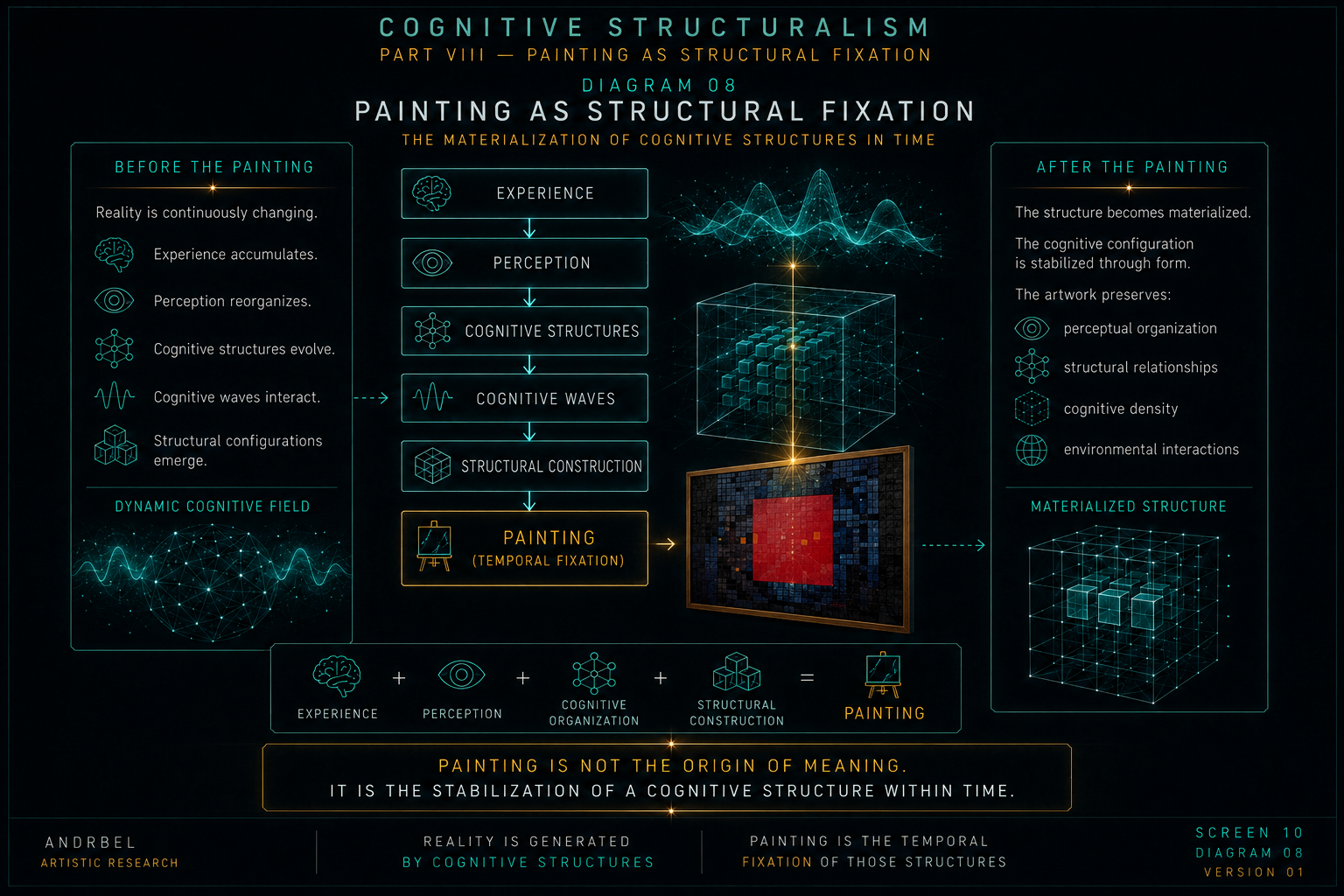
Structural Transfer
Experience
↓
Cognitive Structures
↓
CW
↓
PCW
↓
CWB
↓
Structural Construction
↓
Painting
The painting therefore does not simply contain meaning.
It contains:
- the trace of a cognitive organization process.
Painting as Cognitive Artifact
Not because it explains cognition.
But because it preserves evidence of cognitive structuring.
The painting functions simultaneously as:
- object,
- process,
- structure,
- document,
- cognitive model.
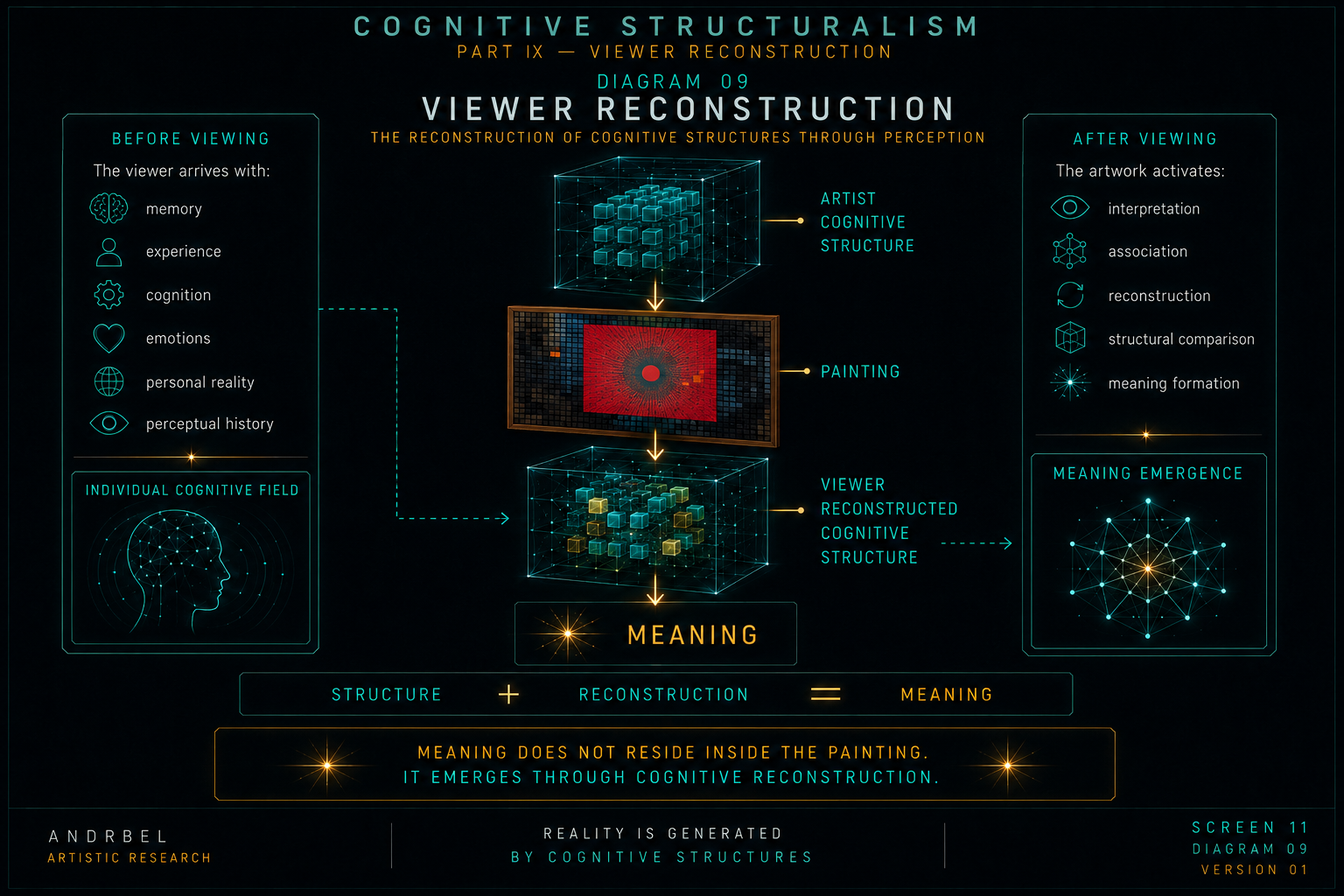
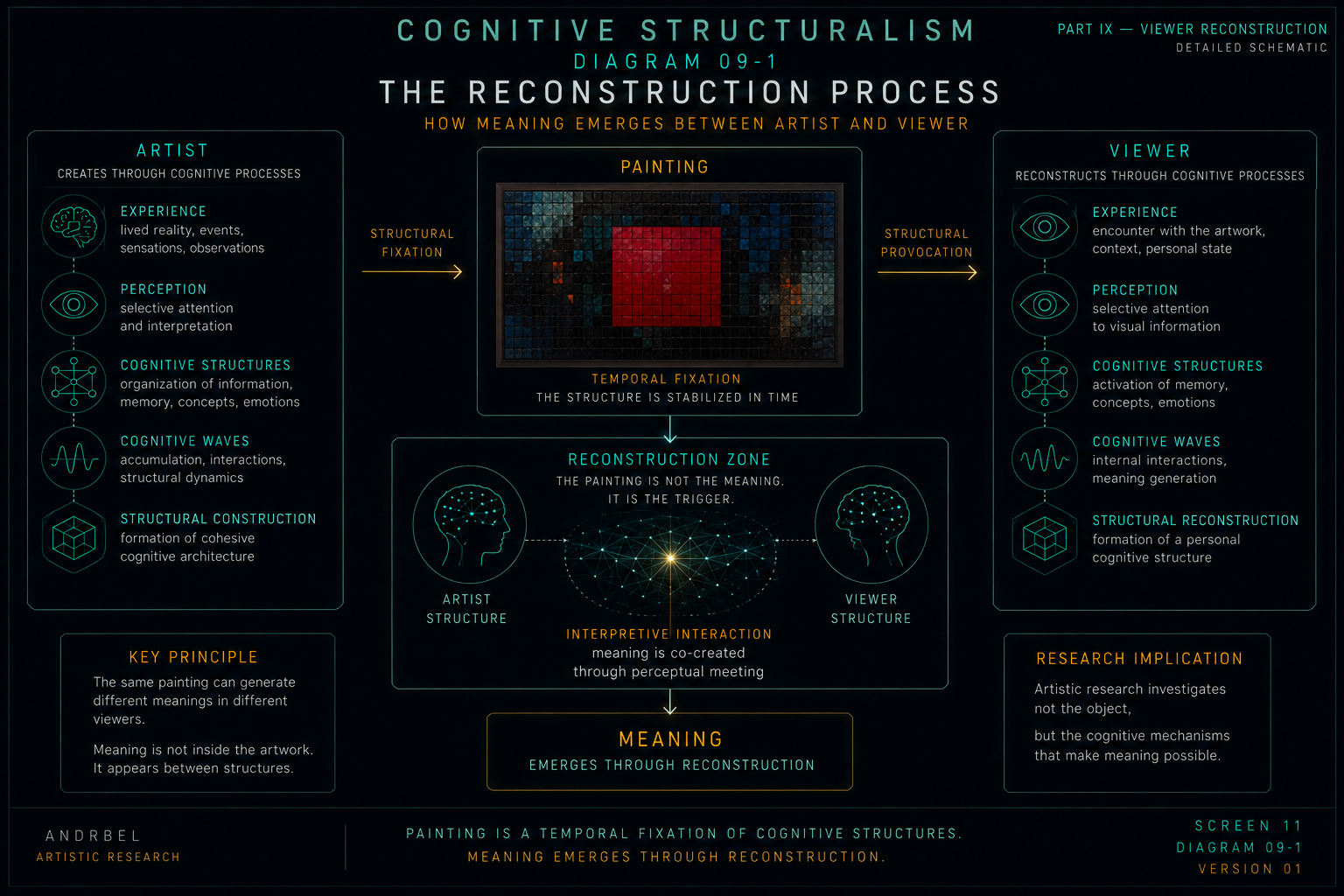
Viewer Reconstruction
When another individual encounters the artwork, a new process begins.
The viewer reconstructs the structure through:
- perception,
- memory,
- experience,
- emotional state,
- biological conditions,
- social conditioning.
The artwork therefore becomes a meeting point between two cognitive systems:
Artist Cognitive Structure
↓
Painting
↓
Viewer Cognitive Structure
Meaning emerges through interaction.
The painting becomes a site of cognitive reconstruction.
Research Outcome
They function as:
- materialized cognitive structures temporarily stabilized through artistic practice.
The artwork records neither reality itself nor imagination alone.
It records:
- a constructed cognitive configuration emerging from interactions between perception, environment, cognition, and time.
Transition to Part IX
- What are the limits of such a framework?
Can Cognitive Structuralism be understood solely as an artistic model?
Or does it propose broader implications for understanding perception and reality?
These questions remain unresolved.
The following section therefore examines the limitations, uncertainties, and open questions that continue to shape the development of the research.
Part IX — Limitations and Open Questions
Boundaries, Uncertainties, and Future Directions
Introduction
The framework emerged through artistic practice and developed through a series of observations concerning cognitive organization, structural relationships, geometry, perceptual systems, Cognitive Waves, and the construction of reality.
However, the development of any research framework necessarily generates new questions.
The purpose of this section is therefore not to resolve uncertainty.
Rather, it is to identify the limitations, boundaries, and unresolved problems that remain within the current state of the research.
These questions should be understood not as weaknesses of the framework, but as directions for future investigation.
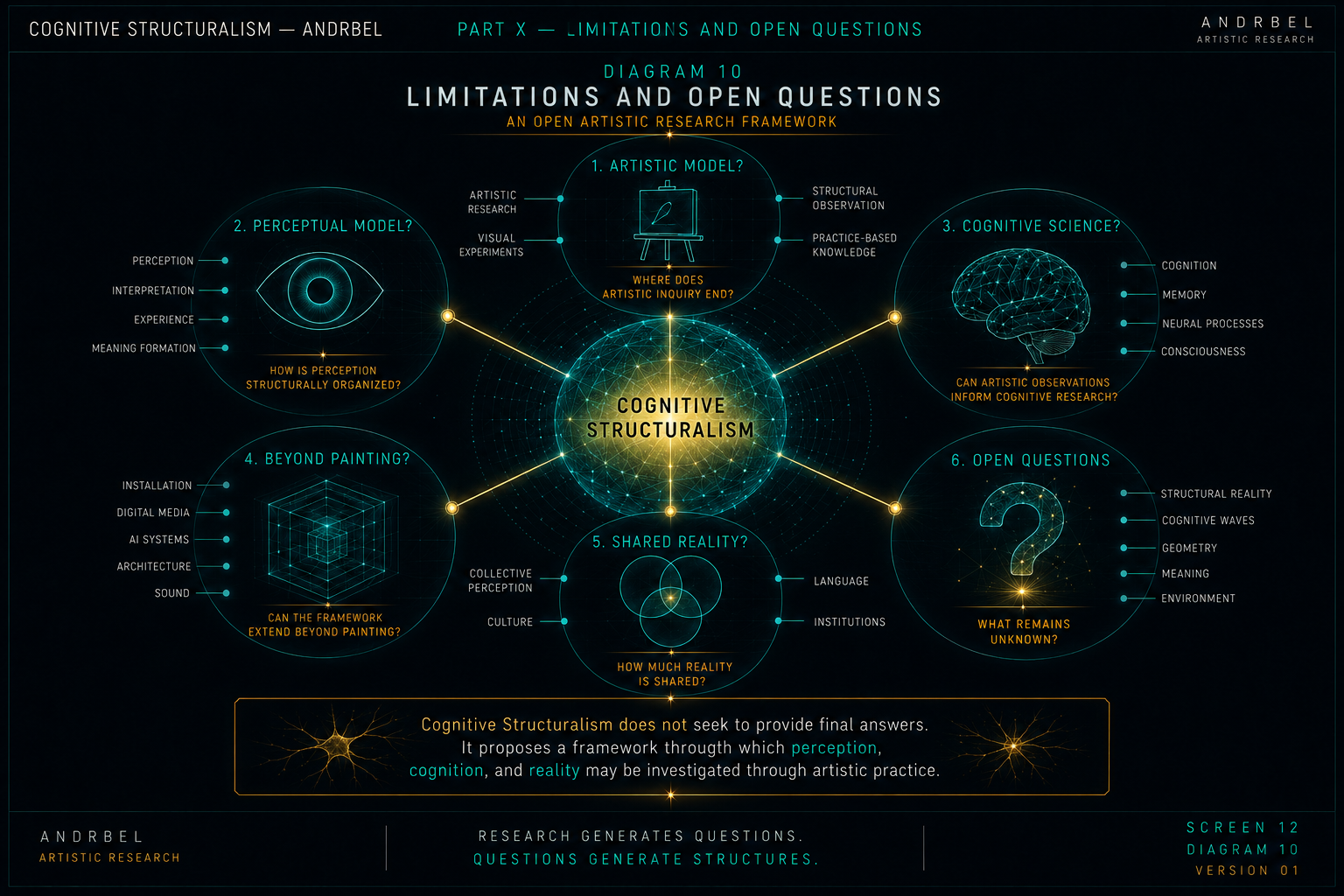
1. Is Cognitive Structuralism an Artistic Framework or a Broader Model of Perception?
At present, Cognitive Structuralism is positioned as an artistic research framework.
Its observations emerge through artistic practice.
Its methods are rooted in painting.
Its experiments are conducted through visual structures.
Yet many of its propositions extend beyond art.
Questions concerning:
- perception,
- cognition,
- reality construction,
- structural organization,
- are not exclusively artistic questions.
This raises an important uncertainty:
Is Cognitive Structuralism primarily a framework for artistic investigation, or does it point toward a broader model of perception?
At present, the research does not claim to provide an answer. The question remains open.
2. Where Does Artistic Research End and Cognitive Science Begin?
Throughout this research, concepts such as cognition, perception, memory, and reality have been discussed.
These concepts are also central to scientific research.
However, Cognitive Structuralism does not attempt to function as cognitive science.
It does not seek to produce experimental validation, predictive models, or neuroscientific explanations.
Its methods remain artistic rather than scientific.
Nevertheless, the framework repeatedly encounters questions that overlap with scientific inquiry.
This creates a productive tension.
The research occupies a position between:
Artistic Practice
↔
Artistic Research
↔
Cognitive Inquiry
The precise location of the boundary remains uncertain.
Future interdisciplinary collaborations may help clarify this relationship.
3. Can Cognitive Structures Be Investigated Through Painting Alone?
This choice reflects the origin of the framework.
Yet an important methodological question remains.
Is painting sufficient for investigating cognitive structures?
Or might other media reveal dimensions of cognition that painting cannot access?
Possible extensions include:
- installation,
- spatial environments,
- digital systems,
- sound structures,
- choreography,
- moving image,
- artificial intelligence.
If cognition operates through multiple sensory modalities, then painting may represent only one domain of a broader field of investigation.
This possibility remains largely unexplored.
4. Are Cognitive Waves Artistic Observations or General Cognitive Phenomena?
The model proposes that cognitive structures accumulate, intensify, and occasionally generate moments of structural emergence preceding artistic formation.
Within the framework, these processes are described through:
- Cognitive Waves (CW),
- Peak of Cognitive Waves (PCW),
- Cognitive Wave Burst (CWB).
However, an important question remains.
Are these phenomena specific to artistic cognition?
Or do they describe more general processes of cognitive organization?
At present, the model should be understood as an artistic observation rather than a universal cognitive theory.
Further investigation would be required before broader claims could be made.
5. Is Shared Reality a Conceptual Model or a Descriptive Hypothesis?
This proposition functions as one of the central ideas within Cognitive Structuralism.
Yet its status remains intentionally unresolved.
It may be interpreted as:
- a conceptual framework,
- a philosophical proposition,
- an artistic model,
- a descriptive hypothesis.
The framework does not currently determine which interpretation is correct.
Instead, Shared Reality functions as a productive lens through which questions of perception and reality may be investigated.
Its explanatory limits remain unknown.
6. What Remains Unresolved?
It may be the questions it generates.
Among the unresolved issues are:
Reality
- What constitutes reality beyond cognitive organization?
- Can multiple realities coexist without contradiction?
- How are cognitive structures formed?
- What determines structural stability?
- Why do geometric relationships appear repeatedly in perceptual organization?
- Are geometric structures fundamental to cognition or merely useful representations?
- Does meaning emerge from structures themselves?
- Or from interactions between structures and observers?
- What distinguishes artistic cognition from other forms of cognition?
- Can painting reveal structures inaccessible to language?
- How much of reality is truly shared?
- How much remains private?
The Value of Uncertainty
In many cases, uncertainty functions as a productive force.
The development of Cognitive Structuralism has repeatedly demonstrated that questions often generate more insight than conclusions.
The framework therefore remains intentionally open.
Its purpose is not to establish a final theory of perception or reality.
Its purpose is to create conditions through which these phenomena can be investigated through artistic practice
Conclusion
The framework proposes a set of models, observations, and methods for investigating the relationships between cognition, perception, structure, and reality.
Many questions remain unresolved.
Indeed, some may never be fully resolved.
Yet it is precisely within these uncertainties that future research becomes possible.
The framework remains open to revision, expansion, contradiction, and transformation.
In this sense, Cognitive Structuralism is not presented as a conclusion.
It is presented as an invitation to continued inquiry.
Part X — Future Research Expanding Cognitive Structures Beyond Painting
Introduction
This focus reflects the origin of Cognitive Structuralism.
The framework emerged through painting.
Its concepts developed through artistic practice.
Its observations were generated through visual experimentation.
Yet throughout the research, an increasingly important realization emerged.
The central questions addressed by Cognitive Structuralism do not appear to belong exclusively to painting.
Questions concerning perception, cognition, reality formation, structural organization, meaning generation, and experiential construction may potentially be investigated through a wide range of artistic and non-artistic systems.
This possibility suggests that painting may represent only one manifestation of a broader field of cognitive structures.
The present section outlines several future directions through which the framework may continue to evolve.
Visual Systems
Painting continues to function as the primary experimental field of Cognitive Structuralism.
Future investigations may further explore:
- perceptual organization,
- structural density,
- geometric cognition,
- Cognitive Waves,
- viewer reconstruction,
- shared and individual realities.
Future research may extend toward:
- digital art,
- generative visual systems,
- algorithmic image production,
- interactive visual environments.
How can visual structures reveal cognitive structures?
Spatial Systems
If cognition organizes experience structurally, then space may function as a cognitive medium.
Future investigations may include:
- installation art,
- spatial environments,
- immersive systems,
- architectural structures,
- environmental perception models.
Within such works, the viewer no longer observes a structure from outside.
Instead, the viewer enters the structure.
The artwork becomes an experiential cognitive environment.
This shift may provide new opportunities for investigating perception beyond the limits of the image plane.
Sonic Systems
Sound structures perception in profoundly different ways.
Future research may therefore explore:
- music,
- sound structures,
- acoustic environments,
- temporal perception,
- auditory cognition.
Within this perspective, music may be approached not simply as composition but as a structural organization of cognitive experience unfolding through time.
The investigation shifts from:
What does the music express?
to:
What cognitive structures does the music generate?
Performative Systems
Future directions may include:
- dance,
- choreography,
- embodied cognition,
- movement systems,
- performative environments.
The artwork is no longer fixed in material form.
It unfolds through action, sequence, rhythm, and physical organization.
The investigation becomes:
- How do cognitive structures manifest through movement?
Narrative Systems
Possible directions include:
- literature,
- poetry,
- cinema,
- screenwriting,
- narrative architecture.
From this perspective:
- A film may be understood as the structural reality of a screenwriter or director materialized through narrative time.
The emphasis shifts from representation toward the structural organization of experience.
Algorithmic Systems
Contemporary artificial intelligence increasingly participates in the production, interpretation, and transformation of information.
Future investigations may explore:
- AI systems,
- generative cognition,
- machine perception models,
- algorithmic structures,
- human–machine cognitive interactions.
The more important question may be:
- Can cognitive structures be modeled, transformed, or generated through algorithmic systems?
Such investigations may eventually expand the framework beyond exclusively human cognition.
Entrepreneurial Structures
Throughout human history, inventors, founders, and innovators have repeatedly attempted to transform imagined futures into material realities.
From the perspective of Cognitive Structuralism, entrepreneurial projects may be interpreted as cognitive structures operating beyond traditional artistic domains.
A startup may be viewed as a structural attempt to materialize a perceived future reality.
This process can be represented as:
Inventor
↓
Cognitive Reality
↓
Startup
↓
Materialization Attempt
The inventor perceives a reality that does not yet exist.
The entrepreneurial project becomes a structure through which that reality is communicated, tested, and potentially realized.
In this sense, entrepreneurship may function as a form of cognitive construction comparable to artistic practice.
The challenge often lies in the fact that others—investors, institutions, or society—may not yet perceive the same reality.
The startup therefore becomes a medium through which competing cognitive realities interact.
This perspective suggests that Cognitive Structuralism may eventually contribute to understanding not only artworks, but also inventions, innovations, and systems of future-making.
Toward Cognitive Structuralism Version 03
Future investigations may explore cognitive structures through:
Visual
- Painting
- Digital Art
- Generative Systems
- Installation
- Spatial Environments
- Immersive Systems
- Music
- Sound Structures
- Acoustic Cognition
- Dance
- Choreography
- Movement Systems
- Literature
- Poetry
- Cinema
- Screenwriting
- AI Systems
- Generative Cognition
- Machine Perception Models
- Innovation Systems
- Startups
- Future Reality Construction
These directions collectively point toward what may be described as:
Cognitive Structuralism Version 03
A broader investigation into how cognitive structures become materialized across multiple media, environments, and systems.
Conclusion
It does not claim completion.
It does not propose a final theory.
Nor does it seek to establish definitive answers concerning perception, cognition, or reality.
Instead, it presents an evolving artistic research framework generated through practice, observation, experimentation, and structural inquiry.
The framework remains open.
It remains incomplete.
It remains subject to revision, expansion, contradiction, and transformation.
Future iterations may expand beyond painting toward spatial, sonic, algorithmic, performative, narrative, and entrepreneurial forms of cognitive structure.
In this sense, Cognitive Structuralism should not be understood as a finished system.
It should be understood as an ongoing investigation into how cognition structures perception, how perception structures reality, and how reality becomes materialized through human and potentially non-human forms of creation.
FINAL THEORETICAL SYNTHESIS
Five Structural Principles of Cognitive Structuralism Subtitle
A Summary of the Current Research Framework (Version-02-CS/01)
The framework remains open, evolving, and incomplete.
Future iterations may expand beyond painting toward spatial, sonic, algorithmic, performative, narrative, and entrepreneurial forms of cognitive structure.
FINAL THEORETICAL SYNTHESIS
Cognitive Structuralism
Painting is not an image of reality.
It is a structural model of thinking through which reality becomes visible.
— AndrBel
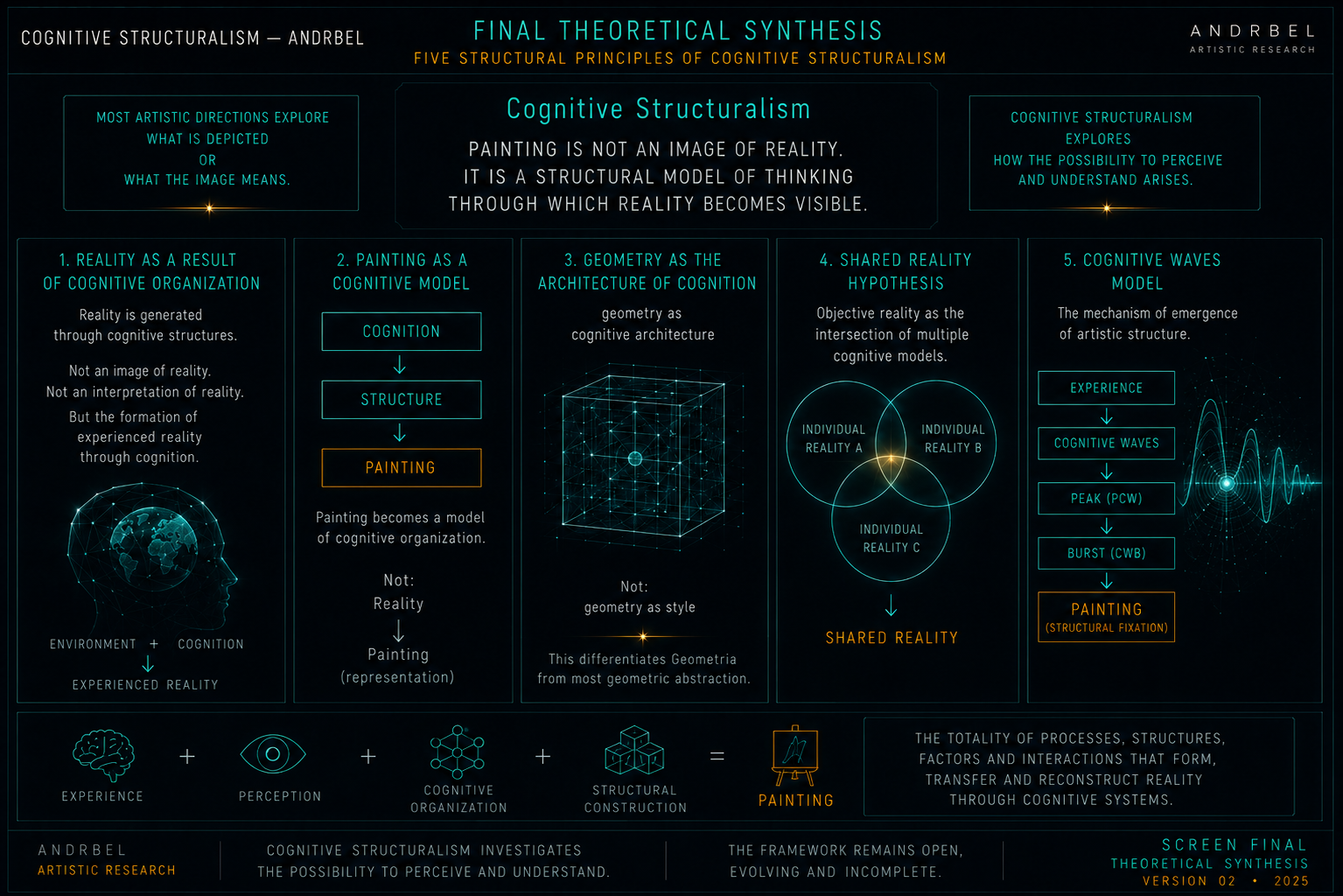
Five Structural Principles of Cognitive Structuralism
Perceptual Accumulation, Structural Emergence, and Artistic Formation
Principle I
Reality as Cognitive Organization
Experienced reality emerges through interactions between:
- biological environments,
- social environments,
- internal environments,
- which become organized through cognition.
Principle II
Painting as Cognitive Model
↓
Structure
↓
Painting
The painting functions as a model of cognitive organization.
Not:
Reality
↓
Painting
but:
Cognition
↓
Structural Organization
↓
Painting
Principle III
Geometry as the Architecture of Cognition
Within Cognitive Structuralism:
geometry ≠ style
Geometry is investigated as an organizational framework through which perception becomes structured.
This distinguishes Geometria from most traditions of geometric abstraction.
Principle IV
Shared Reality Hypothesis
Individual Reality A
Individual Reality B
Individual Reality C
↓
Shared Reality
Shared Reality emerges through intersections between cognitive models rather than existing independently of them.
Principle V
Cognitive Waves Model
Experience
↓
Cognitive Waves
↓
Peak
↓
Burst
↓
Painting
The artwork emerges not from a single idea but from the accumulation, convergence, and materialization of cognitive structures.
FINAL STATEMENT
Painting is not an image of reality.
It is a structural model of thinking through which reality becomes visible.
Cognitive Structuralism does not seek to explain what reality is.
It investigates how reality becomes perceptible, how cognition organizes experience, and how those structures may be materialized through artistic practice.
FINAL RESEARCH STATEMENT
Rather than asking what reality is, the framework investigates how reality becomes perceptible.
AndrBel 2025–2026
Cognitive Structuralism Version-02-CS/01
An Artistic Research Framework on Perception and Structural Reality
SUGGESTED CITATION
AndrBel. “Cognitive Structuralism: Toward an Artistic Research Framework on Perception and Structural Reality.” Research Catalogue, 2025.
Cognitive Structuralism is an artistic research framework developed by AndrBel.All diagrams, conceptual systems, visual structures, and written materials presented in this exposition form part of an ongoing artistic research practice.© AndrBel, 2025–Present
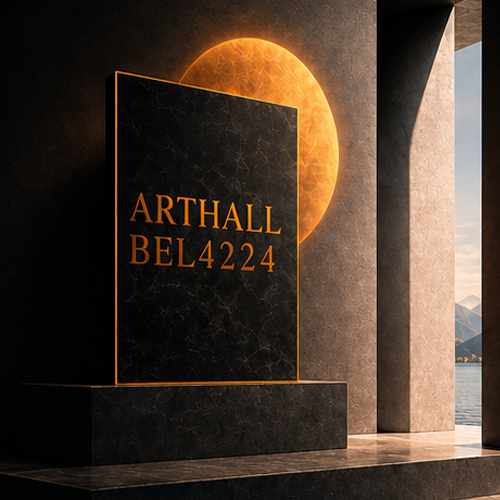
This paper is published within the ARTHALL BEL4224 institutional research framework.
The concepts presented, including Artist Legacy Infrastructure and related structural models, form part of the intellectual property of AndrBel and ARTHALL BEL4224.
Unauthorized commercial use, replication, or derivative development of these concepts is strictly prohibited.



Support independent artistic research in Cognitive Structuralism, conceptual painting, and long-term cultural infrastructure development.
[Support Research]
Cognitive Structuralism — AndrBel
Ongoing Artistic Research Framework
© AndrBel, 2025–Present
Cognitive Structuralism is an original conceptual and theoretical framework developed by AndrBel.
No part of this concept, including its terminology, structural models, or theoretical formulations, may be reproduced, distributed, or adapted without prior written permission from the author.
This material is protected as intellectual property within the AndrBel artistic and research practice.
This publication is part of the ARTHALL BEL4224 Research Program.
No part of this publication may be reproduced, distributed, or transmitted in any form or by any means without prior written permission from the author and ARTHALL BEL4224, except in the case of brief quotations for academic or curatorial purposes.