PAPER #8
PAPER #8
Physical Cultural Objects and Cultural Digital Assets
ANDRBEL Research Program
Demonstration and Validation Project (DAP) Research Series
DAP #0A
AndrBel
PAPER #8
Physical Cultural Objects and Cultural Digital Assets
Page 4
Publication Metadata
Research Program: ANDRBEL Research Program
Framework Context: ADAS Framework Series
Research Type: Foundational Ontological Investigation
Protocol Function: Physical–Digital Ontology and Cultural Qualification Foundation
Future Standard Context: CDA Protocol v1.0
Institutional Context: CDA Standards Organization
Publication Position: PAPER #8 (DAP #0A)
Version: 1.0
PART IX
Standardization and Institutional Implications
Defining the Boundary Between Cultural Judgment, Protocol Structure, and Standards Governance
9.1 Purpose of PART IX
The preceding Parts established the substantive architecture of DAP #0A.
PART III defined the physical cultural ontology:
PAO
↓
PCO Candidate
↓
PCO
PART IV established distributed Cultural Recognition.
PART V developed the PCO Qualification Architecture.
PART VI established independent PCO and CDA qualification.
PART VII introduced the Relational Cultural Layer.
PART VIII connected provenance, governance, and continuity to long-term cultural stewardship.
PART IX now asks a different question:
- Which of these findings may legitimately become part of a common cultural standard, and what institutional architecture is required to maintain that standard without allowing the standards body itself to become an authority over culture?
DAP #0A does not conclude that every research concept should become a normative requirement.
The translation is instead:
Research Architecture
↓
Standardization Boundary
↓
Protocol Architecture
↓
Institutional Stewardship
The principal task of PART IX is therefore to define the boundary between:
Cultural Judgment
Protocol Structure
Institutional Standards Governance
9.2 Standardization Is Not Cultural Determination
The first principle follows directly from PARTS III–VIII.
Cultural significance originates through cultural relationships, judgments, evidence, institutions, communities, research, and historical processes.
A standards protocol cannot legitimately generate that significance by itself.
Therefore:
- CDA Protocol should standardize the structure through which cultural claims are represented, qualified, governed, reviewed, and preserved; it should not determine cultural meaning itself.
CULTURAL ACTORS
↓
produce
Cultural Recognition
Cultural Significance Claims
Interpretations
Evidence
↓
CDA PROTOCOL
↓
structures
Identity
Qualification
Records
Scope
Provenance
Governance
Continuity
Conformity
Interoperability
The distinction is fundamental.
9.3 What CDA Protocol May Standardize
DAP #0A identifies several domains that are structurally appropriate for standardization.
These include:
Terminology
Common definitions for concepts such as:
- Physical Artistic Object (PAO);
- PCO Candidate;
- Physical Cultural Object (PCO);
- Cultural Digital Asset (CDA);
- Recognition Record;
- PCO Qualification;
- Qualification Authority;
- Qualification Provenance;
- Relational Provenance.
The Protocol may standardize how records identify:
- physical objects;
- digital objects;
- qualification records;
- relationship records.
It may define procedural requirements concerning:
Qualification Initiation
↓
Candidate State
↓
Evidence
↓
Assessment
↓
Decision
↓
Qualification Record
↓
Review / Versioning
Evidence Structure
It may define how evidence is:
- attributed;
- referenced;
- dated;
- classified;
- preserved.
It may define fields for:
- Recognizing Entity;
- mandate;
- Recognition Type;
- Recognition Scope;
- evidence;
- status.
It may standardize representation of:
- Physical Provenance;
- Digital Provenance;
- Relational Provenance;
- Qualification Provenance.
It may define structural roles and permissions concerning:
- record maintenance;
- qualification actions;
- custodianship;
- review;
- governance transfer.
It may define how continuity conditions are represented across:
- Material;
- Identity;
- Provenance;
- Interpretive;
- Governance;
- Qualification;
- Institutional domains.
It may define interoperable structures for:
- PCO ↔ CDA relationships;
- relationship types;
- dependencies;
- authorization;
- relationship provenance.
It may define what it means for:
- a record;
- process;
- implementation;
Versioning and Interoperability
It may define requirements enabling records to remain:
- versioned;
- portable;
- interpretable across systems;
- historically reconstructable.
These are legitimate objects of standardization because they concern structure rather than cultural superiority.
9.4 What CDA Protocol Must Not Standardize
The opposite boundary is equally important.
CDA Protocol should not attempt to standardize:
- artistic quality;
- aesthetic merit;
- beauty;
- originality as universal cultural superiority;
- cultural prestige;
- artistic ranking;
- cultural taste;
- universal interpretation;
- ideological approval;
- political approval;
- market desirability;
- investment quality.
Protocol
MAY standardize
how a claim is recorded
Protocol
MUST NOT determine
which interpretation is culturally correct
Likewise:
Protocol
MAY define
PCO Qualification procedure
Protocol
MUST NOT create
a universal hierarchy of “better” cultural objects
This is the core Standardization Boundary of Paper #8.
9.5 Standardizing Qualification Without Standardizing Culture
At first sight, PCO Qualification may appear to contradict this boundary.
If the Protocol determines whether an object is a PCO, does it not determine cultural value?
DAP #0A resolves this apparent contradiction through a critical separation:
- The Protocol does not itself decide cultural significance. It specifies how an attributable Qualification Authority may assess whether the documented cultural basis satisfies the requirements of a defined qualification framework.
CULTURAL JUDGMENT
↓
produced by
Recognizing Entities
EVIDENCE
↓
assembled and attributed
QUALIFICATION AUTHORITY
↓
assesses the structured basis
PROTOCOL
↓
defines how that process must operate
The Protocol governs the method of qualification.
It does not monopolize the underlying cultural judgment.
9.6 Cultural Recognition Authority
The architecture developed in PART IV identified:
- Cultural Recognition Authority
Instead, different entities possess different cultural mandates.
Examples include:
- artist;
- museum;
- curator;
- research body;
- community;
- public institution;
- state authority.
The standards system should preserve those claims.
It should not erase their institutional origins.
9.7 PCO Qualification Authority
PART V introduced:
- PCO Qualification Authority
It determines whether the full qualification architecture is sufficiently satisfied.
The relationship is:
Cultural Recognition Authority
↓
produces Recognition Record
PCO Qualification Authority
↓
assesses complete qualification structure
These functions may be performed by the same institution.
But they must remain conceptually distinct.
9.8 Qualification Authority Eligibility
DAP #0A supports a distributed qualification architecture.
A Qualification Authority need not belong to one closed institutional class.
Potential authorities may include:
- museums;
- archives;
- research institutions;
- appropriately governed artist estates;
- cultural foundations;
- public cultural bodies;
- qualified registries;
- other entities operating under an identifiable mandate.
- What prestige category does the institution belong to?
- Does it possess sufficient mandate, competence, transparency, governance, and accountability to conduct the qualification?
Institutional Name
≠
Qualification Legitimacy by itself
9.9 Qualification Mandate
A Qualification Authority should be able to state:
- Why does this entity possess authority to issue this qualification?
- Qualification Mandate
Qualification Authority
Qualification Mandate
Relevant Competence
Relationship to Object
Conflict of Interest
Decision Date
Applicable Protocol Version
This creates accountability without centralizing cultural authority.
9.10 Qualification Competence
Mandate alone is insufficient.
An institution may possess general cultural authority but lack competence concerning a specific object.
Relevant competence may involve:
- artistic practice;
- art history;
- provenance;
- archives;
- community cultural knowledge;
- conservation;
- digital cultural infrastructure.
- Qualification legitimacy depends on relevant competence as well as mandate.
It should not establish one universal hierarchy of professions.
9.11 Conflict of Interest
A Qualification Authority may have a relationship to the object.
For example:
- artist;
- owner;
- representing gallery;
- estate;
- seller.
But they alter the context.
Therefore:
- Conflict of interest should be disclosed rather than silently ignored.
Creator
Owner
Seller
Representative
Custodian
Independent
as relationship categories.
This does not yet determine whether independent recognition must always be mandatory.
That remains an open normative question identified in DAP #0A.
9.12 Qualification Authority Is Not Cultural Sovereignty
Even a valid Qualification Authority does not acquire authority over all cultural interpretations of the object.
Its function is limited.
For example:
Museum A
↓
issues PCO Qualification
does not imply:
Museum A
↓
owns the cultural meaning
of the object
The qualification decision remains one institutional act within a larger cultural ecosystem.
9.13 Record Custodian
DAP #0A also separates:
- Record Custodian
A Record Custodian maintains:
- accessibility;
- record integrity;
- version history;
- evidence references;
- continuity.
Museum A
=
Qualification Authority
Registry B
=
Record Custodian
is structurally possible.
This is important for long-term institutional continuity.
9.14 Custodianship Is Not Qualification Authority
The entity storing or maintaining the record should not automatically possess the right to change its cultural decision.
Therefore:
Record Custodian
≠
Qualification Authority
unless explicitly authorized.
This distinction protects against a technical provider silently becoming a cultural decision-maker.
9.15 Protocol Conformity Authority
A further role is:
- Protocol Conformity Authority
- Does the qualification process, record, or implementation satisfy the structural requirements of CDA Protocol?
- required fields;
- procedural completeness;
- evidence attribution;
- versioning;
- governance;
- record integrity.
Is this culturally important enough?
Therefore:
Cultural Qualification
≠
Protocol Conformity
This is one of the most important institutional separations in the emerging architecture.
9.16 A Qualified Object May Have Non-Conformant Records
Consider:
Museum A
issues a culturally defensible qualification
but
required Protocol fields
are incomplete
The resulting situation may be:
Cultural Qualification:
Established
Protocol Conformity:
Not Demonstrated
The cultural judgment does not disappear.
But the implementation cannot claim full Protocol conformity.
9.17 A Conformant Record Does Not Guarantee Cultural Correctness
The reverse is equally important.
A record may satisfy every structural requirement:
Identity
Evidence
Scope
Authority
Versioning
and still later face:
- new evidence;
- attribution revision;
- recognition conflict.
Protocol Conformity
≠
Permanent Cultural Truth
Conformity verifies the process and structure.
It does not immunize cultural conclusions from future research.
9.18 Self-Declared Conformity
For an open standards system, one possible model is:
- Self-Declared Conformity
“This record conforms to CDA Protocol v1.0.”
Such a declaration must remain attributable.
For example:
Conformity Type:
Self-Declared
Claiming Entity:
Institution X
Protocol Version:
1.0
Conformity Scope:
PCO Qualification Core
Self-declaration is not equivalent to external certification.
9.19 Independently Reviewed Conformity
A stronger optional model may be:
- Independently Reviewed Conformity
This may become particularly useful for:
- institutional exchange;
- major registries;
- cross-platform interoperability;
- public cultural systems.
independent conformity review still verifies the standard structure, not cultural value.
9.20 Certification Remains a Separate Future Question
DAP #0A does not establish a mandatory certification regime.
A possible future architecture might include:
Protocol
↓
Conformity Requirements
↓
Independent Assessment
↓
Certification
But certification is an institutional mechanism beyond the core research findings.
The present paper therefore does not equate:
PCO Qualification
with:
CDA Standards Organization Certification.
9.21 CDA Standards Organization
DAP #0A substantially clarifies the institutional role of:
- CDA Standards Organization
- standards steward
- universal object-level cultural qualifier.
- maintaining CDA Protocol;
- maintaining terminology;
- publishing Protocol versions;
- coordinating consultation;
- preserving version history;
- publishing implementation guidance;
- defining conformity structures;
- supporting interoperability;
- maintaining institutional continuity of the standard.
9.22 What CDA Standards Organization Should Not Ordinarily Do
To preserve institutional neutrality, CDA Standards Organization should not ordinarily function as:
- universal art-selection committee;
- artistic-quality authority;
- cultural prestige ranking body;
- global heritage ministry;
- market-rating agency;
- universal owner of cultural interpretation.
- CDA Standards Organization should not be the default authority deciding which individual artworks are culturally important.
9.23 Why Centralized Qualification Should Be Rejected
Consider a centralized model:
Every object
↓
submitted to
CDA Standards Organization
↓
Central Committee
↓
PCO / Not PCO
This architecture creates several problems:
- cultural centralization;
- institutional bias;
- limited scalability;
- conflicts with community authority;
- conflicts with national institutions;
- excessive institutional liability;
- cultural homogenization.
COMMON PROTOCOL
↓
Distributed Qualification Authorities
↓
Interoperable Qualification Records
This preserves a common structural language without creating a global cultural tribunal.
9.24 Common Rules, Distributed Cultural Authority
The institutional principle can be summarized:
- Common rules, distributed cultural authority.
how qualification must be structured
while legitimate cultural actors determine:
the substantive cultural claims
within their mandates
This produces a standards system capable of being international without imposing a single universal cultural authority.
9.25 Institutional Non-Substitution Principle
The Protocol should therefore preserve an:
- Institutional Non-Substitution Principle
- Use of CDA Protocol does not replace or transfer the institutional mandate of the cultural actor applying it.
Museum
remains museum
Community Authority
remains community authority
State Authority
retains legal jurisdiction
Artist
retains authorial authority
The Protocol supplies a common structural framework.
It does not absorb their institutional mandates.
9.26 Voluntary Adoption
DAP #0A supports voluntary adoption of CDA Protocol across the cultural ecosystem.
Potential users may include:
- artists;
- artist estates;
- museums;
- galleries;
- archives;
- collectors;
- auction houses;
- foundations;
- universities;
- communities;
- municipalities;
- ministries;
- registries;
- independent cultural platforms.
- CDA Protocol should function as an openly adoptable common framework unless a competent external legal, contractual, or institutional system independently makes its use mandatory.
9.27 Voluntary Does Not Mean Informal
Voluntary adoption does not allow institutions to use the terminology arbitrarily.
If an institution claims:
- CDA Protocol conformant
Thus:
Voluntary Adoption
↓
Conformity Claim
↓
Accountability
This distinction is central to credible open standards.
9.28 Partial Adoption
Institutions may not need to implement the entire Protocol immediately.
A museum might initially implement:
- PCO identifiers;
- provenance;
- relationship records;
This suggests:
- Conformity Scope
Conformity Scope:
PCO Provenance Module
or:
Conformity Scope:
Full PCO Qualification Architecture
The Protocol may eventually support modular adoption.
9.29 Conformity Scope
Conformity Scope answers:
- Which portion of CDA Protocol does this implementation claim to conform to?
- Core Terminology;
- PCO Qualification;
- CDA Qualification;
- Physical–Digital Relationships;
- Provenance;
- Governance;
- Continuity;
- Interoperability.
9.30 Open Implementation
The standards architecture should also avoid technological monopoly.
Valid PCO or CDA records should not require one:
- registry;
- blockchain;
- database;
- commercial vendor;
- company.
The standard should remain portable across implementation environments.
This produces:
Standard
=
stable common structure
Implementation
=
replaceable technical environment
This is essential for Institutional Continuity.
9.31 Protocol Independence from MADO cod ART
This separation has particular importance within the wider research architecture.
MADO cod ART may potentially implement:
- PCO records;
- CDA records;
- provenance;
- continuity;
- governance.
MADO cod ART
≠
CDA Protocol
and:
MADO cod ART implementation
≠
mandatory standards infrastructure
The Protocol must remain institutionally and technically usable beyond any single commercial implementation.
This protects the independence of CDA Standards Organization.
9.32 Standards Stewardship vs Implementation
The architecture should therefore distinguish:
CDA STANDARDS ORGANIZATION
↓
maintains standards
IMPLEMENTATION ENTITIES
↓
implement standards
Implementation entities may include:
- museum software;
- registries;
- archives;
- MADO cod ART;
- independent cultural platforms.
9.33 The Physical Cultural Layer
DAP #0A introduces a major expansion of CDA standards architecture:
- Physical Cultural Layer
Physical Object
↓
Physical Artistic Object (PAO)
↓
PCO Candidate
↓
PCO Qualification
↓
Physical Cultural Object (PCO)
along with:
- PCO Qualification Records;
- Recognition Profiles;
- Physical Provenance;
- governance;
- continuity.
9.34 The Digital Cultural Layer
The existing CDA architecture forms the:
- Digital Cultural Layer
Digital Object
↓
Digital Cultural Qualification
↓
Cultural Digital Asset (CDA)
The exact transitional terminology between Digital Object and CDA remains subject to comparative validation.
As established earlier, the functional need for a candidate state exists.
The final term CDA Candidate remains provisional until Comparative DAP Analysis.
9.35 The Relational Cultural Layer
PART VII established the:
- Relational Cultural Layer
It contains:
Relationship ID
Relationship Type
Source Relationship
Cultural Dependency
Qualification Dependency
Governance Dependency
Authorization
Relationship Evidence
Relational Provenance
Relationship Status
Relationship Governance
This is not a third cultural-object class.
It is a standards layer governing the relationship between object domains.
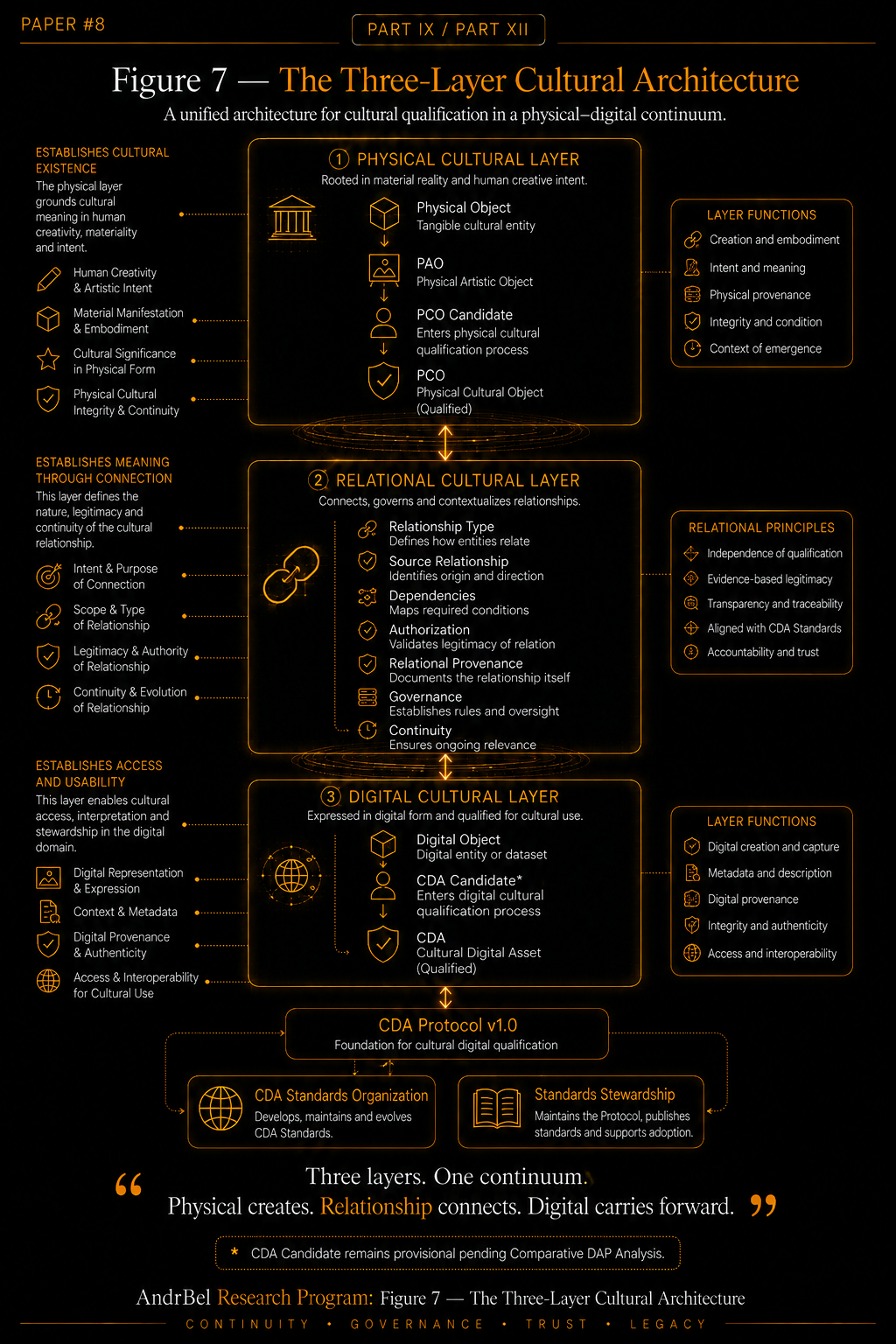
9.36 The Three-Layer CDA Standards Architecture
The institutional architecture emerging from Paper #8 is therefore:
CDA PROTOCOL
┌─────────────────────────────────┐
│ │
│ PHYSICAL CULTURAL LAYER │
│ │
│ PAO │
│ PCO Candidate │
│ PCO │
│ │
└───────────────┬─────────────────┘
│
↕
┌───────────────┴─────────────────┐
│ │
│ RELATIONAL CULTURAL LAYER │
│ │
│ Relationships │
│ Dependencies │
│ Authorization │
│ Relational Provenance │
│ Relationship Governance │
│ │
└───────────────┬─────────────────┘
│
↕
┌───────────────┴─────────────────┐
│ │
│ DIGITAL CULTURAL LAYER │
│ │
│ Digital Object │
│ Digital Qualification │
│ CDA │
│ │
└─────────────────────────────────┘
This three-layer architecture is one of the principal institutional consequences of DAP #0A.
9.37 Layer Independence
The three layers should remain independently applicable.
Thus:
PCO
+
No CDA
is valid.
CDA
+
No PCO
is valid.
And:
PCO ↔ CDA
activates the Relational Cultural Layer.
Therefore:
- interoperability does not require universal co-existence of all three layers.
9.38 Physical Cultural Layer Does Not Change the Core Institutional Mission
The introduction of PCO terminology does not mean that CDA Standards Organization becomes a general global heritage authority.
The reason the physical layer enters the framework is specific:
- CDA infrastructure requires a reliable method for describing physical artistic and cultural objects when those objects participate in physical–digital cultural relationships.
It does not replace the institutional focus on cultural digital infrastructure.
9.39 PCO as Institutional Vocabulary
DAP #0A supports the incorporation of three terms into future CDA Standards vocabulary:
These terms now possess sufficiently developed research definitions to enter Protocol translation.
However, their final normative definitions still require:
- comparative review;
- glossary harmonization;
- Protocol drafting;
- consultation.
Research Definition
↓
Protocol-Ready Definition
↓
Normative Definition
remains the correct sequence.
9.40 CDA Candidate Remains Provisional
The physical qualification architecture revealed a structural need for a digital transitional state.
However, DAP #0A does not finalize the term:
- CDA Candidate
- The Digital Cultural Layer requires an explicit qualification-in-progress state; “CDA Candidate” remains the provisional term pending Comparative DAP Analysis across DAP #1–#9.
9.41 Relationship to Existing CDA Standards Documents
The introduction of PCO and the three-layer architecture has implications for future institutional documents.
Relevant materials may eventually require updates concerning:
- Protocol terminology;
- Standards page;
- Research architecture;
- Glossary;
- implementation guidance;
- institutional diagrams;
- future Protocol specifications.
existing documents should not be silently rewritten to imply that these concepts existed before DAP #0A.
Updates should occur through:
- explicit versions;
- amendments;
- new publications.
9.42 Relationship to CDA Charter
DAP #0A does not automatically require immediate rewriting of the CDA Charter.
The institutional mission remains centered on open standards for cultural digital infrastructure.
The PCO layer may be understood as:
- a physical cultural reference and qualification layer necessary for interoperable physical–digital cultural systems.
9.43 Relationship to Institutional Architecture
The emerging PCO architecture reinforces several principles already necessary for institutional standards governance:
- research before normative standardization;
- consultation;
- version stewardship;
- institutional independence;
- long-term continuity.
It creates a new standards domain that must remain subject to the same institutional lifecycle as CDA itself.
9.44 Standards Lifecycle for PCO Findings
The correct translation pathway is:
DAP #0A
↓
Research Findings
↓
Protocol Implications
↓
DAP #8
↓
DAP #9
↓
Comparative DAP Analysis
↓
Structural Knowledge Matrix
↓
AFM v2.0
↓
ADAS Foundation Framework
↓
Protocol-Ready Findings Register
↓
CDA Protocol v1.0
↓
Institutional Consultation
↓
Revision
↓
Publication / Stewardship
This means:
- PART IX identifies standardizable structures, but does not itself enact them as standards.
9.45 Protocol Conformity vs Institutional Adoption
Another important distinction is:
- Institution uses some CDA terminology
- Institution is CDA Protocol conformant
This prevents casual terminology use from being mistaken for formal implementation.
9.46 Public Representation of PCO Qualification
If the standard is eventually adopted, public representation must remain precise.
A weak formulation would be:
- CDA Standards Organization certified this artwork as culturally important.
A more accurate formulation is:
- This object holds active PCO qualification under CDA Protocol v1.0, issued by [Qualification Authority].
Qualification Status:
Active
Qualification Authority:
Institution X
Protocol:
CDA Protocol v1.0
Conformity Type:
Self-Declared / Independently Reviewed
Record Custodian:
Institution Y
This preserves attribution.
9.47 “Under CDA Protocol” Must Have Precise Meaning
The phrase:
- under CDA Protocol
- identified Protocol version;
- defined Conformity Scope;
- attributable Qualification Authority;
- traceable Qualification Record;
- applicable procedural compliance.
Without these conditions, “under CDA Protocol” would gradually lose institutional meaning.
9.48 Candidate Status Must Not Be Marketed as Qualification
The same precision applies to:
- PCO Candidate.
- PCO Qualified.
PCO Candidate
≠
PCO
must remain visible in:
- registries;
- gallery interfaces;
- artist archives;
- marketplaces;
- institutional platforms.
It is not cultural endorsement.
9.49 Conformity Must Not Become Cultural Branding
Likewise:
- Protocol Conformant
- structurally compliant with the standard.
- prestigious;
- culturally superior;
- institutionally endorsed by CDA Standards Organization.
It is not a cultural-quality badge.
9.50 The Risk of Institutional Overreach
DAP #0A identifies several forms of potential standards overreach.
Cultural Overreach
The Organization begins choosing what culture should value.
Legal Overreach
PCO is represented as equivalent to state heritage protection.
Market Overreach
Qualification becomes an investment or pricing signal.
Technical Overreach
One platform or blockchain becomes mandatory.
Institutional Overreach
CDA Standards Organization absorbs the mandates of museums, communities, states, or researchers.
The future Protocol must structurally resist all five.
9.51 Institutional Neutrality
The appropriate institutional position is:
- CDA Standards Organization maintains a neutral standards architecture while permitting plural cultural authorities to operate within it.
The Organization must govern:
- terminology;
- versioning;
- conformity;
- consultation;
- interoperability.
- aesthetic judgment;
- cultural superiority;
- competing legitimate interpretations.
9.52 Cultural Neutrality vs Structural Rigor
Cultural neutrality should not be confused with weak standards.
The Protocol may still rigorously require:
Attribution
Evidence
Scope
Qualification Authority
Conflict Disclosure
Versioning
Provenance
Governance
Thus:
plural cultural judgment can coexist with rigorous structural standards.
This is a major institutional conclusion of DAP #0A.
9.53 Interoperability Without Cultural Uniformity
The resulting model can be expressed:
Museum A
Community B
Artist Estate C
Research Institution D
National Registry E
│
▼
different cultural mandates
│
▼
COMMON CDA PROTOCOL STRUCTURE
│
▼
interoperable records
The institutions remain culturally distinct.
Their records become structurally interoperable.
This is the central value proposition of standardization.
9.54 International Standards Without Universal Cultural Judgment
This allows CDA Standards Organization to pursue international standards without asserting:
- one international interpretation of culture.
Universal Structural Language
+
Plural Cultural Authorities
+
Scoped Recognition
+
Attributable Qualification
rather than:
Universal Cultural Judgment
This distinction may prove essential to long-term international legitimacy.
9.55 Protocol Core vs Extension Profiles
DAP #0A also suggests that not every specialized cultural case belongs in the Protocol Core.
A future architecture may distinguish:
CDA PROTOCOL CORE
from:
Extension Profiles
Possible extensions might eventually address:
- community cultural governance;
- contested heritage;
- sacred objects;
- archaeological objects;
- hybrid systems.
It identifies the need to avoid overloading the universal Core with unresolved boundary cases.
9.56 Physical Cultural Layer as Initial Scope
For CDA Protocol v1.0, the PCO layer should initially reflect the scope actually validated by DAP #0A:
- physical artistic objects.
This is an important institutional safeguard.
A standards organization gains credibility by specifying its limits.
9.57 Future Expansion Through Boundary Research
The physical layer can expand later through:
Research
↓
Boundary DAP
↓
Comparative Validation
↓
Protocol Extension / Revision
Potential future domains include:
- archaeological artifacts;
- indigenous cultural authority;
- sacred objects;
- mass-produced cultural objects;
- reconstructions;
- ephemeral works.
9.58 Qualification Authority vs Protocol Conformity Authority vs Standards Steward
The institutional architecture can now be stated precisely:
CULTURAL RECOGNITION AUTHORITY
↓
produces cultural claims
PCO QUALIFICATION AUTHORITY
↓
issues object-level qualification
RECORD CUSTODIAN
↓
maintains qualification record
PROTOCOL CONFORMITY AUTHORITY
↓
assesses standards compliance
CDA STANDARDS ORGANIZATION
↓
maintains the standard
This hierarchy is functional rather than cultural.
The Organization sits above the standard, not above culture.
9.59 One Institution May Perform Multiple Roles
In practice, one museum may be:
Recognition Authority
+
Qualification Authority
+
Record Custodian
+
Self-Declared Conformity Entity
This is possible.
But each role should be separately visible.
Why?
Because:
- authority basis differs;
- conflicts differ;
- future transfers may differ.
9.60 Distributed Standards Architecture
The complete standards architecture emerging from DAP #0A can now be represented:
CDA STANDARDS ORGANIZATION
│
▼
CDA PROTOCOL
│
┌────────────────┼────────────────┐
│ │ │
▼ ▼ ▼
PHYSICAL LAYER RELATIONAL LAYER DIGITAL LAYER
│ │ │
▼ ▼ ▼
PAO / PCO PCO ↔ CDA Digital / CDA
│ │ │
└────────────────┼────────────────┘
│
▼
DISTRIBUTED CULTURAL
IMPLEMENTATION
│
┌───────────────────┼───────────────────┐
│ │ │
Museum Artist Community
│ Estate │
Archive Research Municipality
│ │ │
└───────────────────┼───────────────────┘
│
▼
INTEROPERABLE RECORDS
This is the institutional synthesis of the preceding Parts.
9.61 Principal Finding: Standardize Infrastructure, Not Culture
The first major finding of PART IX is:
- CDA Protocol may standardize cultural qualification infrastructure without standardizing cultural meaning, aesthetic value, or cultural superiority.
9.62 Principal Finding: Distributed Qualification Is Compatible with Common Standards
The second finding is:
- A common international qualification framework does not require centralized object-level cultural authority.
9.63 Principal Finding: Qualification and Conformity Are Distinct
The third finding is:
- PCO Qualification concerns the cultural qualification of an object, while Protocol Conformity concerns whether the relevant process and record satisfy structural standards requirements.
9.64 Principal Finding: CDA Standards Organization Is Standards Steward
The fourth finding is:
- CDA Standards Organization should maintain the standards framework rather than function as the default authority selecting culturally significant objects.
9.65 Principal Finding: The Standards Architecture Requires Three Cultural Layers
The fifth finding is:
- The emerging CDA Protocol architecture requires distinguishable Physical Cultural, Relational Cultural, and Digital Cultural Layers.
9.66 Principal Finding: Open Implementation Is Necessary for Continuity
The sixth finding is:
- No single registry, commercial platform, blockchain, or technical provider should be required for valid implementation of CDA Protocol.
9.67 Principal Finding: Institutional Mandates Must Remain Intact
The seventh finding is:
- Adoption of CDA Protocol does not transfer or replace the cultural, legal, research, community, or institutional authority of participating actors.
It does not absorb institutional sovereignty.
9.68 Protocol Implications
PART IX generates several high-level Protocol Implications.
Protocol Implication 1
CDA Protocol should explicitly define its Standardization Boundary.
Protocol Implication 2
The Protocol should distinguish Cultural Recognition Authority, PCO Qualification Authority, Record Custodian, Protocol Conformity Authority, and Standards Steward.
Protocol Implication 3
PCO Qualification Authority should be attributable through mandate, competence, relationship disclosure, and decision provenance.
Protocol Implication 4
CDA Standards Organization should not be the default object-level PCO Qualification Authority.
Protocol Implication 5
The Protocol should define conformity separately from cultural qualification.
Protocol Implication 6
The Protocol should support attributable self-declared and, where developed, independently reviewed conformity.
Protocol Implication 7
Conformity claims should identify Protocol version and Conformity Scope.
Protocol Implication 8
The Protocol should support voluntary and modular adoption.
Protocol Implication 9
The Protocol should remain technologically and commercially implementation-neutral.
Protocol Implication 10
The Protocol should formally support Physical Cultural, Relational Cultural, and Digital Cultural Layers.
Protocol Implication 11
PAO, PCO Candidate, and PCO should enter future CDA Standards terminology.
Protocol Implication 12
The digital transitional qualification state should be standardized only after final comparative validation of the provisional CDA Candidate terminology.
Protocol Implication 13
Institutional adoption should preserve existing mandates rather than replace them.
Protocol Implication 14
The PCO layer should initially remain within the validated physical-artistic-object scope unless future research expands it.
Protocol Implication 15
Updates to CDA Standards institutional documents should follow explicit versioning rather than retrospective rewriting.
9.69 Part IX Synthesis
PART IX translates the substantive findings of DAP #0A into a bounded standards and institutional architecture.
The research does not conclude:
CDA Standards Organization
↓
determines culture
It concludes:
CULTURAL ACTORS
↓
produce cultural claims,
recognition and interpretation
QUALIFICATION AUTHORITIES
↓
apply structured qualification
CDA PROTOCOL
↓
standardizes the common framework
CDA STANDARDS ORGANIZATION
↓
maintains and evolves the standard
This produces the central institutional principle:
- The Organization governs the standard; it does not govern culture itself.
PHYSICAL CULTURAL LAYER
PAO → PCO Candidate → PCO
↕
RELATIONAL CULTURAL LAYER
PCO / PAO ↔ Digital Object / CDA
↕
DIGITAL CULTURAL LAYER
Digital Object → CDA
The third major conclusion is:
- Structural interoperability can coexist with cultural plurality.
And the fourth is the decisive Standardization Boundary of Paper #8:
- CDA Protocol may standardize terminology, qualification procedure, evidence, records, recognition scope, provenance, governance, continuity, relationships, versioning, interoperability, and conformity—but it should not standardize artistic quality, cultural meaning, aesthetic judgment, cultural superiority, or the culture itself.
The next approved section is therefore PART X — Consolidated Research Findings and Protocol Implications. There we should no longer develop new theory. We need to compress the much larger Full Research Record into approximately 12–16 genuinely consolidated findings, and for each one show the corresponding Protocol Implication, preserving the strict chain:
Research Finding
↓
Protocol Implication
without yet translating either into final SHALL / SHOULD / MAY normative language of CDA Protocol v1.0.
PART X
Consolidated Research Findings and Protocol Implications
From DAP #0A Research Results to Protocol-Ready Structural Direction
10.1 Purpose of PART X
PARTS III–IX developed the substantive architecture of DAP #0A.
This Part does not introduce new theory.
Its purpose is to consolidate the results of the investigation into a smaller number of research findings and to identify the corresponding consequences for future CDA Protocol development.
The methodological sequence is:
Research Finding
↓
Protocol Implication
A Research Finding records what DAP #0A has sufficiently established within its investigated scope.
A Protocol Implication identifies what the future CDA Protocol should be capable of representing, distinguishing, or structuring because of that finding.
These implications are not yet final normative requirements.
Therefore:
Protocol Implication
≠
Final Protocol Rule
The later sequence remains:
DAP #0A Findings
↓
DAP #8
↓
DAP #9
↓
Comparative DAP Analysis
↓
Structural Knowledge Matrix
↓
AFM v2.0
↓
ADAS Foundation Framework
↓
Protocol-Ready Findings Register
↓
CDA Protocol v1.0
The findings below are therefore consolidated outputs of DAP #0A, not final SHALL / SHOULD / MAY clauses.
10.2 Consolidated Finding 1
Physical Artistic Object and Physical Cultural Object Are Distinct
Research Finding
- A Physical Artistic Object (PAO) and a Physical Cultural Object (PCO) are structurally distinct categories.
Therefore:
PAO
≠
PCO
The transition between them is not a material transformation.
It is a change in the object's qualified cultural and institutional condition.
Protocol Implication
- The Protocol should distinguish Physical Artistic Object, PCO Candidate, and Physical Cultural Object as separate object or procedural states and should prevent PCO status from being inferred automatically from artistic objecthood alone.
10.3 Consolidated Finding 2
PCO Qualification Requires a Structured and Attributable Process
Research Finding
- PCO status cannot be established through an unsupported label, market status, institutional reputation, or informal assertion.
Object Identity
+
Qualification Claim
+
Cultural Relevance
+
Cultural Significance
+
Recognition
+
Evidence
+
Scope
+
Qualification Authority
+
Decision
+
Record
PCO Candidate is therefore a procedural state indicating that this process has begun.
Protocol Implication
- The Protocol should define a traceable PCO qualification workflow from Qualification Claim and Candidate state through evidence, assessment, decision, and persistent PCO Qualification Record.
10.4 Consolidated Finding 3
Cultural Qualification Is Object-Referential but Relationally Constituted
Research Finding
- PCO qualification concerns an identifiable physical object, but the cultural basis of that qualification emerges through relationships among evidence, cultural contexts, recognizing actors, institutions, provenance, governance, and continuity.
purely intrinsic to material substance
nor:
detached from the object itself
It is:
- object-referential and relationally constituted.
- The Protocol should preserve persistent object identity while representing the cultural relationships and evidence through which qualification is established.
10.5 Consolidated Finding 4
Cultural Recognition Is Distributed, Attributable, and Scoped
Research Finding
- No single cultural actor possesses universal Cultural Recognition Authority.
Recognition is therefore meaningful only where its:
- source;
- mandate;
- claim;
- scope;
- evidence;
- date;
Protocol Implication
- The Protocol should support multiple attributable Recognition Records rather than one universal recognition field or recognition authority.
Recognizing Entity
Recognition Type
Recognition Scope
Evidence
Date
Status
10.6 Consolidated Finding 5
Recognition Scope Is Not Cultural Rank
Research Finding
- Object-Level, Series-Level, Corpus-Level, Practice-Level, Institutional, Community, Territorial, National, Transnational, and International recognition describe different scopes rather than levels of cultural superiority.
International Recognition
≠
automatically greater cultural value
than
Local or Community Recognition
Recognition at one level may strengthen the Cultural Relevance of related objects but does not automatically propagate PCO qualification.
Protocol Implication
- The Protocol should represent Recognition Scope as contextual structured data and should prohibit automatic qualification propagation from artist-, practice-, series-, corpus-, territorial-, or institutional-level recognition to individual objects.
10.7 Consolidated Finding 6
Cultural Plurality and Recognition Conflict Must Be Representable
Research Finding
- Different cultural actors may legitimately reach different recognition outcomes without producing a logical contradiction.
- Scope Difference;
- Interpretive Difference;
- Evidentiary Conflict;
- Authority Conflict;
- Qualification-Critical Conflict.
Protocol Implication
- The Protocol should support concurrent and potentially conflicting Recognition Records, distinguish difference from qualification-critical conflict, and preserve historical recognition states through versioning rather than silent deletion.
10.8 Consolidated Finding 7
Cultural Qualification Must Remain Distinct from Market, Popularity, Territory, and Legal Status
Research Finding
DAP #0A establishes that:
Cultural Significance
≠
Economic Value
Cultural Recognition
≠
Popularity
Cultural Affiliation
≠
Nationality
PCO Qualification
≠
Legal Heritage Designation
Market price, public visibility, territorial relationships, and legal status may all produce relevant evidence.
None independently constitutes PCO qualification.
A PCO valued at $1 and a PCO valued at $10 million may both hold equally valid PCO status.
Protocol Implication
No market price, audience threshold, nationality, or legal designation should automatically create PCO qualification.
10.9 Consolidated Finding 8
PCO Qualification Is Non-Scalar and Multidimensional
Research Finding
- PCO qualification should not be expressed as a universal cultural ranking or level system.
PCO Level 1
PCO Level 2
PCO Level 3
because recognition, significance, provenance, continuity, market context, and institutional reach vary independently.
Instead:
Object Qualification
=
non-scalar
Cultural Profile
=
multidimensional
Lifecycle
=
multi-state
Protocol Implication
10.10 Consolidated Finding 9
PCO and CDA Are Independently Qualified Cultural Object Classes
Research Finding
Therefore:
PCO Qualification
≠
CDA Qualification
and neither object automatically inherits qualification from the other.
The following states are all structurally valid:
PAO only
PCO only
PAO ↔ CDA
PCO ↔ CDA
CDA without physical object
Protocol Implication
- The Protocol should maintain separate PCO and CDA qualification structures and records and should not require qualification in one domain as a universal prerequisite for qualification in the other.
10.11 Consolidated Finding 10
A CDA May Precede PCO Qualification
Research Finding
One of the central results of DAP #0A is:
- A digital object may legitimately qualify as a CDA before its related Physical Artistic Object receives PCO qualification.
PAO
↓
related CDA qualified
↓
later PCO assessment
↓
PCO
is structurally valid.
The CDA may generate:
- research;
- documentation;
- provenance;
- institutional relationships;
- public access;
- recognition;
But CDA qualification does not automatically create PCO status.
Protocol Implication
- The Protocol should permit a CDA to reference a related PAO whose PCO status is Not Assessed, Candidate, or otherwise not yet active, and should permit CDA-generated evidence to enter later PCO assessment without transferring qualification automatically.
10.12 Consolidated Finding 11
Reciprocal Influence Does Not Constitute Qualification Inheritance
Research Finding
Thus:
Cultural Influence
≠
Qualification Transfer
A PCO may support CDA qualification as cultural-source evidence.
A CDA may later strengthen PCO qualification evidence.
But each decision remains independently attributable.
Protocol Implication
Where a qualification genuinely depends on a relationship claim, that dependency should be explicit.
10.13 Consolidated Finding 12
Physical–Digital Relationships Constitute a Distinct Cultural Infrastructure Layer
Research Finding
Physical–digital relationships may differ structurally as:
- Representational;
- Derived;
- Parallel;
- Reciprocal;
- Hybrid.
- Source Relationships;
- Cultural Dependencies;
- Qualification Dependencies;
- Governance Dependencies;
- Authorization conditions.
Protocol Implication
- The Protocol should provide a distinct Physical–Digital Relationship Record capable of representing relationship type, endpoints, dependencies, authorization, evidence, status, governance, and version history.
10.14 Consolidated Finding 13
Relational Provenance Is a Distinct Provenance Domain
Research Finding
The history of how a specific physical object and digital object became related cannot be reconstructed completely from either object's independent provenance.
DAP #0A therefore establishes:
Physical Provenance
Digital Provenance
Relational Provenance
Qualification Provenance
as four distinct provenance domains.
Relational Provenance records:
- relationship origin;
- source;
- authorization;
- creation event;
- institutional linkage;
- changes;
- disputes;
- termination or supersession.
- The Protocol should represent Physical, Digital, Relational, and Qualification Provenance separately while allowing them to interoperate through common identifiers, evidence references, and historical events.
10.15 Consolidated Finding 14
Governance Is Distributed, Action-Specific, and Distinct from Ownership
Research Finding
Different actions may legitimately belong to different actors:
Artist
Successor
Artistic Legacy Representative
Institutional Custodian
Museum
Archive
Research Body
Registry
Community Authority
State Authority
Governance is therefore distributed and action-specific.
Protocol Implication
Material governance actions should remain attributable through:
Actor
Authority Basis
Action
Date
Previous State
New State
10.16 Consolidated Finding 15
Cultural Continuity Is a Multidimensional System Property
Research Finding
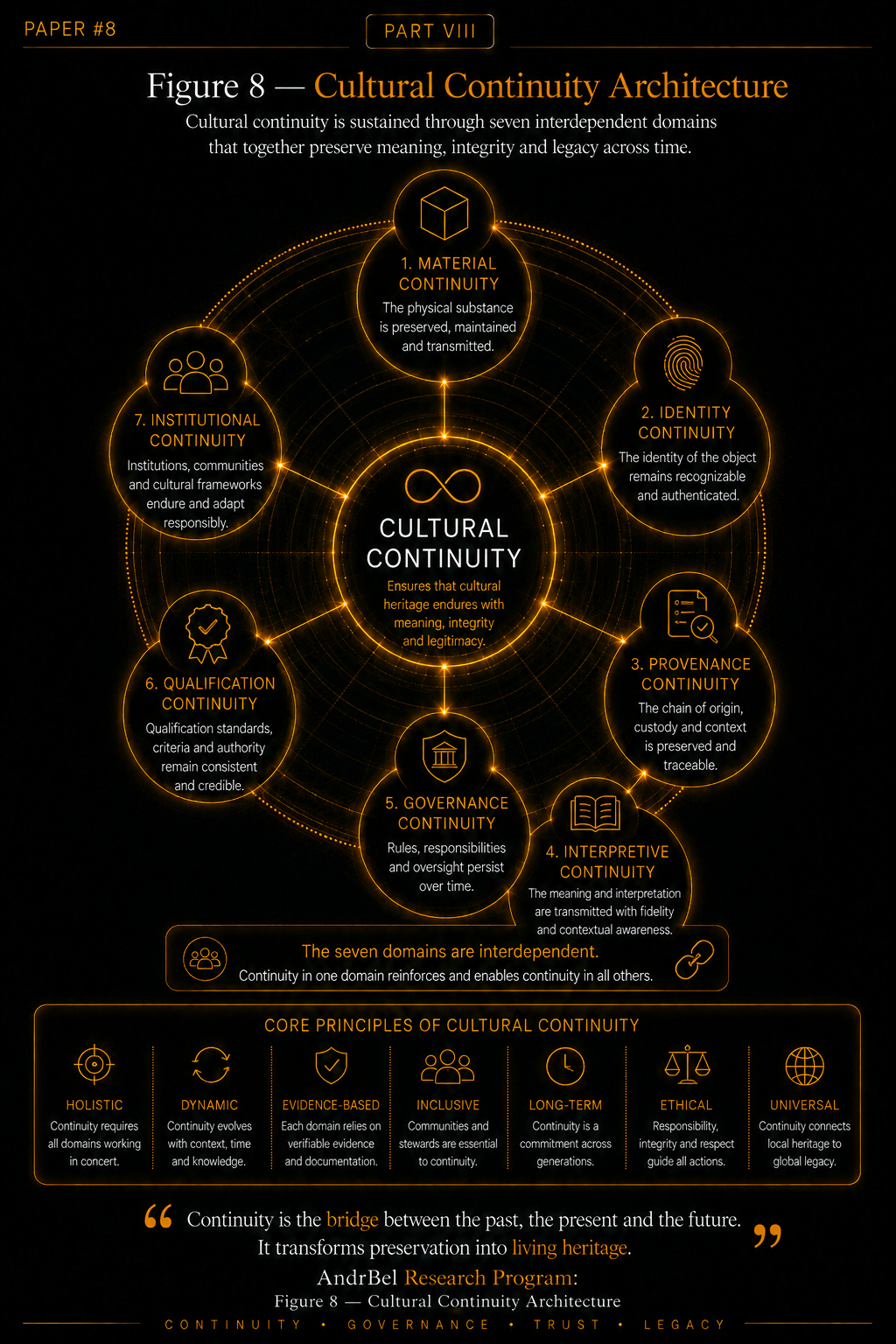
DAP #0A identifies seven principal continuity domains:
Material Continuity
Identity Continuity
Provenance Continuity
Interpretive Continuity
Governance Continuity
Qualification Continuity
Institutional Continuity
Material loss does not necessarily eliminate cultural continuity where the remaining dimensions remain preserved.
Protocol Implication
Lost or destroyed PCOs should remain capable of maintaining historical PCO records and relationships.
10.17 Consolidated Finding 16
Artistic Continuity Infrastructure and CDA Infrastructure Converge Through Governance and Stewardship
Research Finding
DAP #0A establishes a direct bridge between the earlier Artist Legacy / Artistic Continuity research and the emerging CDA architecture.
The governance sequence:
Artist
↓
Successor
↓
Artistic Legacy Representative
↓
Institutional Custodian
can support long-term stewardship of:
- PCO records;
- CDA records;
- provenance;
- relationship records;
- qualification histories;
- interpretive histories.
They intersect.
Protocol Implication
- The Protocol should support transferable governance and custodianship structures compatible with long-term artistic succession and institutional stewardship while avoiding the assumption that this sequence constitutes a universal legal succession rule.
10.18 Consolidated Finding 17
CDA Protocol Can Standardize Cultural Infrastructure Without Standardizing Culture
Research Finding
DAP #0A establishes a clear Standardization Boundary.
CDA Protocol may legitimately standardize:
Terminology
Identity
Qualification Procedure
Evidence Structure
Recognition Records
Recognition Scope
Provenance
Governance
Continuity
Relationships
Versioning
Interoperability
Conformity
It should not standardize:
Artistic Quality
Aesthetic Merit
Universal Cultural Meaning
Cultural Superiority
Cultural Taste
Political Approval
Market Desirability
Therefore:
- The legitimate object of standardization is cultural infrastructure, not culture itself.
- CDA Protocol should explicitly state its Standardization Boundary and keep substantive cultural judgments attributable to the cultural actors that produce them.
10.19 Consolidated Finding 18
Common Standards Are Compatible with Distributed Cultural Authority
Research Finding
The existence of a common international framework does not require centralized cultural decision-making.
The emerging institutional sequence is:
Cultural Recognition Authority
↓
PCO Qualification Authority
↓
Record Custodian
↓
Protocol Conformity Authority
↓
CDA Standards Organization
These roles perform different functions.
CDA Standards Organization therefore governs:
- the standard,
- culture itself.
- The Protocol should formally distinguish Recognition, Qualification, Custodianship, Conformity, and Standards Stewardship and should not make CDA Standards Organization the default object-level cultural qualifier.
10.20 Consolidated Finding 19
Protocol Conformity Is Distinct from Cultural Qualification
Research Finding
- A culturally qualified object and a Protocol-conformant record are not the same thing.
A record may be structurally conformant while future research later challenges the cultural judgment.
Therefore:
Cultural Qualification
≠
Protocol Conformity
and:
Protocol Conformity
≠
Cultural Endorsement
Protocol Implication
10.21 Consolidated Finding 20
The Emerging CDA Architecture Requires Physical, Relational, and Digital Cultural Layers
Research Finding
DAP #0A materially expands the original CDA architecture.
The emerging structure is:
PHYSICAL CULTURAL LAYER
PAO
↓
PCO Candidate
↓
PCO
↕
RELATIONAL CULTURAL LAYER
Relationship
Dependencies
Authorization
Relational Provenance
Governance
↕
DIGITAL CULTURAL LAYER
Digital Object
↓
CDA
The layers are interoperable but independently applicable.
A PCO need not possess CDA.
A CDA need not possess PCO.
The Relational Layer becomes applicable where a meaningful physical–digital relationship exists.
Protocol Implication
The term CDA Candidate remains provisional pending comparative validation, although the functional need for a digital qualification-in-progress state has been established.
10.22 Consolidated Findings Architecture
The twenty findings can be grouped into five major structural families.
A. Physical Cultural Ontology
Finding 1
PAO ≠ PCO
Finding 2
Qualification requires process
Finding 3
Qualification is object-referential
but relationally constituted
B. Cultural Recognition and Qualification
Finding 4
Recognition is distributed
Finding 5
Scope ≠ rank
Finding 6
Plurality and conflict are representable
Finding 7
Market / popularity / territory / law
remain separate
Finding 8
PCO qualification is non-scalar
C. PCO–CDA Ontology and Relationships
Finding 9
PCO and CDA qualify independently
Finding 10
CDA may precede PCO
Finding 11
Influence ≠ inheritance
Finding 12
Relationship is a distinct domain
Finding 13
Relational Provenance is distinct
D. Governance and Continuity
Finding 14
Governance is distributed
Finding 15
Continuity is multidimensional
Finding 16
Artistic Continuity and CDA Infrastructure converge
E. Standardization and Institutional Architecture
Finding 17
Standardize infrastructure, not culture
Finding 18
Common standards + distributed authority
Finding 19
Qualification ≠ conformity
Finding 20
Three-layer CDA architecture
This structure will make later Comparative DAP Analysis significantly easier because findings can be compared by domain rather than only by DAP number.
10.23 Core Findings of Highest Protocol Relevance
Not every finding has equal significance for the future CDA Protocol.
Several should be treated as especially important during Comparative DAP Analysis.
Core Finding A
PCO and CDA are independently qualified cultural object classes.
Core Finding B
A CDA may precede PCO qualification of its related Physical Artistic Object.
Core Finding C
Cultural Recognition is attributable, scoped, plural, and distributed rather than universally centralized.
Core Finding D
PCO qualification is non-scalar and should be accompanied by multidimensional profiles rather than cultural-ranking levels.
Core Finding E
Physical–digital cultural relationships require their own structured records and Relational Provenance.
Core Finding F
Cultural Continuity is multidimensional and requires governance beyond material preservation.
Core Finding G
CDA Protocol should standardize cultural infrastructure without standardizing cultural meaning or superiority.
Core Finding H
CDA Standards Organization should steward the standard rather than function as the default cultural qualification authority.
Core Finding I
The future CDA architecture requires Physical Cultural, Relational Cultural, and Digital Cultural Layers.
These findings should receive particular attention when constructing the Structural Knowledge Matrix.
10.24 Findings That Remain Scope-Bounded
Several findings are strong within DAP #0A but must retain their scope qualification.
Most importantly:
PAO
↓
PCO Candidate
↓
PCO
has been validated primarily for:
- physical artistic objects
Similarly:
- distributed PCO qualification
And:
- PCO Candidate
- CDA Candidate
These limitations should not be removed in later synthesis.
10.25 Protocol Implication Categories
The implications generated by DAP #0A can now be organized into future Protocol domains.
A. TERMINOLOGY
PAO
PCO Candidate
PCO
CDA
Recognition
Qualification
Relationship
Provenance
B. IDENTIFICATION
Object IDs
Record IDs
Relationship IDs
C. QUALIFICATION
Claim
Candidate state
Assessment
Authority
Decision
Status
D. EVIDENCE
Evidence attribution
Evidence provenance
Uncertainty
Conflicting evidence
E. RECOGNITION
Recognizing Entity
Recognition Type
Scope
Status
Conflicts
F. PHYSICAL–DIGITAL RELATIONSHIPS
Relationship Type
Dependencies
Authorization
Relationship Record
G. PROVENANCE
Physical
Digital
Relational
Qualification
H. GOVERNANCE
Authorities
permissions
custodianship
succession
I. CONTINUITY
Material
Identity
Provenance
Interpretive
Governance
Qualification
Institutional
J. CONFORMITY
Protocol Version
Conformity Scope
Conformity Type
K. INSTITUTIONAL BOUNDARIES
Distributed authority
Voluntary adoption
Implementation neutrality
Legal non-substitution
Cultural non-ranking
This is not yet the Protocol table of contents.
It is a research-derived map of standardizable domains.
10.26 From Detailed Findings to Protocol-Ready Findings
The Full DAP #0A Research Record contains a much larger number of detailed findings.
Paper #8 deliberately consolidates them.
The relationship should therefore be:
DAP #0A Full Research Record
Detailed Findings
↓
Paper #8
Consolidated Research Findings
↓
Comparative DAP Analysis
Cross-DAP Validation
↓
Protocol-Ready Findings Register
This prevents the future Protocol from becoming a direct transcription of the working research record.
10.27 Why Consolidation Is Necessary
A detailed research finding may state:
- market price does not determine PCO qualification.
- insurance value does not determine PCO qualification.
- appraisal does not determine PCO qualification.
- Economic Value and PCO Qualification are structurally distinct domains.
The same logic applies across recognition, governance, provenance, and continuity.
10.28 Protocol Implications Are Still Research Outputs
Although Protocol Implications point toward standardization, they remain outputs of the research stage.
Thus:
Protocol Implication
↓
requires
Comparative Validation
before:
Normative Requirement
The future Protocol may:
- adopt;
- narrow;
- split;
- combine;
- reject;
This protects the research methodology from premature normativity.
10.29 Example of Future Normative Translation
For illustration only:
Research Finding
- Economic Value does not establish PCO qualification.
- Economic data should remain structurally separate from PCO Qualification Status.
- Economic value SHALL NOT constitute an independent basis for PCO qualification.
This separation should remain strict.
10.30 Another Translation Example
Research Finding
- Multiple cultural recognitions may legitimately coexist.
- The Protocol should support multiple attributable Recognition Records.
- A conformant PCO record SHALL support multiple attributable Recognition Records.
10.31 Third Translation Example
Research Finding
- CDA may precede PCO qualification.
- A CDA record should be capable of referencing a PAO without requiring prior PCO qualification.
But DAP #0A does not yet prescribe the final implementation syntax.
10.32 Research Integrity Safeguard
The consolidation process produces an important methodological safeguard:
- No conclusion should enter CDA Protocol merely because it appears persuasive in one DAP.
Individual DAP Finding
↓
Cross-DAP Comparison
↓
Structural Pattern
↓
Foundation Finding
↓
Protocol-Ready Finding
↓
Normative Translation
This is especially important for DAP #0A because the study introduces a substantial new physical-cultural layer.
Its importance increases the need for comparative validation rather than reducing it.
10.33 Part X Synthesis
PART X consolidates the extensive research of DAP #0A into twenty principal findings and their corresponding Protocol Implications.
The findings establish an integrated architecture in which:
PAO
↓
PCO Qualification
↓
PCO
↕
Physical–Digital
Relationship
↕
Digital Object
↓
CDA
operates within a larger structure of:
Recognition
Evidence
Scope
Provenance
Governance
Continuity
Conformity
The most important consolidated conclusion is:
- Physical and digital cultural status should be independently qualified, while the cultural relationships connecting physical and digital objects should be explicitly structured, evidenced, governed, versioned, and preserved.
- Cultural qualification can be standardized structurally without centralizing cultural authority or standardizing cultural meaning.
- The emerging CDA architecture therefore requires three interoperable but independently applicable domains: Physical Cultural, Relational Cultural, and Digital Cultural Layers.
- CDA Standards Organization should maintain the common standards architecture through which distributed cultural actors may create interoperable cultural records without transferring their cultural mandates to the standards body itself.
PART XI
Limitations and Future Boundary Research
Defining the Limits of DAP #0A and the Next Research Frontier
Publication Metadata
Research Program: ANDRBEL Research Program
Framework Context: ADAS Framework Series
Research Type: Foundational Ontological Investigation
Protocol Function: Physical–Digital Ontology and Cultural Qualification Foundation
Future Standard Context: CDA Protocol v1.0
Institutional Context: CDA Standards Organization
Publication Position: PAPER #8 (DAP #0A)
Version: 1.0
Citation
Support independent artistic research in Cognitive Structuralism, conceptual painting, and long-term cultural infrastructure development.
[Support Research]
This publication forms part of the Demonstration and Validation Project (DAP) Research Series within the ANDRBEL Research Program.
The DAP Research Series provides the research and validation foundation for the development of the CDA Protocol and the future standards of the CDA Standards Organization.
All research models, validation methodologies, ontological classifications, diagrams, conceptual systems, terminologies, and written materials presented herein form part of the intellectual work of AndrBel.
© AndrBel, 2025–Present. All rights reserved.
For academic reference, citation is permitted with proper attribution.
Commercial implementation, derivative standards, or commercial reuse of the presented research requires prior written permission.