PAPER #8
PAPER #8
Physical Cultural Objects and Cultural Digital Assets
ANDRBEL Research Program
Demonstration and Validation Project (DAP) Research Series
DAP #0A
AndrBel
PAPER #8
Physical Cultural Objects and Cultural Digital Assets
Page 5
Publication Metadata
Research Program: ANDRBEL Research Program
Framework Context: ADAS Framework Series
Research Type: Foundational Ontological Investigation
Protocol Function: Physical–Digital Ontology and Cultural Qualification Foundation
Future Standard Context: CDA Protocol v1.0
Institutional Context: CDA Standards Organization
Publication Position: PAPER #8 (DAP #0A)
Version: 1.0
PART XI
Limitations and Future Boundary Research
Defining the Limits of DAP #0A and the Next Research Frontier
11.1 Purpose of PART XI
DAP #0A has established a substantial physical–digital cultural architecture.
It has defined and investigated:
- Physical Artistic Object (PAO);
- PCO Candidate;
- Physical Cultural Object (PCO);
- Cultural Recognition;
- Recognition Scope;
- PCO Qualification;
- PCO–CDA independence;
- Physical–Digital Relationship Architecture;
- Relational Provenance;
- distributed governance;
- multidimensional cultural continuity;
- the Physical / Relational / Digital Cultural Layers.
This Part therefore identifies:
- the limitations of DAP #0A;
- unresolved questions that remain relevant to CDA Protocol v1.0;
- questions that should not block Protocol v1.0;
- areas appropriate for future Boundary DAP investigations.
Confirmed Finding
=
sufficiently investigated within DAP #0A
Open Question
=
requires further investigation
Protocol-Critical Open Question
=
must be resolved before normative implementation
Future Boundary Case
=
may remain outside CDA Protocol v1.0
and be investigated later
This distinction prevents the future Protocol from converting unresolved research questions into artificial normative certainty.
11.2 DAP #0A Does Not Establish a Universal Theory of All Physical Cultural Objects
The first limitation is scope.
DAP #0A develops PCO theory primarily through:
- physical artistic objects
- paintings;
- sculptures;
- drawings;
- physical installations;
- mixed-media artworks;
- other identifiable physical artistic objects.
Physical Artistic Object
↓
PCO Candidate
↓
Physical Cultural Object
should not yet be generalized to every category of physical cultural heritage.
DAP #0A does not establish that all future PCOs must first be PAOs.
This matters for objects such as:
- archaeological artifacts;
- sacred objects;
- historical objects;
- architectural heritage;
- culturally significant everyday objects;
- natural objects with acquired cultural significance.
11.3 Research Limitation: Conceptual Rather Than Population-Level Empirical Validation
DAP #0A is primarily a:
- structural and conceptual investigation.
- structural decomposition;
- boundary testing;
- independence testing;
- relational analysis;
- temporal analysis;
- authority separation.
- global museums;
- heritage institutions;
- communities;
- states;
- cultural registries.
It does not claim global institutional consensus.
Future consultation and pilot implementation remain necessary.
11.4 Research Limitation: No External Institutional Consensus
The findings of DAP #0A arise within the ANDRBEL Research Program / ADAS / DAP research architecture.
They have not yet been validated through systematic external processes involving:
- museum working groups;
- heritage organizations;
- community authorities;
- standards organizations;
- legal specialists;
- conservation specialists;
- public cultural authorities.
- research maturity should not be confused with institutional adoption.
11.5 Research Limitation: No Final Normative PCO Qualification Threshold
The most important unresolved Protocol-level question concerns the transition:
PCO Candidate
↓
PCO
DAP #0A establishes what a qualification architecture must be capable of considering.
It includes:
- object identity;
- Cultural Relevance;
- Cultural Significance;
- Recognition Records;
- Recognition Scope;
- evidence;
- authority;
- conflicts;
- qualification provenance.
- When is the evidence sufficient?
1 museum
+
2 researchers
+
3 recognition records
Such a numerical threshold would contradict much of the analysis.
Nevertheless, CDA Protocol v1.0 will require an operational decision architecture.
This is therefore a Protocol-critical open question.
11.6 Qualification Threshold Should Not Become a Vote Count
Any later solution must preserve an important DAP #0A finding:
- evidence and recognition are not interchangeable votes.
- evidentiary sufficiency;
- cultural relevance;
- scope appropriateness;
- authority;
- reliability;
- qualification-critical uncertainty.
The open question is therefore not:
- How many recognizers are enough?
- What constitutes a sufficient structured basis for active PCO qualification within a legitimate scope?
11.7 Independent Recognition Requirement
A closely related unresolved issue concerns independence.
Can an artist or estate initiate and complete a PCO qualification without any independent third-party recognition?
DAP #0A establishes that:
- creator evidence is legitimate;
- interested-party evidence is not automatically invalid;
- conflicts of interest should be disclosed.
Possible future models include:
Model A
Independent recognition always required
Model B
Independent recognition required only for certain qualification scopes
Model C
Creator-led qualification permitted,
but independence profile must be explicit
This remains a Protocol-critical question.
11.8 Qualification Authority Eligibility
PART IX established the concept of:
- PCO Qualification Authority
- mandate;
- competence;
- transparency;
- accountability;
- disclosure of relationship to the object.
Open questions include:
- minimum expertise;
- governance requirements;
- institutional independence;
- auditability;
- conflict-of-interest rules;
- whether individuals may qualify;
- whether only institutions may qualify;
- whether community authorities require separate criteria.
11.9 Accreditation Remains Unresolved
DAP #0A does not conclude that CDA Standards Organization should accredit Qualification Authorities.
Possible future institutional models include:
No Accreditation
or:
Optional Recognition / Accreditation
or:
Independent Conformity Bodies
or:
Sector-Specific Qualification Profiles
Premature accreditation could centralize the architecture that DAP #0A deliberately keeps distributed.
Therefore accreditation remains outside the confirmed findings.
11.10 Certification Remains Unresolved
Likewise, DAP #0A does not establish:
- PCO Certification
The current architecture supports:
Qualification
+
Qualification Record
+
Protocol Conformity
Whether a later:
- certificate;
- mark;
- accreditation seal;
Certification should not be assumed merely because a standards organization exists.
11.11 Final Digital Candidate Terminology
DAP #0A established a structural need for a digital transitional state between:
Digital Object
and:
CDA
once formal qualification begins.
The provisional term is:
- CDA Candidate
This is intentionally deferred until DAP #1–#9 can be compared.
The important distinction is:
- The function is supported; the terminology remains provisional.
11.12 PCO Candidate Terminology Is Stronger Than CDA Candidate Terminology
The two candidate categories should therefore not yet be treated as having identical epistemic status.
DAP #0A directly investigates:
PAO
↓
PCO Candidate
↓
PCO
and supports PCO Candidate strongly.
By contrast:
Digital Object
↓
CDA Candidate
↓
CDA
has been inferred as a structurally useful parallel and must still be tested against the previous digital DAP corpus.
This asymmetry should remain visible until Comparative Analysis.
11.13 The Outer Boundary of PCO
A major future research question remains:
- What kinds of physical objects can ultimately qualify as PCO?
- physical artistic objects.
- archaeological material;
- cultural artifacts;
- manuscripts;
- ceremonial objects;
- memorial objects;
- historical scientific objects;
- mass-produced objects;
- buildings;
- monuments.
PCO Core Ontology
+
Object-Type Profiles
rather than one universal precursor model.
11.14 Archaeological Objects
Archaeological objects are a strong future Boundary DAP candidate.
They challenge several assumptions used in artistic-object qualification.
For archaeological material:
- creator may be unknown;
- artistic intention may be irrelevant;
- excavation context may be central;
- state ownership may apply;
- legal restrictions may dominate;
- cultural identity may be collective.
PAO → PCO
cannot simply be imposed.
A future investigation should ask:
- How does PCO qualification operate where archaeological context rather than artistic authorship is qualification-critical?
11.15 Sacred Objects
Sacred objects create a different boundary condition.
Their cultural significance may depend upon:
- ritual use;
- restricted knowledge;
- sacred authority;
- community control;
- prohibited public access.
- Can an external institution initiate qualification?
- Must community consent exist?
- Can qualification records contain restricted fields?
- Can public interoperability itself be culturally inappropriate?
11.16 Indigenous Cultural Authority
Indigenous cultural governance requires particular caution.
DAP #0A recognizes Community Recognition but does not establish that indigenous authority can be reduced to a generic community category.
Open questions include:
- customary authority;
- collective governance;
- community consent;
- knowledge restrictions;
- culturally specific ownership;
- culturally restricted metadata;
- conflict between state law and indigenous authority.
- Indigenous Cultural Authority requires dedicated research and should not be normalized through assumptions derived from museum or market systems.
11.17 Contested Heritage
Some cultural objects are claimed simultaneously by multiple:
- communities;
- museums;
- states;
- descendants;
- former colonial powers;
- religious institutions.
- multiple claims;
- conflict;
- provenance;
- scope.
This is intentional.
A future Boundary DAP should investigate:
- How can CDA Protocol represent contested heritage without transforming itself into a tribunal for sovereignty, ownership, or restitution disputes?
11.18 Inter-State Cultural Conflicts
A particular contested-heritage case involves competing national claims.
For example:
Country A
claims national cultural significance
Country B
claims national cultural significance
DAP #0A permits plural affiliation.
But if both claims assert exclusivity, the issue becomes more complex.
The Protocol may need to represent:
Claim A
+
Claim B
+
Conflict Status
without resolving geopolitical disputes itself.
The operational structure remains open.
11.19 Restitution
Restitution is related to provenance and contested heritage but is not equivalent to either.
Questions may concern:
- colonial acquisition;
- theft;
- forced transfer;
- wartime displacement;
- illegal excavation;
- community claims.
- provenance;
- dispute records;
- ownership claims;
- recognition.
- whether the object should legally or ethically be returned.
- PCO Qualification must not be interpreted as resolving restitution.
11.20 Cultural Ownership
DAP #0A rejects:
Cultural Recognition
=
Cultural Ownership
But it does not fully define cultural ownership as a separate concept.
Future research may need to distinguish:
- property ownership;
- cultural stewardship;
- symbolic cultural claim;
- collective cultural rights;
- legal title.
11.21 Anonymous Works
Another future boundary concerns anonymous artistic objects.
The current architecture assumes that authorship may be uncertain, but much of the PAO model still derives naturally from artistic practice.
An anonymous object raises questions such as:
- who provides authorial context;
- who can define series membership;
- how is artistic intention treated;
- what governance replaces artist-centered authority?
But this should be tested directly rather than merely assumed.
11.22 Disputed Attribution
Anonymous objects should also be distinguished from:
- disputed attribution.
Artist A
Workshop of Artist A
Artist B
Unknown
If attribution is qualification-critical, a dispute may affect PCO status.
If historical significance is independent of authorship, it may not.
Future implementation requires object-specific treatment of attribution criticality.
11.23 Collective Authorship
Collective artistic creation also challenges the individual-artist governance model.
Potential creators include:
- artist collectives;
- workshops;
- anonymous groups;
- communities;
- collaborative institutions.
- who speaks for the collective;
- how authority survives dissolution;
- how succession works;
- how conflicting member claims are represented.
11.24 Unauthorized Digital Derivatives
PART VII established authorization as a relationship attribute.
But DAP #0A does not answer:
- Can an unauthorized derivative qualify independently as CDA?
- appropriation;
- transformative art;
- unauthorized documentary use;
- research use;
- illegal reproduction that later acquires cultural significance.
Unauthorized
=
Not CDA
because:
- legal legitimacy;
- cultural significance;
- authorship;
- provenance;
This is an important future Boundary DAP.
11.25 Illicit but Culturally Significant Digital Objects
A more difficult case arises where an object is legally problematic but historically significant.
For example, an unauthorized digital archive might later become important evidence of cultural history.
DAP #0A establishes:
Cultural Qualification
≠
Legal Status
But the limits of that principle need dedicated testing.
The Protocol should not accidentally appear to legitimize unlawful activity merely because cultural significance exists.
11.26 AI-Generated Cultural Objects
DAP #0A deliberately does not resolve the central AI questions.
These are reserved for DAP #8.
The planned investigation includes:
- AI-generated digital images;
- artist prompting;
- iterative creation;
- creative contribution;
- authorship;
- originality;
- governance;
- CDA qualification.
11.27 AI Physical–Digital Artworks
DAP #9 will test another boundary:
AI-generated digital object
↓
physical materialization
Questions include:
- what is the original;
- whether the physical object is PAO;
- whether both qualify independently;
- whether the relationship is Derived, Parallel, or Hybrid;
- whether a Composite Cultural System emerges.
DAP #9 must test its limits.
11.28 Autonomous Creative Systems
A future research case goes beyond human prompting.
An autonomous system may:
- generate outputs continuously;
- select without human intervention;
- evolve over time.
- creator;
- authorship;
- qualification authority;
- object boundaries;
- continuity.
It is likely a separate future Boundary DAP.
11.29 Hybrid and Composite Cultural Systems
PART VII supports:
- Hybrid Relationship
- Composite Cultural System
The unresolved question is:
PCO
+
CDA
+
Integrated Operation
=
only relationship architecture?
or:
=
new higher-order cultural object?
DAP #9 is likely the appropriate first test.
Until then, Composite Cultural System should remain a research hypothesis.
11.30 Qualification of Composite Systems
If a PCO and CDA are each qualified independently, should an integrated hybrid system require:
- another qualification?
Model A
PCO + CDA + Relationship Record
is sufficient
or:
Model B
Integrated system requires
Composite Qualification
DAP #0A does not resolve this.
This should remain outside CDA Protocol v1.0 unless DAP #9 produces sufficiently clear findings.
11.31 Mass-Produced Cultural Objects
DAP #0A established that scarcity is not required for cultural qualification.
Therefore mass production cannot automatically exclude PCO status.
But difficult questions remain.
If a culturally important poster exists in one million copies:
- Is every copy PCO?
- Is the design itself the cultural object?
- Is one representative physical specimen qualified?
- Is the edition or production run the relevant corpus?
11.32 Physical Editions
Similar questions apply to sculpture editions and other physically repeated works.
For example:
Edition 1/10
Edition 2/10
...
Edition 10/10
If the edition is culturally significant:
- are all objects PCO?
- does each require separate qualification?
- can one have different provenance and status?
The final qualification architecture requires additional research.
11.33 Reproductions as Independent Cultural Objects
A physical reproduction may itself acquire cultural significance.
Examples may include:
- historic poster;
- exhibition reproduction;
- politically significant print.
Reproduction
≠
Automatically Non-PCO
The open question is:
- Under what conditions does a reproduction acquire independent cultural objecthood rather than remain solely representation of another object?
11.34 Reconstructions
Lost physical works may later be reconstructed from:
- artist instructions;
- photographs;
- archival records.
- same identity or new PAO;
- inherited PCO status or new qualification;
- relationship to original object;
- reconstruction provenance.
Dedicated testing remains necessary.
11.35 Posthumous Production
Related cases include:
- posthumous casts;
- posthumous editions;
- estate-completed works.
- authorship;
- creation event;
- originality;
- governance;
- corpus membership.
11.36 Evolving Physical Objects
Some artworks change continuously.
Examples include:
- kinetic works;
- biological works;
- environmental installations;
- computational physical systems.
- What is the persistent physical cultural object?
- material substrate;
- system;
- instructions;
- changing state sequence;
- entire lifecycle.
11.37 Performance and Ephemeral Art
Performance art does not fit naturally into:
- Physical Artistic Object
- props;
- costumes;
- recordings;
- instructions;
- documentation.
- Which elements, if any, are PCO?
11.38 Living Biological Cultural Objects
Bio-art introduces even more complex continuity questions.
A cultural object may:
- grow;
- reproduce;
- die;
- mutate.
This domain likely requires a specialist Boundary DAP.
11.39 Natural Objects Acquiring Cultural Significance
DAP #0A starts from artistic objects.
But a natural object may later acquire cultural significance through:
- ritual use;
- historical association;
- artistic incorporation.
This remains open.
11.40 Conservation and Identity Threshold
PART VIII establishes that material change does not automatically destroy identity.
But no universal answer exists to:
- how much material change is too much?
10% replaced
50% replaced
90% replaced
cannot serve as universal identity thresholds.
Conservation identity is medium- and practice-dependent.
Therefore this remains an expert-domain question rather than a core universal rule.
11.41 Destruction and Re-Creation
Suppose a PCO is destroyed and later recreated.
Is the recreation:
the same PCO;
a new PAO;
a reconstruction linked to a historical PCO?
DAP #0A supports persistent historical identity for the lost original, making silent identity transfer problematic.
However, the exact reconstruction model remains open.
11.42 Qualification of Lost Objects
A particularly important question is:
- Can an object first receive PCO qualification after it has already been lost or destroyed?
Artwork destroyed in 1950
↓
later research establishes
major historical significance
What is being qualified?
- the historical physical object;
- its documented identity;
- its surviving documentation?
11.43 Objects Known Only Through Documentation
A related case concerns physical works known only through:
- photographs;
- descriptions;
- archival records.
Or should only the documentation itself be qualified separately?
This requires further investigation.
11.44 Public Cultural Recognition Methodology
DAP #0A establishes Public Cultural Recognition as legitimate.
But it does not define a universal methodology for proving it.
Possible evidence may include:
- educational use;
- public memory;
- archival media;
- long-term symbolic association.
1 million views
=
Public Cultural Recognition
Implementation guidance may eventually need context-specific methodologies.
11.45 Internet-Native Cultural Recognition
Public cultural recognition may now emerge primarily through online environments.
This creates new questions concerning:
- algorithmic amplification;
- platform migration;
- meme culture;
- anonymous communities;
- short-term virality;
- long-term digital memory.
11.46 Market Manipulation
Economic value remains separate from cultural qualification.
But market evidence may sometimes become historically relevant.
If market activity is manipulated, how should the system distinguish:
- real historical market significance;
- artificial price movement;
- related-party sales;
- speculative manipulation?
11.47 Cultural Significance Taxonomy Remains Extensible
DAP #0A identifies significance domains including:
- artistic;
- historical;
- research;
- institutional;
- community;
- territorial;
- symbolic;
- educational.
Therefore:
- Cultural Significance taxonomy should remain extensible until broader DAP comparison is complete.
11.48 Cross-Domain Weighting
Another unresolved issue concerns cases where significance is strong in one domain but weak in another.
For example:
Community Significance:
Very strong
Museum Recognition:
None
Market Recognition:
None
Should this be sufficient for PCO qualification?
DAP #0A rejects universal weighted scoring.
The likely solution must be based on:
- sufficient cultural basis within a legitimate scope.
This connects directly to the qualification threshold question.
11.49 Federated Registry Architecture
DAP #0A supports interoperability rather than one mandatory global registry.
But a federated system creates technical questions:
- duplicate records;
- identifier resolution;
- conflicting qualification records;
- synchronization;
- registry discovery.
11.50 Canonical Object Identity
If several systems create records for the same physical object:
- How is identity equivalence established?
- persistent identifiers;
- identity mappings;
- authoritative references;
- reconciliation procedures.
11.51 Record Merge and Split
Technical implementation must eventually support cases where:
- two records are found to represent one object;
- one record is found to represent several distinct objects.
Merge
Split
Supersession
Identity Resolution
These are future technical specification questions.
11.52 Long-Term Custodian Failure
PART VIII establishes governance succession.
But what happens when:
- artist is gone;
- estate is gone;
- ALR is gone;
- institutional custodian fails?
- fallback custodian;
- distributed archival replication;
- emergency transfer.
The operational fallback architecture remains open.
11.53 Minimum Continuity Requirements
DAP #0A defines seven continuity dimensions.
It does not establish which are mandatory for active Protocol conformity.
For example:
Governance Continuity:
Unknown
may or may not prevent full conformity.
The final minimum continuity conditions belong to Protocol design.
This is another potentially Protocol-critical question.
11.54 Continuity Risk Assessment
A Continuity Profile may reveal risks such as:
- no successor;
- obsolete format;
- disputed provenance;
- unstable custodian.
- Continuity Risk Assessment
- qualitative;
- categorical;
- numeric.
11.55 Interpretive Authority After Artist Death
DAP #0A preserves plural interpretations.
But posthumous governance raises difficult questions:
- who may interpret unfinished work;
- who may redefine series;
- what weight belongs to artist statements;
- how later scholarship may challenge estate interpretations.
11.56 Governance Authority Conflicts
The Artist → Successor → ALR → Institutional Custodian sequence provides continuity architecture.
But conflict may arise among legitimate actors.
For example:
Successor:
Decision A
ALR:
Decision B
Museum:
Decision C
DAP #0A supports preserving authority and conflict provenance.
It does not establish a universal hierarchy resolving every such dispute.
Some conflicts must remain external legal or institutional matters.
11.57 Sensitive Cultural Data
Interoperability should not imply universal public disclosure.
Cultural records may contain:
- private ownership;
- security-sensitive location;
- sacred information;
- restricted community knowledge;
- personal data.
Record Existence
≠
Universal Public Access
Access governance remains an important technical and ethical question.
11.58 Historical Integrity vs Required Removal or Correction
DAP #0A supports append-preserving record history.
But legal or ethical obligations may sometimes require:
- privacy protection;
- restricted access;
- correction;
- removal from public display.
Historical Traceability
with:
Legal / Ethical Data Governance
This requires later legal and technical work.
11.59 Interoperability with Existing Cultural Standards
Paper #8 develops an internal PCO/CDA architecture.
Before normative adoption, it should be compared with relevant existing domains such as:
- museum documentation;
- archival standards;
- heritage registries;
- provenance systems;
- cultural-property vocabularies;
- persistent identifier systems.
It should be:
- mapping and interoperability where possible.
11.60 International Legal Compatibility
The same applies to law.
DAP #0A establishes:
- legal non-substitution.
Future review may need to consider:
- cultural-property law;
- heritage law;
- intellectual property;
- privacy;
- export restrictions;
- data governance.
11.61 Core vs Extension Profiles
The unresolved boundary cases suggest that CDA Protocol may need:
CORE
+
EXTENSION PROFILES
The Core might contain universal structural principles such as:
- identity;
- qualification provenance;
- attribution;
- versioning;
- governance;
- relationship records.
- archaeological objects;
- community-governed culture;
- contested heritage;
- hybrid systems.
11.62 Protocol-Critical Questions Before CDA Protocol v1.0
Not every open question needs to be resolved before Protocol v1.0.
However, several appear directly relevant to the Core.
At minimum:
1. PCO Qualification Threshold
2. Independent Recognition Requirement
3. Qualification Authority Eligibility
4. Final Digital Candidate Terminology
5. Core vs Extension Profile Architecture
6. Minimum Conformity Requirements
7. Minimum Continuity Requirements
8. Federated Identity / Record Architecture
These should receive priority during:
- DAP #8;
- DAP #9 where relevant;
- Comparative DAP Analysis;
- SKM;
- AFM v2.0;
- AFF;
- Protocol-Ready Findings Register.
11.63 Non-Blocking Future Boundary Research
Other questions may remain explicitly outside CDA Protocol v1.0.
Examples include:
- archaeological objects;
- sacred objects;
- indigenous authority;
- restitution;
- contested heritage;
- autonomous creative systems;
- mass-produced cultural objects;
- biological cultural objects.
It needs to define:
- a coherent core and its boundaries.
11.64 Proposed Future Boundary DAP Families
The open questions can be organized into several future research families.
Family A — Cultural Authority Boundary Cases
Possible subjects:
- Indigenous Cultural Authority;
- Sacred Objects;
- Contested Heritage;
- Inter-State Recognition Conflicts;
- Restitution.
Possible subjects:
- Anonymous Works;
- Disputed Attribution;
- Collective Authorship;
- AI Authorship;
- Autonomous Creative Systems.
Possible subjects:
- Archaeological Objects;
- Mass-Produced Cultural Objects;
- Physical Editions;
- Reconstructions;
- Ephemeral Works;
- Living Biological Works.
Possible subjects:
- Unauthorized Derivatives;
- AI-Generated Digital Objects;
- AI Physical–Digital Artworks;
- Hybrid Cultural Systems;
- Composite Qualification.
Possible subjects:
- Custodian Failure;
- Succession Conflicts;
- Posthumous Authority;
- Sensitive Cultural Data;
- Long-Term Registry Migration.
11.65 DAP #8 as the Immediate Boundary Test
The next planned investigation:
- DAP #8 — AI-Generated Digital Image Created Through Artist Prompting
Most importantly:
- creator identity;
- authorship;
- creative contribution;
- digital qualification;
- born-digital CDA;
- governance;
- provenance.
11.66 DAP #9 as the Physical–Digital Stress Test
DAP #9 will then examine:
- AI-Generated Physical–Digital Artwork
- originality;
- physical materialization;
- PAO qualification;
- CDA qualification;
- Derived / Parallel / Hybrid relationships;
- Composite Cultural System hypothesis.
11.67 Not Every Open Question Should Become a New DAP
Future research must also remain disciplined.
An unresolved implementation detail does not automatically require its own DAP.
For example:
- field naming;
- JSON serialization;
- interface design;
Boundary DAPs should be reserved for questions that materially test:
- ontology;
- qualification;
- authorship;
- authority;
- governance;
- continuity;
- relationship architecture.
11.68 Boundary DAP Selection Principle
A future Boundary DAP should therefore be justified where:
- an unresolved case may materially alter or invalidate a structural assumption of the existing CDA / PCO architecture.
- Can an unauthorized derivative become CDA?
- Can a sacred object be qualified without community consent?
- Can a physical–digital hybrid become one composite cultural object?
These are genuine boundary questions.
11.69 Open Questions Register
The Full DAP #0A Research Record contains a much larger set of individual open questions.
For publication, Paper #8 consolidates them into research families.
The detailed questions should remain preserved separately as:
- Appendix C — Open Questions and Boundary Cases Register
Open Question ID
Research Domain
Question
Reason Unresolved
Affected Protocol Domain
v1.0 Criticality
Required Research
Boundary DAP Candidate
This preserves research depth without overloading the main paper.
11.70 Protocol-Criticality Classification
During Comparative Analysis, each open question should be classified as:
BLOCKING
must be resolved for CDA Protocol v1.0
NON-BLOCKING
can remain explicitly out of scope
EXTENSION
requires later Protocol profile
BOUNDARY RESEARCH
requires future DAP
This classification should not be performed arbitrarily inside Paper #8.
PART XI identifies likely categories.
The final decision belongs to comparative synthesis.
11.71 Research Limitations Should Remain Visible After Protocol Publication
If CDA Protocol v1.0 is later published, unresolved areas should not disappear from institutional memory.
The standards lifecycle should preserve:
- known limitations;
- unresolved cases;
- deferred research;
- version boundaries.
11.72 Explicit Scope Is a Strength, Not a Weakness
A standards-oriented research paper may be tempted to present its framework as universally applicable.
DAP #0A takes the opposite position.
The framework becomes stronger by saying:
- this is what has been investigated; this is what remains open.
11.73 Research Principle: Unresolved Does Not Mean Negative
An unresolved case should not be represented as:
Not Qualifiable
unless the research establishes that conclusion.
Instead:
Not Yet Resolved
must remain a legitimate research condition.
This follows the broader epistemic architecture developed throughout DAP #0A.
11.74 Research Principle: Absence of Protocol Coverage Is Not Absence of Cultural Significance
Similarly, an object outside the current PCO scope should not be interpreted as:
For example, if CDA Protocol v1.0 does not cover sacred objects, this means only:
- the current standards architecture has not yet been validated for that domain.
Not a cultural judgment.
11.75 Research Principle: Future Versions May Legitimately Expand the Ontology
The PCO architecture should therefore remain extensible.
Future research may discover:
- new precursor categories;
- new relationship types;
- new governance models;
- new cultural-object classes.
Research
↓
Validation
↓
Versioned Extension
rather than silent reinterpretation of earlier Protocol versions.
11.76 Part XI Synthesis
PART XI defines the limits of DAP #0A and establishes the research frontier beyond Paper #8.
The study has established a coherent framework for:
Physical Artistic Object
↓
PCO Qualification
↓
Physical Cultural Object
↕
Physical–Digital Relationship
↕
Cultural Digital Asset
within a larger infrastructure of:
Recognition
Evidence
Scope
Provenance
Governance
Continuity
But the study does not claim complete coverage of all cultural-object domains.
Several unresolved issues remain directly relevant to CDA Protocol v1.0, particularly:
PCO Qualification Threshold
Independent Recognition Requirement
Qualification Authority Eligibility
Digital Candidate Terminology
Core vs Extension Architecture
Conformity Minimum
Continuity Minimum
Federated Identity Architecture
Other questions should instead become future Boundary DAPs, including:
Contested Heritage
Indigenous Cultural Authority
Sacred Objects
Archaeological Objects
Restitution
Anonymous / Collective Authorship
Unauthorized Derivatives
Mass-Produced Cultural Objects
Hybrid / Composite Systems
Autonomous Creative Systems
The central methodological conclusion is:
- A standard should be defined not only by the questions it answers, but also by the questions it explicitly recognizes as unresolved.
- CDA Protocol v1.0 does not need to resolve every possible cultural-object case; it needs a coherent and validated core capable of identifying its own limits and supporting future research-driven extensions.
- Unresolved cultural complexity should remain visible as an open research condition rather than being converted into normative certainty merely to complete a standards document.
what the research establishes
and:
where its claims stop
PART XII
Final Research Conclusion
Toward a Relational Physical–Digital Cultural Infrastructure
12.1 Returning to the Central Research Question
DAP #0A began with a foundational question:
- What is the relationship between a Physical Cultural Object and a Cultural Digital Asset, and where does cultural status structurally emerge?
Previous investigations had progressively examined Cultural Digital Assets and the conditions under which different digital objects might acquire structured cultural qualification.
However, where a digital object related to a physical artwork, one assumption remained insufficiently examined:
- What is the cultural status of the physical object itself?
The investigation therefore moved from a digital-cultural problem into a broader physical–digital cultural ontology.
Its principal conclusion is:
- Physical and digital cultural status should be independently qualified, while the relationships connecting physical and digital cultural objects should be explicitly structured, evidenced, governed, versioned, and preserved.
12.2 The First Structural Result: Artwork and Cultural Object Are Not Synonymous
The first problem concerned physical artistic existence.
DAP #0A establishes that:
Physical Artistic Object (PAO)
≠
Physical Cultural Object (PCO)
A physical object may fully exist as an artwork before any formal cultural qualification process occurs.
The physical-artistic pathway developed in this study is therefore:
Physical Object
↓
Physical Artistic Object (PAO)
↓
PCO Candidate
↓
PCO Qualification
↓
Physical Cultural Object (PCO)
Within the validated scope of Paper #8, this pathway applies primarily to physical artistic objects.
It should not yet be interpreted as the universal ontology of all forms of physical cultural heritage.
This distinction is fundamental.
If every artwork were automatically a PCO, PCO would add no structural information beyond the category of artwork itself.
12.3 The Meaning of PCO Qualification
DAP #0A does not define PCO as:
- a famous artwork;
- an expensive artwork;
- a museum masterpiece;
- a legally protected heritage object;
- an artwork approved by a central standards organization.
A Physical Cultural Object is therefore understood as an identifiable physical object whose qualification is supported through an attributable architecture involving:
Object Identity
+
Cultural Relevance
+
Cultural Significance
+
Cultural Recognition
+
Evidence
+
Recognition Scope
+
Qualification Authority
+
Qualification Decision
+
Persistent Record
The transition from PAO to PCO is therefore not primarily a material transformation.
The material object may remain physically unchanged.
What changes is its qualified cultural and institutional legibility.
12.4 Where Cultural Status Structurally Emerges
The investigation does not support the proposition that cultural status exists solely as an intrinsic physical property of an object.
Nor does it support the opposite proposition that cultural status is entirely external to the object.
Instead, the research establishes:
- Cultural qualification is object-referential but relationally constituted.
But its qualification is made intelligible through relationships involving:
- cultural context;
- evidence;
- recognition;
- authority;
- provenance;
- governance;
- continuity.
Nor is it reducible to institutional declaration alone.
It emerges structurally through an identifiable object's participation in an attributable cultural system.
12.5 Recognition Is Distributed Rather Than Universal
DAP #0A also rejects the assumption that one institution must possess universal authority to determine cultural significance.
Cultural Recognition may originate from:
- artists;
- museums;
- curators;
- researchers;
- archives;
- galleries;
- communities;
- public institutions;
- territorial authorities;
- states;
- other legitimate cultural actors.
Recognizing Entity
+
Mandate
+
Claim
+
Scope
+
Evidence
+
Time
rather than prestige alone.
The central principle is therefore:
Cultural authority is distributed and mandate-specific.
This does not imply that every cultural claim is equally strong.
It means that claims must remain attributable and assessable according to their actual authority and scope.
12.6 Recognition Scope Prevents False Universality
The research further establishes that the statement:
- “This object is culturally recognized.”
Recognition may exist at:
- Object-Level;
- Series-Level;
- Corpus-Level;
- Practice-Level;
- Institutional;
- Community;
- Local;
- Regional;
- National;
- Transnational;
- International;
- Legal scopes.
They do not form a universal ladder of cultural worth.
Therefore:
- scope breadth is not cultural rank.
This conclusion is essential if a future standard is to remain internationally usable without reproducing a cultural prestige hierarchy.
12.7 Cultural Plurality Must Be Preserved
DAP #0A also establishes that several Recognition Records may coexist.
A museum may recognize an object.
Another institution may not.
A community may assign major significance to it.
Research may remain disputed.
These conditions are not inherently incompatible.
The framework therefore distinguishes:
- Scope Difference;
- Interpretive Difference;
- Evidentiary Conflict;
- Authority Conflict;
- Qualification-Critical Conflict.
- A cultural infrastructure should structure disagreement rather than manufacture artificial consensus.
Structural interoperability does not require interpretive uniformity.
12.8 Economic Value, Popularity, Territory, and Law Remain Separate
The investigation also resolves several common category errors.
It establishes that:
Cultural Significance
≠
Economic Value
and:
Public Cultural Recognition
≠
Popularity
and:
Cultural Affiliation
≠
Nationality
and:
PCO Qualification
≠
Legal Heritage Designation
Market value, media attention, cultural geography, and legal status may all become relevant contextual evidence.
But none independently creates PCO qualification.
This preserves the physical cultural framework from becoming:
- a market ranking;
- a popularity index;
- a nationality classification;
- an imitation of state heritage law.
12.9 PCO Qualification Is Non-Scalar
DAP #0A further rejects a universal linear hierarchy such as:
PCO Level 1
↓
PCO Level 2
↓
PCO Level 3
The reason is structural.
Two objects may differ independently across:
- Cultural Significance;
- Recognition;
- Scope;
- Provenance;
- Public Recognition;
- Economic Context;
- Governance;
- Continuity.
The resulting architecture is:
PCO Qualification
=
non-scalar
PCO Cultural Profile
=
multidimensional
PCO Lifecycle
=
multi-state
This allows the standard to describe cultural complexity without ranking cultural superiority.
12.10 The Central PCO–CDA Ontological Result
The original DAP #0A problem becomes fully visible at the physical–digital boundary.
The research concludes:
- PCO and CDA are independently qualified cultural object classes.
PCO Qualification
≠
CDA Qualification
and neither status automatically transfers to the other.
The following states are all valid:
PAO
PCO
PAO ↔ CDA
PCO ↔ CDA
CDA without physical object
This resolves the physical–digital dependency problem at the ontological level.
12.11 PCO Does Not Automatically Produce CDA
A culturally qualified physical object may have many digital representations.
These may include:
- photographs;
- scans;
- documentation files;
- thumbnails;
- conservation images;
- digital editions.
But:
- representation of a PCO does not automatically create a CDA.
This preserves the analytical meaning of CDA.
12.12 CDA Does Not Automatically Produce PCO
The reverse is equally important.
A digital object may become CDA in relation to a physical artwork.
That does not automatically transform the physical object into a PCO.
Thus:
PAO
+
related CDA
≠
automatic PCO
Without this principle, digital qualification could be used to bypass the entire physical qualification architecture developed in PART V.
DAP #0A rejects such automatic propagation.
12.13 The Foundational Asymmetry: CDA May Precede PCO
One of the most important findings of the entire study is:
- A CDA may legitimately be qualified before its related Physical Artistic Object receives PCO qualification.
PAO
↓
related Digital Object
↓
CDA Qualification
↓
CDA
↓
later PCO assessment
↓
PCO
is structurally valid.
This occurs because physical and digital cultural development may follow different institutional chronologies.
A digital object may enter:
- research;
- archives;
- educational systems;
- digital exhibitions;
- provenance infrastructure;
- institutional governance;
This does not represent an error in cultural order.
It represents qualification autonomy across domains.
12.14 Reciprocal Influence Without Qualification Transfer
Although qualification remains independent, physical and digital objects may influence one another.
A PCO may support a CDA through:
- source provenance;
- cultural context;
- recognition;
- institutional significance.
- documentation;
- research;
- discoverability;
- provenance visibility;
- continuity;
- new institutional relationships.
- reciprocal cultural influence without automatic qualification inheritance.
Influence
≠
Inheritance
This distinction is one of the central theoretical contributions of DAP #0A.
12.15 From Object Ontology to Relationship Ontology
Independent qualification creates the need for an explicit relationship architecture.
A simple statement such as:
PCO ID
+
CDA ID
is insufficient.
It does not explain:
- why they are related;
- how the relationship originated;
- whether it is authorized;
- what one object depends upon in the other;
- whether the relationship is disputed;
- how it changes through time.
- Relational Cultural Layer
12.16 The Relational Cultural Layer
The relationship architecture supports at least five principal relationship types:
- Representational;
- Derived;
- Parallel;
- Reciprocal;
- Hybrid.
- Source Relationship;
- Cultural Dependency;
- Qualification Dependency;
- Governance Dependency.
For example:
Strong Source Relationship
may coexist with:
Low Qualification Dependency
Thus physical–digital relationship architecture must remain multidimensional.
12.17 The PCO–CDA Relationship Record
A major structural consequence follows.
Where a meaningful physical–digital cultural relationship exists, that relationship should possess an explicit record capable of preserving:
Relationship Identity
Relationship Type
Physical Endpoint
Digital Endpoint
Source Relationship
Dependencies
Authorization
Evidence
Status
Governance
Version History
The relationship itself is not a third cultural object class.
It is a separately structured cultural-infrastructure entity.
This distinction allows object identity and relationship identity to evolve independently.
12.18 Relational Provenance
The relationship architecture produces one of the study's most important new provenance concepts:
- Relational Provenance
- how a particular physical object and digital object became related, through which events, evidence, authorization, institutions, and subsequent changes.
DAP #0A therefore establishes four provenance domains:
Physical Provenance
Digital Provenance
Relational Provenance
Qualification Provenance
Together they produce a more complete cultural history.
12.19 Provenance Becomes Multidimensional
Physical Provenance asks:
- What happened to the physical object?
- What happened to the digital object?
- How did the two become related?
- How did the present cultural qualification arise?
Their separation substantially strengthens the traceability of future physical–digital cultural infrastructure.
12.20 Governance Is Not Ownership
The study also establishes that long-term cultural infrastructure cannot be governed through ownership alone.
Owning an object does not automatically create authority to:
- rewrite attribution;
- modify external Recognition Records;
- withdraw another institution's recognition;
- alter Qualification Provenance;
- control every related CDA.
- distributed and action-specific.
- Who may perform which action, under what mandate, and with what accountability?
12.21 Distributed Governance
Relevant actors may include:
- Artist;
- Successor;
- Artistic Legacy Representative;
- Institutional Custodian;
- Museum;
- Archive;
- Research Institution;
- Registry;
- Community Authority;
- State Authority.
- evidence;
- attribution;
- recognition;
- qualification;
- provenance;
- custodianship;
- relationship records.
It is a structured distribution of responsibilities.
12.22 The Bridge to Artistic Continuity Infrastructure
This is where DAP #0A intersects directly with earlier Artist Legacy Infrastructure and Artistic Continuity Infrastructure research.
The continuity sequence:
Artist
↓
Successor
↓
Artistic Legacy Representative
↓
Institutional Custodian
was developed to address the long-term survival of artistic practice and governance beyond the artist.
DAP #0A demonstrates that the same continuity logic can extend to:
- PCO records;
- CDA records;
- relationship records;
- Qualification Provenance;
- cultural interpretation;
- institutional stewardship.
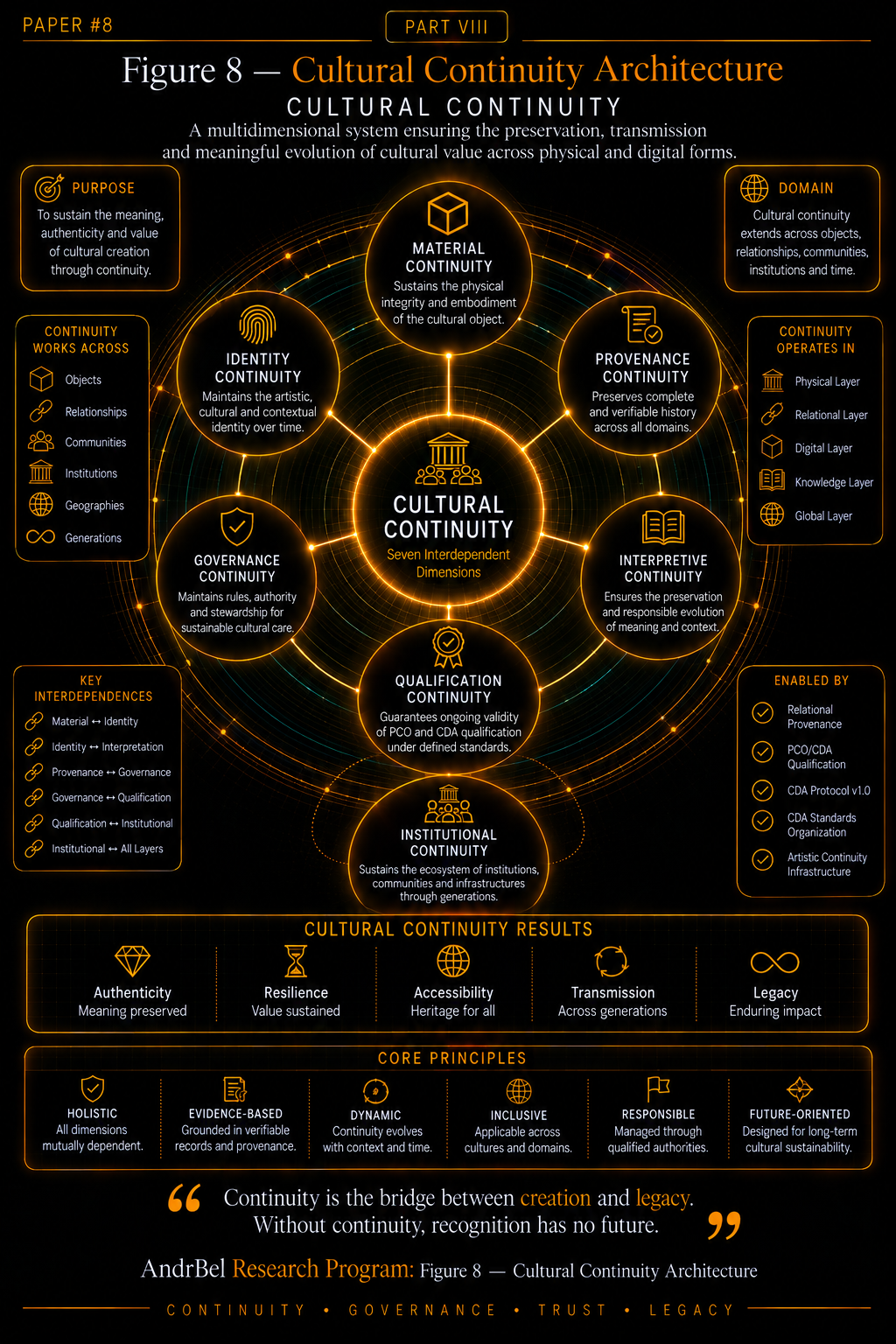
12.23 Cultural Continuity Is a System Property
The study identifies seven principal continuity domains:
Material Continuity
Identity Continuity
Provenance Continuity
Interpretive Continuity
Governance Continuity
Qualification Continuity
Institutional Continuity
This leads to another major conclusion:
- Cultural Continuity is a system property rather than a single material condition.
- identity is lost;
- provenance disappears;
- interpretation becomes inaccessible;
- governance collapses.
- documentation;
- identity;
- provenance;
- qualification records;
- research;
- related CDA.
Material Survival
≠
Complete Cultural Continuity
12.24 Cultural Continuity Can Survive Material Loss
This result is especially significant.
If a PCO is destroyed, its:
- Material Continuity
But:
- Identity Continuity;
- Provenance Continuity;
- Interpretive Continuity;
- Qualification Continuity;
- Institutional Continuity;
A related CDA may support that persistence.
The CDA does not become the destroyed PCO.
Instead, it may preserve dimensions of the PCO's cultural continuity.
This further demonstrates why physical and digital identity must remain distinct even where continuity becomes reciprocal.
12.25 The Standardization Boundary
After establishing physical, digital, relational, governance, and continuity structures, DAP #0A asks what a future standard may legitimately regulate.
The research concludes that CDA Protocol may standardize:
Terminology
Object Identification
Qualification Procedure
Evidence Structure
Recognition Records
Recognition Scope
Provenance
Relationship Records
Governance
Continuity
Versioning
Interoperability
Conformity
But it should not standardize:
Artistic Quality
Aesthetic Merit
Universal Cultural Meaning
Cultural Superiority
Cultural Taste
Political Approval
Market Desirability
The resulting principle is:
- Standardize cultural infrastructure, not culture itself.
12.26 Qualification Without Cultural Centralization
This boundary resolves an apparent contradiction.
How can a Protocol define PCO Qualification without becoming the authority that decides cultural value?
The answer is through institutional separation:
Cultural Actors
↓
produce Cultural Recognition,
Cultural Significance Claims,
Interpretation and Evidence
Qualification Authority
↓
assesses whether the structured
qualification basis is sufficient
CDA Protocol
↓
defines the process and record structure
CDA Standards Organization
↓
maintains the standard
The standards body does not need to make every cultural judgment itself.
12.27 Qualification Authority and Conformity Authority Are Different
DAP #0A therefore distinguishes:
Cultural Recognition Authority
↓
PCO Qualification Authority
↓
Record Custodian
↓
Protocol Conformity Authority
↓
CDA Standards Organization
These roles answer different questions.
Recognition asks:
- What cultural claim is being made?
- Does the object satisfy the qualification architecture?
- Who maintains the record?
- Was the applicable Protocol structure followed?
- Who maintains the common standard?
12.28 CDA Standards Organization
The research substantially clarifies the role of CDA Standards Organization.
The Organization should not become:
- a universal cultural tribunal;
- an international ranking body for artworks;
- a market certification authority;
- a substitute for museums or cultural ministries.
- to steward the common standards architecture through which distributed cultural actors may create attributable, reviewable, interoperable, and continuous cultural records.
- The Organization governs the standard; it does not govern culture itself.
12.29 The Three-Layer CDA Architecture
DAP #0A materially changes the architecture through which future CDA Protocol development should proceed.
The emerging structure is no longer only:
Digital Object
↓
CDA
It becomes:
PHYSICAL CULTURAL LAYER
Physical Object
↓
PAO
↓
PCO Candidate
↓
PCO
↕
RELATIONAL CULTURAL LAYER
Relationship
Dependencies
Authorization
Relational Provenance
Relationship Governance
↕
DIGITAL CULTURAL LAYER
Digital Object
↓
Digital Cultural Qualification
↓
CDA
The three layers are:
- distinct;
- interoperable;
- independently applicable.
12.30 Why the Relational Layer Matters
Without the Relational Cultural Layer, CDA infrastructure would have only two alternatives:
Physical object
and:
Digital object
with the cultural logic connecting them left implicit.
DAP #0A demonstrates that the relationship itself may contain:
- source history;
- authorization;
- dependencies;
- provenance;
- conflict;
- governance;
- continuity.
It is a necessary trust and continuity structure wherever physical and digital cultural objects interact.
12.31 The Broader Theoretical Contribution
DAP #0A begins as an investigation of the relationship between a physical artwork and a digital cultural asset.
It ends with a broader theoretical result.
Sustainable cultural infrastructure cannot preserve only:
- objects.
OBJECTS
+
IDENTITY
+
CULTURAL CLAIMS
+
EVIDENCE
+
RECOGNITION
+
SCOPE
+
RELATIONSHIPS
+
PROVENANCE
+
GOVERNANCE
+
CONTINUITY
The object remains fundamental.
But an object without its surrounding structures may become culturally unintelligible over time.
This represents a transition from a purely object-centered model toward a:
- relational cultural infrastructure model.
12.32 The Answer to the Central Research Question
The Central Research Question can now be answered directly.
- What is the relationship between a Physical Cultural Object and a Cultural Digital Asset, and where does cultural status structurally emerge?
A Physical Cultural Object and a Cultural Digital Asset are independently identifiable and independently qualified cultural object classes.
Neither automatically derives cultural qualification from the other.
Where a relationship exists, it must be independently structured through:
- source;
- representation or derivation;
- authorization;
- dependencies;
- evidence;
- Relational Provenance;
- governance;
- continuity.
Therefore:
- cultural status is object-referential in qualification but relationally constituted through evidence, recognition, scope, provenance, governance, and continuity.
12.33 The Central DAP #0A Principle
The complete research result can be expressed through one central principle:
- Physical and digital cultural objects should be independently qualified but relationally governed.
Independent Qualification
prevents:
- automatic PCO → CDA inheritance;
- automatic CDA → PCO inheritance;
- physical dominance of digital culture;
- digital dominance of physical culture.
ensures that:
- the relationship is evidenced;
- provenance is preserved;
- dependencies are explicit;
- authority is attributable;
- continuity remains possible.
12.34 The PCO → CDA → Continuity Bridge
The final structural bridge established by Paper #8 can therefore be represented as:
PHYSICAL ARTISTIC OBJECT
↓
PAO
↓
PCO QUALIFICATION
↓
PHYSICAL CULTURAL OBJECT
PCO
│
│
↕
│
RELATIONAL CULTURAL INFRASTRUCTURE
│
↕
│
CULTURAL DIGITAL ASSET
CDA
│
▼
PROVENANCE
│
▼
GOVERNANCE
│
▼
ARTISTIC CONTINUITY INFRASTRUCTURE
│
▼
LONG-TERM CULTURAL CONTINUITY
This is the central bridge between the physical-cultural research introduced by DAP #0A and the earlier Artistic Continuity Infrastructure research.
12.35 DAP #0A as a Retrospective Foundational Investigation
DAP #0A also occupies a distinctive position within the DAP Research Series.
Chronologically:
DAP #0
↓
DAP #1
↓
DAP #2
↓
DAP #3
↓
DAP #4
↓
DAP #5
↓
DAP #6
↓
DAP #7
↓
DAP #0A
Conceptually:
DAP #0
↓
DAP #0A
↓
DAP #1–#7
The designation #0A therefore identifies a retrospective foundational insertion.
The investigation returns to an implicit assumption exposed by the accumulated DAP #1–#7 research.
It does not claim that those earlier DAPs were originally derived from PCO theory.
This preserves the Research Chronology Principle.
12.36 Paper #8 Does Not Replace DAP #1–#7
DAP #0A does not rewrite the earlier DAP investigations.
Instead, it provides a new physical-cultural ontology through which some earlier physical–digital cases may later be reconsidered during Comparative DAP Analysis.
Thus:
Earlier DAP findings
remain historically valid
while:
DAP #0A
adds a new comparative layer
This distinction is important for future SKM construction.
12.37 Immediate Research Continuation: DAP #8
The next planned investigation is:
- DAP #8 — AI-Generated Digital Image Created Through Artist Prompting
- digital objecthood;
- creator identity;
- authorship;
- human–AI creative contribution;
- cultural qualification;
- born-digital CDA;
- provenance;
- governance.
12.38 Immediate Research Continuation: DAP #9
DAP #9 will then investigate:
- AI-Generated Physical–Digital Artwork
- PAO ontology;
- physical–digital qualification independence;
- originality;
- Derived / Parallel / Hybrid relationship types;
- Relational Provenance;
- potential Composite Cultural System architecture.
12.39 From Individual DAP Findings to Comparative Knowledge
DAP #0A does not move directly into CDA Protocol v1.0.
The confirmed research sequence remains:
DAP #0A
↓
DAP #8
↓
DAP #9
↓
Comparative DAP Analysis
↓
Structural Knowledge Matrix
↓
AFM v2.0
↓
ADAS Foundation Framework
↓
Protocol-Ready Findings Register
↓
CDA Protocol v1.0
This sequence is methodologically important.
Individual DAP findings must become:
- cross-DAP structural patterns
- normative requirements.
12.40 Structural Knowledge Matrix
The future Structural Knowledge Matrix will make it possible to compare questions such as:
Which findings recur across DAPs?
Which are unique to PCO?
Which apply only to digital assets?
Which become universal CDA principles?
Which remain boundary-case findings?
Paper #8 therefore contributes substantial new knowledge to the future SKM, but does not itself determine which findings are universally protocol-ready.
12.41 AFM v2.0 and ADAS Foundation Framework
The accumulated DAP evidence will later feed:
AFM v2.0
and:
ADAS Foundation Framework (AFF)
The purpose of that consolidation stage is not to rewrite individual DAP histories.
It is to extract broader structural principles from empirical application.
DAP #0A is especially important here because it expands the research beyond digital-object qualification into:
- physical culture;
- relational infrastructure;
- continuity;
- distributed cultural authority.
12.42 From Research Finding to Protocol Rule
The correct translation remains:
Research Finding
↓
Protocol Implication
↓
Comparative Validation
↓
Protocol-Ready Finding
↓
Normative Translation
Paper #8 therefore intentionally stops before normative language such as:
- SHALL;
- SHOULD;
- MAY.
12.43 What Paper #8 Establishes for CDA Protocol
Although it does not write the Protocol, Paper #8 materially changes what the future Protocol must be capable of considering.
It establishes the need to evaluate at least:
Physical Cultural Objects
Physical Qualification
Recognition Scope
Recognition Plurality
Physical–Digital Relationships
Relationship Dependencies
Relational Provenance
Qualification Provenance
Distributed Governance
Multidimensional Continuity
Qualification vs Conformity
Three Cultural Layers
These domains did not exist with the same clarity before DAP #0A.
12.44 What Paper #8 Deliberately Leaves Open
Paper #8 also deliberately leaves unresolved:
- final PCO qualification threshold;
- independent recognition requirement;
- precise Qualification Authority eligibility;
- accreditation;
- certification;
- final CDA Candidate terminology;
- archaeological PCO ontology;
- indigenous and sacred cultural authority;
- contested heritage;
- restitution;
- composite cultural-object qualification;
- several technical implementation questions.
They define the boundary of the current research.
12.45 Future Boundary DAPs
The study therefore establishes a future research logic in which Boundary DAPs are used when a case materially tests the existing architecture.
Examples include:
AI-Generated Works
Sacred Objects
Indigenous Cultural Authority
Contested Heritage
Unauthorized Derivatives
Mass-Produced Cultural Objects
Hybrid Systems
Autonomous Creative Systems
This makes the DAP Research Series extensible without requiring CDA Protocol v1.0 to solve every conceivable cultural problem before publication.
12.46 The Institutional Consequence
The broader institutional outcome can be summarized:
CULTURAL ACTORS
↓
retain their mandates
CDA PROTOCOL
↓
provides shared structure
CDA STANDARDS ORGANIZATION
↓
maintains standards
IMPLEMENTATIONS
↓
remain plural and interoperable
This provides:
- structural universality without cultural centralization.
12.47 The Research Contribution to Artistic Continuity Infrastructure
Paper #8 also changes the relationship between two previously distinct research lines:
ARTISTIC CONTINUITY INFRASTRUCTURE
and:
ADAS / CDA INFRASTRUCTURE
DAP #0A demonstrates that they converge through:
- object identity;
- provenance;
- governance;
- successorship;
- custodianship;
- institutional continuity.
12.48 From Archive to Continuity Infrastructure
This reinforces a broader conclusion already present in the earlier continuity research.
An archive preserves information.
A continuity infrastructure preserves:
- identity;
- responsibility;
- authority;
- provenance;
- interpretive traceability;
- institutional capacity.
A cultural object is not made continuous merely because a file or physical object is stored.
It requires a system capable of carrying its cultural relationships through time.
12.49 Final Structural Model
The complete Paper #8 model can now be represented as:
ARTISTIC / CULTURAL CREATION
│
▼
PHYSICAL ARTISTIC OBJECT
│
PAO
│
▼
PCO QUALIFICATION
│
▼
PHYSICAL CULTURAL OBJECT
PCO
│
│
↕
│
RELATIONAL CULTURAL LAYER
│
↕
│
CULTURAL DIGITAL ASSET
CDA
│
▼
PROVENANCE ARCHITECTURE
Physical
Digital
Relational
Qualification
│
▼
DISTRIBUTED GOVERNANCE
│
▼
Artist
→ Successor
→ Artistic Legacy Representative
→ Institutional Custodian
│
▼
CULTURAL CONTINUITY
Material
Identity
Provenance
Interpretive
Governance
Qualification
Institutional
│
▼
INTEROPERABLE CULTURAL INFRASTRUCTURE
│
▼
FUTURE CDA PROTOCOL
This model summarizes the principal theoretical contribution of DAP #0A.
12.50 Final Research Statement
The research may therefore conclude:
- A Physical Cultural Object should not be understood merely as a physical artwork that has acquired market value, institutional prestige, legal protection, or public visibility. Within the scope investigated by DAP #0A, it is an identifiable physical artistic object whose cultural qualification is established through an attributable, evidenced, scoped, reviewable, and versionable process.
- A Cultural Digital Asset does not inherit cultural qualification automatically from a Physical Cultural Object, nor does CDA qualification automatically transform a related physical artwork into a PCO. Physical and digital cultural objects remain independently qualified while participating, where appropriate, in explicit relational cultural infrastructure.
- The physical–digital relationship itself requires structural representation because its source, authorization, dependencies, provenance, governance, and continuity cannot be adequately reconstructed from either object's record alone.
12.51 Final Institutional Statement
At the institutional level:
- CDA Protocol should provide a common architecture through which physical cultural objects, cultural digital assets, and their relationships can be identified, qualified, evidenced, attributed, governed, challenged, versioned, preserved, and made interoperable without replacing the cultural judgments, institutional mandates, community authorities, or legal systems from which their significance derives.
12.52 Final Principle of DAP #0A
The central principle of the study can therefore be stated in its most compact form:
- Independent Qualification. Relational Governance. Cultural Continuity.
Independent Qualification
preserves the ontological autonomy of PCO and CDA.
Relational Governance
makes physical–digital cultural relationships attributable and trustworthy.
Cultural Continuity
extends the life of objects beyond material survival, individual ownership, one institution, or one technological system.
Together they form the foundation of the physical–digital cultural infrastructure developed through DAP #0A.
12.53 Closing Research Position
DAP #0A does not conclude the investigation of Physical Cultural Objects.
Nor does it finalize CDA Protocol.
It establishes the structural foundation required for the next research stage.
Its role within the wider ANDRBEL Research Program is therefore:
identify the missing physical-cultural ontology
↓
separate physical and digital qualification
↓
formalize the relationship layer
↓
connect provenance, governance, and continuity
↓
define the Standardization Boundary
↓
produce consolidated findings
↓
prepare the architecture for comparative validation
The next movement is no longer further expansion of Paper #8 itself.
It is:
DAP #8
↓
DAP #9
↓
Comparative DAP Analysis
where the physical–digital ontology established here can now be tested against new boundary conditions.
12.54 Final Conclusion
The study began with a physical artwork and a deceptively simple question:
- If a related digital object becomes a Cultural Digital Asset, what does that mean for the physical artwork?
The physical object does not become culturally qualified because the digital object has been qualified.
The digital object does not become culturally qualified merely because its physical source is culturally significant.
Instead, both domains require their own qualification.
What connects them is not inherited status but structured relationship.
What preserves them is not storage alone but provenance, governance, and continuity.
And what a future standard can legitimately provide is not a universal judgment about culture, but a shared infrastructure through which cultural judgments can remain attributable, transparent, interoperable, reviewable, and continuous.
The final research conclusion of DAP #0A is therefore:
- Physical and digital cultural objects are independently qualified, relationally connected, and continuously governed within a shared cultural infrastructure.
Publication Metadata
Research Program: ANDRBEL Research Program
Framework Context: ADAS Framework Series
Research Type: Foundational Ontological Investigation
Protocol Function: Physical–Digital Ontology and Cultural Qualification Foundation
Future Standard Context: CDA Protocol v1.0
Institutional Context: CDA Standards Organization
Publication Position: PAPER #8 (DAP #0A)
Version: 1.0
Citation
Support independent artistic research in Cognitive Structuralism, conceptual painting, and long-term cultural infrastructure development.
[Support Research]
This publication forms part of the Demonstration and Validation Project (DAP) Research Series within the ANDRBEL Research Program.
The DAP Research Series provides the research and validation foundation for the development of the CDA Protocol and the future standards of the CDA Standards Organization.
All research models, validation methodologies, ontological classifications, diagrams, conceptual systems, terminologies, and written materials presented herein form part of the intellectual work of AndrBel.
© AndrBel, 2025–Present. All rights reserved.
For academic reference, citation is permitted with proper attribution.
Commercial implementation, derivative standards, or commercial reuse of the presented research requires prior written permission.