PAPER #8
PAPER #8
Physical Cultural Objects and Cultural Digital Assets
ANDRBEL Research Program
Demonstration and Validation Project (DAP) Research Series
DAP #0A
AndrBel
PAPER #8
Physical Cultural Objects and Cultural Digital Assets
Page 3
Publication Metadata
Research Program: ANDRBEL Research Program
Framework Context: ADAS Framework Series
Research Type: Foundational Ontological Investigation
Protocol Function: Physical–Digital Ontology and Cultural Qualification Foundation
Future Standard Context: CDA Protocol v1.0
Institutional Context: CDA Standards Organization
Publication Position: PAPER #8 (DAP #0A)
Version: 1.0
PART VII
Physical–Digital Relationship Architecture
Relationship Types, Dependencies, Relationship Records, and Relational Provenance
7.1 Purpose of PART VII
PART VI established that Physical Cultural Objects and Cultural Digital Assets are independently qualified cultural object classes.
This resolved one problem but created another.
If:
PCO
≠
CDA
and if qualification does not automatically transfer between them, then the relationship connecting a physical and digital object cannot remain implicit.
The next question is therefore:
When a physical artistic or cultural object and a digital object are related, what exactly is the structure of that relationship?
This Part does not reconsider whether PCO or CDA can exist independently.
That was established in PART VI.
Instead, it investigates the intermediate domain:
PHYSICAL OBJECT
↕
RELATIONSHIP
↕
DIGITAL OBJECT
and asks whether that relationship possesses sufficient independent structure to require its own:
- classification;
- evidence;
- provenance;
- governance;
- status;
- record.
7.2 The Relationship Is Not the Object
The first distinction is fundamental.
A PCO–CDA relationship is not itself:
- the PCO;
- the CDA;
- automatically a new cultural object.
PCO
≠
Relationship
≠
CDA
The relationship exists between identifiable objects.
Its purpose is to describe:
- why they are connected;
- how that connection originated;
- whether it is authorized;
- what one object depends upon in the other;
- whether the relationship changes over time.
Object A
+
Relationship
+
Object B
rather than a two-object architecture with an undocumented assumption between them.
7.3 Why a Simple Identifier Link Is Insufficient
A minimal database might contain:
PCO ID: PCO-001
Related CDA:
CDA-004
This tells us that somebody connected the records.
It does not tell us:
- why;
- when;
- who;
- under what authority;
- through what creation event;
- whether the relationship is representational or derivative;
- whether the relationship is disputed;
- whether one object's qualification depends on it.
- An identifier link records association but does not establish the meaning, provenance, or legitimacy of that association.
7.4 The Relational Cultural Domain
DAP #0A introduces the concept of a:
- Relational Cultural Domain
Conceptually:
PHYSICAL CULTURAL LAYER
PAO / PCO
│
▼
RELATIONAL CULTURAL LAYER
relationship
provenance
authorization
dependency
governance
│
▼
DIGITAL CULTURAL LAYER
Digital Object / CDA
The relational layer becomes active where a meaningful physical–digital relationship is asserted.
It is not required where no such relationship exists.
7.5 Relationship Identification
Any formal physical–digital relationship requires at least two identifiable endpoints.
For example:
Physical Endpoint:
PAO-001
Digital Endpoint:
CDA-005
or:
Physical Endpoint:
PCO-002
Digital Endpoint:
Digital Object-014
Thus the relationship architecture should be capable of linking:
- PAO ↔ Digital Object;
- PAO ↔ CDA;
- PCO ↔ Digital Object;
- PCO ↔ CDA.
This is consistent with PART VI.
7.6 Relationship Qualification Is Not Object Qualification
Suppose:
PCO:
Qualified
CDA:
Qualified
This still does not automatically prove:
the claimed relationship between them is valid.
Conversely:
PAO:
Not PCO-qualified
CDA:
Qualified
may still possess a valid and well-evidenced relationship.
Therefore three different questions exist:
Is the physical object qualified?
Is the digital object qualified?
Is their relationship valid?
These must remain separate.
7.7 Relationship Types
The Full Research Record identified several recurring physical–digital relationship families.
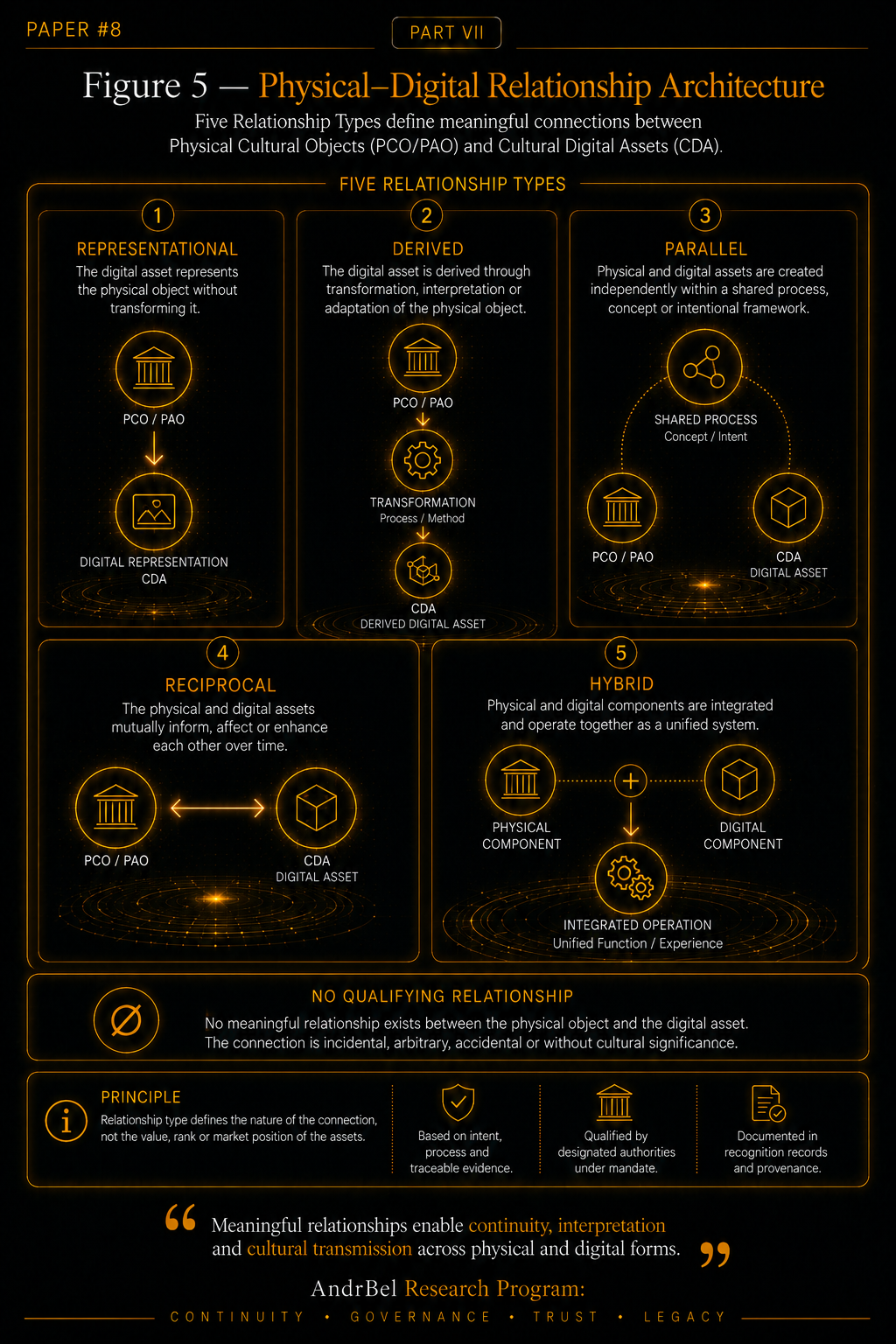
The publication architecture retains five principal relationship types:
- Representational;
- Derived;
- Parallel;
- Reciprocal;
- Hybrid.
- Independent
If two objects are independent and have no meaningful relationship, then “Independent” is not properly a relationship type.
It is more accurately represented as:
- No Qualifying Relationship
- Independent Objects
7.8 Representational Relationship
A:
- Representational Relationship
Conceptually:
Physical Object
↓
Digital Representation
Examples may include:
- digital photograph;
- scan;
- high-resolution reproduction;
- 3D capture;
- documentary digital model.
the digital object's primary relationship to the physical object is representational.
Representation alone does not determine CDA qualification.
A simple documentation image may remain an ordinary Digital Object.
A representational digital object may become CDA only through independent CDA qualification.
7.9 Representation Does Not Equal Copy Ontology
The term “representation” should not be confused with an ontological claim that the digital object is culturally insignificant.
For example:
PCO
↓
Digital Representation
↓
independent research use
↓
institutional governance
↓
CDA Qualification
is possible.
Thus:
Representational Relationship describes how the digital object relates to the physical source, not how culturally important the digital object is.
This follows directly from the Independent Qualification Principle.
7.10 Derived Relationship
A:
- Derived Relationship
Conceptually:
Physical Object
↓
Source Material
↓
Transformation
↓
Digital Object
Examples might include:
- transformed digital artwork based on a physical painting;
- digital reconstruction;
- interpretive digital work;
- derived digital edition.
Representation
primarily reproduces
Derivation
materially transforms
7.11 Derivation Does Not Imply Loss of Independence
A derived CDA may remain strongly dependent on its physical source historically while independently qualifying as a cultural digital object.
Thus:
Source Dependency:
Strong
Qualification Dependency:
Not necessarily strong
This distinction demonstrates why relationship type and dependency type must remain separate.
7.12 Parallel Relationship
A:
- Parallel Relationship
Conceptually:
Shared Concept / Creation Process
├── Physical Object
└── Digital Object
Neither object must be treated as:
- original followed by copy.
This will become especially important for future physical–digital artistic practices.
7.13 Parallel Creation and Chronology
Parallel does not necessarily mean simultaneous.
For example:
Shared Project
↓
Digital Object created first
↓
Physical Object created later
may still be structurally parallel if:
- the physical object is not simply a material copy of the digital object but another intended manifestation of the same project.
7.14 Reciprocal Relationship
A:
- Reciprocal Relationship
Conceptually:
PCO
↔
CDA
Each may contribute to the other's:
- recognition;
- documentation;
- interpretation;
- provenance;
- continuity;
- institutional use.
7.15 Reciprocal Relationship and Qualification
Reciprocity does not create qualification inheritance.
Thus:
PCO
↔
CDA
does not mean:
one qualification
=
shared qualification
Each retains independent qualification.
Reciprocity concerns:
ongoing cultural interaction.
This is precisely the distinction established in PART VI.
7.16 Hybrid Relationship
A:
- Hybrid Relationship
Examples may eventually include:
- digitally controlled physical installation;
- physical artwork requiring a digital component;
- materially realized digital work whose intended form includes both domains.
Physical Component
+
Digital Component
↓
Integrated Cultural Operation
Hybrid cases are particularly important but remain only partially validated within DAP #0A.
DAP #9 is expected to stress-test this category.
7.17 Hybrid Relationship Does Not Yet Establish Composite Objecthood
A crucial limitation is necessary.
The existence of a Hybrid Relationship does not automatically establish:
Composite Cultural Object
or:
Composite Cultural System
as a separately qualified object class.
DAP #0A identifies this as an open question.
Therefore Paper #8 uses:
- Hybrid Relationship
7.18 Independent Objects / No Qualifying Relationship
The earlier Full Research Record included:
Independent Relationship.
The publication version refines this.
If:
PCO A
and:
CDA B
possess no culturally meaningful connection, they should be represented as:
Independent Objects / No Qualifying Relationship
not as possessing a special “Independent Relationship.”
This improves the ontology.
It also allows:
Relationship Status:
None
to be a legitimate state.
7.19 Relationship Type Is Not Cultural Rank
The five relationship types do not form a hierarchy.
For example:
Hybrid
≠
more culturally important
than
Representational
and:
Reciprocal
≠
higher CDA class
than
Derived
Relationship Type describes:
structural configuration.
It does not rank cultural significance.
7.20 Multiple Relationships May Exist
One physical–digital pair may potentially exhibit more than one relationship property.
For example:
a digital object may initially be:
- Representational
- Reciprocal
Or a digital object may be:
- Derived
Therefore the future Protocol must decide whether:
- one Primary Relationship Type is required;
- multiple Relationship Types may coexist;
- relationship type changes should be versioned.
7.21 Source Relationship
Relationship Type is only one dimension.
The next concept is:
Source Relationship
Source Relationship asks:
Did one object materially or informationally contribute to the creation or identity of the other?
Examples:
PCO
↓
photographed
↓
Digital Object
Strong Source Relationship.
Or:
Shared artistic concept
├── Physical Object
└── Digital Object
No direct physical-to-digital source relationship may exist.
Thus Source Relationship should not be assumed from cultural association alone.
7.22 Source Object
Where a source relationship exists, the system should identify:
- Source Object
Source Object:
PAO-001
Resulting Digital Object:
CDA-003
But “source” does not necessarily mean:
culturally superior;
nor:
original in every relevant sense.
It means:
the identified object contributed materially or informationally to the creation or identity of another object.
7.23 Cultural Dependency
Another dimension is:
- Cultural Dependency
The degree to which the cultural intelligibility, meaning, function, or significance of one object depends on the existence or interpretation of another.
Example:
A digital documentary object may be culturally unintelligible without knowing the physical painting it documents.
Thus:
Cultural Dependency:
High
even though:
Qualification Dependency:
Low
This distinction is critical.
7.24 Cultural Dependency Is Not Source Dependency
An object may derive physically from another while later developing independent cultural meaning.
For example:
Source Dependency:
High
Cultural Dependency:
Moderate
Conversely, two objects may have no direct source derivation but operate as conceptually inseparable parts of one project:
Source Dependency:
Low
Cultural Dependency:
High
Therefore the two dimensions must not be conflated.
7.25 Qualification Dependency
PART VI introduced the need to distinguish:
- Qualification Dependency
The degree to which the qualification of one object relies upon a specific claim, status, or relationship concerning another object.
Example:
A CDA may be qualified specifically as:
- the authorized institutional digital representation of PCO X.
Thus:
Qualification Dependency:
High
But in another case, a derived digital artwork may have developed sufficient independent cultural basis that:
Qualification Dependency:
Low
even though Source Relationship remains strong.
7.26 Qualification Dependency Must Be Explicit
If qualification depends on another object's status or a relationship claim, this dependency should not remain implicit.
Otherwise:
PCO status changes
may unexpectedly affect:
CDA qualification
without any visible reason.
Therefore:
- Qualification-critical dependencies should be explicitly recorded.
7.27 Governance Dependency
Another independent dimension is:
- Governance Dependency
Does the governance of one object or its record depend upon authority exercised over another object?
For example:
- a museum may control the PCO record;
- an artist estate may control digital reproduction authorization;
- a separate institutional custodian may maintain the CDA.
Alternatively, both objects may be governed together under one institutional framework.
7.28 Governance Dependency Does Not Equal Ownership Dependency
The owner of a physical artwork may not control:
- CDA metadata;
- reproduction rights;
- qualification record;
- digital custodianship.
Therefore:
Ownership Relationship
≠
Governance Relationship
The relational architecture must preserve this distinction.
7.29 Rights Relationship
Although PART VII does not develop a complete rights framework, rights may constitute another important relational attribute.
Relevant questions include:
- Who authorized digitization?
- Who authorized derivative creation?
- Who holds reproduction rights?
- Is the CDA licensed?
- Was the relationship created without authorization?
Thus:
rights status should be representable without being conflated with cultural status.
7.30 Authorization
Authorization becomes especially important in representational and derived relationships.
A digital object may be:
Authorized
or:
Unauthorized
or:
Authorization Unknown
DAP #0A does not conclude that unauthorized objects can never become CDA.
That question remains open for later Boundary DAP research.
However:
authorization status is structurally significant and must be recordable.
7.31 Relationship Evidence
A relationship claim requires evidence.
For example:
“CDA-002 derives from PCO-007.”
may be supported by:
- source files;
- photographs;
- artist documentation;
- creation logs;
- metadata;
- issuance records;
- institutional documentation;
- technical hashes;
- contracts;
- authorization records.
Relationship Claim
≠
Relationship Evidence
as with qualification claims generally.
7.32 Relationship Evidence Must Be Attributable
For each material relationship claim, the system should be able to answer:
Who asserted the relationship?
What evidence supports it?
When was it established?
Was authorization present?
Has the relationship been challenged?
This produces the need for a persistent relational record.
7.33 PCO–CDA Relationship Record
DAP #0A therefore proposes:
- PCO–CDA Relationship Record
- A structured and versionable record documenting the identity, type, provenance, dependencies, authorization, governance, and current status of a claimed relationship between a physical artistic or cultural object and a digital object or Cultural Digital Asset.
PAO ↔ CDA
and:
PCO ↔ Digital Object
The term can be generalized during Protocol design if necessary.
7.34 Minimum Conceptual Relationship Record
A preliminary record may include:
Relationship ID
Physical Object ID
Physical Object Status
PAO / PCO
Digital Object ID
Digital Object Status
Digital Object / CDA
Relationship Type
Source Relationship
Cultural Dependency
Qualification Dependency
Governance Dependency
Authorization Status
Relationship Evidence
Relationship Origin Date
Relationship Authority / Declarant
Relationship Status
Conflict Status
Version
These are research-derived structural fields, not yet final normative requirements.
7.35 Relationship ID
The relationship itself should possess a persistent identifier where long-term institutional use requires one.
Why?
Because the relationship may:
- be reviewed;
- be disputed;
- change classification;
- acquire new evidence;
- continue after transfer of either object.
PCO ID
+
CDA ID
may remain constant while:
Relationship Record
evolves.
A persistent Relationship ID permits that history to remain traceable.
7.36 Relationship Origin Event
Every formal relationship has an origin.
Examples:
- digitization event;
- digital creation event;
- issuance;
- institutional linking;
- artist declaration;
- contractual authorization;
- research determination.
Relationship Origin Event
where possible.
This becomes the beginning of Relational Provenance.
7.37 Relationship Authority
Who has authority to declare:
- “These two objects are related”?
For example:
Artist
may establish:
- the digital object was created from this painting.
may establish:
- this digitization corresponds to this collection object.
may establish:
- these two records likely correspond historically.
may establish:
- derivative use was authorized.
Again:
- no single universal relationship authority exists.
7.38 Relationship Status
A relationship should possess a current status separate from object qualification.
Possible states may include:
Asserted
Documented
Verified
Disputed
Suspended
Withdrawn
Superseded
The exact vocabulary remains a Protocol question.
The structural finding is that:
relationship status may evolve independently from object status.
7.39 Relationship Conflict
Suppose:
PCO:
Qualified
CDA:
Qualified
Relationship:
Disputed
This is a valid state.
The dispute might concern:
- whether the CDA actually derives from the PCO;
- whether authorization existed;
- whether the physical object was correctly identified.
This follows PART VI.
7.40 Relationship Withdrawal
A claimed relationship may later be shown to be false.
For example:
CDA originally linked to PCO A
↓
later research
↓
actual source is PCO B
The correct response is not silent reassignment.
Instead:
Relationship A:
Withdrawn / Superseded
Relationship B:
Established
Historical relational claims remain traceable.
7.41 Relational Provenance
The existence of relationship history leads to one of the major concepts of DAP #0A:
A working definition is:
- Relational Provenance is the documented history through which a relationship between two cultural objects was created, evidenced, authorized, maintained, challenged, modified, or terminated over time.
- Physical Provenance;
- Digital Provenance;
- Qualification Provenance.
- How do we know that these particular physical and digital objects are related, and how has that relationship evolved?
7.42 Four Provenance Domains
At this stage the paper can distinguish:
Physical Provenance
=
history of physical object
Digital Provenance
=
history of digital object
Relational Provenance
=
history of connection between them
Qualification Provenance
=
history of cultural qualification
PART VIII will synthesize all four.
PART VII focuses specifically on Relational Provenance.
7.43 Relational Provenance Example
Consider:
2027
Painting A created
2028
High-resolution digital capture made
2028
Artist authorizes institutional digital edition
2029
Digital Object B issued
2030
Digital Object B qualified as CDA
2032
Relationship classification updated
from Representational
to Reciprocal
after institutional use
Physical Provenance tells us what happened to Painting A.
Digital Provenance tells us what happened to Digital Object B.
Qualification Provenance tells us how each became culturally qualified.
Relational Provenance tells us:
- how Painting A and Digital Object B became connected and how that connection evolved.
7.44 Relational Provenance Prevents False Association
Without Relational Provenance, an institution could simply link:
CDA X
to:
PCO Y
without evidence.
This creates risks including:
- misattribution;
- false provenance;
- unauthorized association;
- counterfeit relationships;
- misleading digital editions.
- Relational Provenance is a trust mechanism for physical–digital cultural infrastructure.
7.45 Relational Provenance and Authorization
Authorization may form one event within Relational Provenance.
For example:
Source Event
Authorization Event
Digital Creation Event
Issuance Event
Relationship Verification Event
These events may have different authorities.
This demonstrates why a single field:
- Authorized: Yes
The history matters.
7.46 Relational Provenance and Rights Change
Rights may change while the cultural relationship remains intact.
For example:
Relationship:
Active
Reproduction License:
Expired
or:
Relationship:
Historically valid
Current commercial rights:
Transferred
Therefore:
- relationship continuity and current rights status are distinct.
7.47 Relational Provenance and Ownership Transfer
Similarly, physical ownership may change:
Collector A
↓
Museum B
without changing the historical relationship between PCO and CDA.
The relational record may only need updated governance information.
Thus:
Ownership Transfer
≠
Relationship Termination
unless the relationship itself depended on a particular ownership condition.
7.48 Relational Provenance and Object Destruction
If a PCO is physically destroyed, its historical relationship to a CDA may remain valid.
For example:
PCO
↓
destroyed
CDA
↓
survives
Relational Provenance
↓
preserves historical relationship
This becomes important for PART VIII's continuity analysis.
The relationship may continue historically even where one endpoint no longer materially survives.
7.49 Relational Provenance and Digital Loss
The reverse is also possible.
If a CDA becomes technically inaccessible or lost:
PCO
survives
CDA
lost
Relationship Record
survives
the cultural history of the relationship need not disappear.
This again demonstrates that:
- the relationship record constitutes an independent continuity structure.
7.50 Relational Provenance and Reconstruction
If a lost digital object is later reconstructed, the record must distinguish:
Original CDA
Lost State
Reconstructed Digital Object
and determine whether the reconstruction is:
- same digital identity;
- new digital object;
- derivative.
But Relational Provenance provides the architecture necessary to preserve the distinction.
7.51 Relationship Versioning
Relationship Type and dependencies may change.
For example:
Version 1:
Representational
Version 2:
Representational + Reciprocal Function
or:
Qualification Dependency:
High
↓
later
Low
because the CDA develops independent cultural significance.
Therefore:
- Relationship Records must be versionable.
7.52 Relationship Evolution
This produces a broader principle:
- Physical–digital cultural relationships are not necessarily static.
- institutional use;
- new research;
- new editions;
- new interpretations;
- changing governance;
- technological migration.
7.53 Relationship Profiles Rather Than Single Labels
Because one pair may exhibit several dimensions, the stronger model is:
RELATIONSHIP PROFILE
Primary Relationship Type:
Derived
Source Relationship:
Strong
Cultural Dependency:
Moderate
Qualification Dependency:
Low
Governance Dependency:
Shared
Authorization:
Documented
Relational Provenance:
Established
This is more informative than:
Relationship:
Derived
alone.
7.54 Dependencies Should Not Become Scores by Default
As elsewhere in DAP #0A, the use of:
High / Moderate / Low
may be useful descriptively.
But the Protocol should be cautious about creating universal numerical dependency scores.
The purpose is to identify dependency structure.
Not to manufacture another ranking system.
7.55 Source Relationship Matrix
A simplified model can be represented:
| Relationship Type | Direct Source Relationship | Typical Cultural Dependency | Automatic Qualification Dependency | |
| Representational | Usually strong | Often strong | No | |
| Derived | Usually strong | Variable | No | |
| Parallel | May be weak/none | Variable | No | |
| Reciprocal | Variable | Often bidirectional | No | |
| Hybrid | Variable | Often strong | No automatic rule |
The table illustrates the central point:
- Relationship Type does not itself determine qualification dependency.
7.56 Representational Case
Example:
PCO Painting
↓
Institutional high-resolution digital representation
↓
CDA
Possible profile:
Relationship Type:
Representational
Source Relationship:
Strong
Cultural Dependency:
Strong
Qualification Dependency:
Moderate
Governance Dependency:
Separate
Relational Provenance:
Documented
The CDA may remain culturally dependent on knowing which PCO it represents, while still maintaining its own qualification status.
7.57 Derived Case
Example:
PAO Painting
↓
digital transformation
↓
new digital artwork
↓
CDA
Possible profile:
Relationship Type:
Derived
Source Relationship:
Strong
Cultural Dependency:
Moderate
Qualification Dependency:
Low
Governance Dependency:
Separate
Here the physical source matters historically, but the digital artwork may develop independent cultural significance.
7.58 Parallel Case
Example:
Artistic Project
├── Physical Artwork
└── Digital Artwork
Possible profile:
Relationship Type:
Parallel
Source Relationship:
None / Shared Conceptual Source
Cultural Dependency:
Moderate
Qualification Dependency:
Independent
Governance Dependency:
Shared or Separate
Neither object needs to be treated as the other's copy.
7.59 Reciprocal Case
Example:
PCO
↔
CDA
where the CDA supports:
- research;
- interpretation;
- continuity;
- source provenance;
- cultural context.
Relationship Type:
Reciprocal
Source Relationship:
Defined historically
Cultural Dependency:
Bidirectional
Qualification Dependency:
Separate
Governance Dependency:
Coordinated
This may be one of the most institutionally significant relationship forms.
7.60 Hybrid Case
Example:
Physical Component
+
Digital Component
=
intended integrated operation
Possible profile:
Relationship Type:
Hybrid
Cultural Dependency:
High
Qualification Dependency:
To be determined
Governance Dependency:
High
Composite Qualification:
Open Question
This is precisely where later DAP #9 becomes necessary.
7.61 Relationship Architecture and Originality
The relationship framework also changes how “original” should be approached.
A physical object may be:
- source object
A digital object may be:
- derived
Therefore:
Source
≠
Cultural Superiority
Original
≠
Only Qualifiable Object
Derivative
≠
Culturally Inferior
This becomes critical for future AI and hybrid research.
7.62 Relationship Architecture and Authenticity
Authenticity likewise needs precision.
The relevant question may be:
- Is this CDA authentically related to the claimed PCO?
This differs from:
- Is the PCO authentic?
- Is the CDA authentic as its own digital object?
Physical Object Authenticity
Digital Object Authenticity
Relationship Authenticity
DAP #0A does not construct a full authentication standard but exposes this structural distinction.
7.63 Relationship Architecture and Copies
Multiple digital objects may relate to one PCO.
For example:
PCO-001
├── Digital Object A
├── CDA B
├── CDA C
└── Documentation D
Each relationship may differ.
Thus the system cannot simply say:
Digital Twin:
Yes
and assume one canonical digital counterpart.
A physical object may possess multiple legitimate digital relationships.
7.64 One CDA May Relate to Multiple Physical Objects
The reverse is also possible.
For example:
a digital research object may synthesize:
PCO A
+
PCO B
+
PCO C
Therefore the relational architecture should support:
- one-to-one;
- one-to-many;
- many-to-one;
- potentially many-to-many relationships.
7.65 Series and Corpus Relationships
A CDA may relate not to one physical object but to:
- physical series;
- corpus;
- artistic practice.
Object Relationship
and:
Higher-Order Cultural Relationship.
DAP #0A recognizes the issue but concentrates on object-level physical–digital relationships.
Higher-order relationship schemas may become extension profiles.
7.66 Relationship Authority Can Be Distributed
Just as Cultural Recognition is distributed, relational authority may be distributed.
Different actors may establish different aspects:
Artist:
creation relationship
Museum:
object identity relationship
Rights Holder:
authorization relationship
Researcher:
historical relationship
Registry:
technical link
A complete relational record may therefore aggregate attributable claims from multiple authorities.
7.67 Registry Link Is Not Relationship Authority
An important institutional distinction follows:
- A registry creating a technical link between two identifiers does not automatically possess cultural authority to establish the relationship itself.
- “Relationship asserted by Artist X.”
- “Registry independently verified relationship.”
7.68 Technical Verification vs Cultural Verification
A technical system may verify:
- hash;
- identifier;
- timestamp;
- signature.
- artistic meaning;
- cultural dependency;
- legitimate authorship;
- cultural significance.
Therefore:
Technical Relationship Integrity
≠
Cultural Relationship Validity
Both may matter.
They should remain distinguishable.
7.69 Relational Governance
Every persistent relationship may eventually require governance.
Questions include:
- who can create the relationship record;
- who can modify its type;
- who can add evidence;
- who can dispute it;
- who can withdraw it;
- who maintains it after one institution closes.
PART VII establishes that:
- relationship governance exists as a distinct responsibility.
7.70 Relationship Custodianship
A Relationship Record may have:
- Record Custodian
For example:
PCO Custodian:
Museum A
CDA Custodian:
Archive B
Relationship Record Custodian:
Registry C
This may be institutionally useful.
But authority provenance must remain visible.
The custodian maintains the record.
It does not automatically own or originate every cultural claim within it.
7.71 Relationship Continuity
A relationship may need to survive:
- ownership transfer;
- artist death;
- platform failure;
- institutional closure;
- technical migration.
- Relationship Continuity
It requires preservation of:
- endpoint identity;
- relationship type;
- evidence;
- provenance;
- governance.
7.72 The Relational Cultural Layer
The full architecture emerging from PART VII is:
PHYSICAL CULTURAL LAYER
PAO / PCO
│
▼
RELATIONAL CULTURAL LAYER
Relationship ID
Relationship Type
Source Relationship
Cultural Dependency
Qualification Dependency
Governance Dependency
Authorization
Relationship Evidence
Relational Provenance
Relationship Status
Relationship Governance
│
▼
DIGITAL CULTURAL LAYER
Digital Object / CDA
The middle layer is therefore not merely a connector.
It has its own:
- identity;
- history;
- status;
- governance;
- evidence.
7.73 Principal Finding: Relationships Require Independent Structure
The first principal finding of PART VII is:
- A culturally significant physical–digital relationship requires its own explicit structure rather than being represented only through object identifiers or assumed source relationships.
- type;
- evidence;
- origin;
- dependencies;
- governance;
- history.
7.74 Principal Finding: Relationship Type and Dependency Are Different
The second major finding is:
- Representational, Derived, Parallel, Reciprocal, and Hybrid relationships describe structural relationship forms, while Source, Cultural, Qualification, and Governance Dependencies describe different properties of those relationships.
Relationship Type
≠
Dependency Profile
This prevents one label from carrying too many hidden assumptions.
7.75 Principal Finding: Relationship Validity Is Independent from Object Qualification
The third finding is:
- PCO Qualification, CDA Qualification, and physical–digital relationship validity are distinct determinations.
Qualified PCO
+
Qualified CDA
+
Disputed Relationship
is possible.
And:
PAO
+
Qualified CDA
+
Verified Relationship
is also possible.
7.76 Principal Finding: Relational Provenance Is a Distinct Provenance Domain
The fourth major finding is:
- The history of how two cultural objects became related cannot be fully represented through either object's individual provenance and therefore requires Relational Provenance.
7.77 Principal Finding: Relationship Evolution Must Be Versioned
The fifth finding is:
- Physical–digital relationships can evolve over time and should therefore be represented through versioned relationship records rather than immutable one-time classifications.
- change type;
- change dependency;
- become disputed;
- be superseded.
7.78 Principal Finding: No Relationship Is a Valid State
The publication analysis also refines the earlier typology:
- Independent objects with no qualifying physical–digital relationship should be represented through absence of relationship rather than through an “Independent Relationship” type.
7.79 Protocol Implications
PART VII produces the following Protocol Implications.
Protocol Implication 1
The Protocol should provide an explicit Physical–Digital Relationship Record.
Protocol Implication 2
Relationship records should identify both physical and digital endpoints through persistent identifiers.
Protocol Implication 3
The Protocol should distinguish Relationship Type from dependency attributes.
Protocol Implication 4
The initial relationship taxonomy should support at least:
- Representational;
- Derived;
- Parallel;
- Reciprocal;
- Hybrid;
Protocol Implication 5
No qualifying relationship should be representable as a valid state.
Protocol Implication 6
The Protocol should distinguish:
- Source Relationship;
- Cultural Dependency;
- Qualification Dependency;
- Governance Dependency.
Authorization status should be separately representable where relevant.
Protocol Implication 8
Relationship claims should require attributable evidence.
Protocol Implication 9
The Protocol should preserve Relational Provenance.
Protocol Implication 10
Relationship status and relationship conflicts should be versionable.
Protocol Implication 11
Changes in relationship validity should affect object qualification only where a documented qualification-critical dependency exists.
Protocol Implication 12
One-to-one, one-to-many, many-to-one, and potentially many-to-many physical–digital relationships should be representable.
These remain research-derived implications rather than final normative requirements.
7.80 Part VII Synthesis
PART VII establishes the third structural domain required by Paper #8.
PART VI showed:
PCO
and
CDA
=
independently qualified
PART VII now establishes:
PCO / PAO
↕
structured relationship
↕
CDA / Digital Object
The resulting architecture is:
PHYSICAL CULTURAL LAYER
│
▼
RELATIONAL CULTURAL LAYER
│
▼
DIGITAL CULTURAL LAYER
The Relational Cultural Layer contains:
Relationship Type
Source Relationship
Cultural Dependency
Qualification Dependency
Governance Dependency
Authorization
Relationship Evidence
Relational Provenance
Relationship Status
Relationship Governance
The central conclusion of PART VII is therefore:
- Physical and digital cultural objects should not only be independently qualified; the relationships connecting them must themselves be explicitly identified, evidenced, versioned, and governed.
- The cultural relationship between two objects is not adequately represented by a technical link. Its provenance, authority, dependencies, and history form an independent layer of cultural infrastructure.
- Relational Provenance is necessary because the history of the relationship between physical and digital cultural objects cannot be reconstructed solely from Physical Provenance or Digital Provenance.
PART VIII — Provenance, Governance and Continuity
There we no longer need to invent another object or relationship ontology. We should synthesize the systems already established into the long-term infrastructure layer:
Physical Provenance
Digital Provenance
Relational Provenance
Qualification Provenance
↓
Distributed Governance
↓
Artist
→ Successor
→ Artistic Legacy Representative
→ Institutional Custodian
↓
Material
Identity
Provenance
Interpretive
Governance
Qualification
Institutional Continuity
That is where Paper #8 will make its full bridge into Artist Legacy Infrastructure / Artistic Continuity Infrastructure.
PART VIII
Provenance, Governance and Continuity
From Object History to Long-Term Cultural Stewardship
8.1 Purpose of PART VIII
PART VI established that Physical Cultural Objects and Cultural Digital Assets are independently qualified cultural object classes.
PART VII established that the relationship between them forms a distinct Relational Cultural Layer with its own:
- identity;
- evidence;
- relationship type;
- dependencies;
- status;
- provenance.
How can PCOs, CDAs, and the relationships connecting them remain culturally intelligible, governable, and institutionally persistent over time?
This requires three interdependent architectures:
PROVENANCE
↓
GOVERNANCE
↓
CONTINUITY
The central proposition tested in this Part is that long-term cultural preservation cannot be reduced to:
- physical conservation;
- digital storage;
- ownership records;
- technical persistence.
- identifiable;
- attributable;
- historically traceable;
- interpretable;
- governable;
- qualified;
- institutionally maintainable.
8.2 Provenance as More Than Ownership History
Within art and cultural systems, provenance is often understood primarily as the history of:
- ownership;
- custody;
- transfer.
However, the architecture established in DAP #0A shows that a physical–digital cultural system contains several different histories.
For example:
PCO
↓
physical history
CDA
↓
digital history
PCO ↔ CDA
↓
relationship history
PCO / CDA Qualification
↓
qualification history
These histories answer different questions.
They cannot be compressed into a single provenance field without losing essential information.
8.3 Four Provenance Domains
DAP #0A therefore distinguishes four principal provenance domains:
Physical Provenance
Digital Provenance
Relational Provenance
Qualification Provenance
The distinction is fundamental because each provenance domain concerns a different object of historical reconstruction.
8.4 Physical Provenance
Physical Provenance concerns the historical continuity of the physical object.
It may include:
- creation;
- authorship;
- attribution;
- ownership;
- custody;
- location;
- exhibition;
- transfer;
- conservation events;
- physical alteration;
- loss;
- destruction.
Physical Object
↓
Creation
↓
Custody
↓
Transfer
↓
Institutional / Collection History
↓
Current State
Physical Provenance answers:
- What has happened to this physical object over time?
- how its cultural qualification emerged;
- how it became related to a digital object.
8.5 Digital Provenance
Digital Provenance concerns the history of the digital object itself.
It may include:
- digital creation event;
- creator;
- source files;
- technical format;
- metadata;
- issuance;
- versions;
- migrations;
- storage environments;
- transfers;
- technical integrity;
- digital custodianship.
Digital Object
↓
Creation
↓
Version 1
↓
Institutional Transfer
↓
Format Migration
↓
Current Version
Digital Provenance answers:
- How did this particular digital object originate and change over time?
8.6 Relational Provenance
PART VII established:
- Relational Provenance
It may include:
- source relationship;
- digitization;
- authorization;
- derivation;
- issuance;
- institutional linking;
- relationship classification;
- relationship disputes;
- relationship revisions.
PCO
↓
Digital Capture
↓
Authorization
↓
CDA Creation
↓
Relationship Established
↓
Relationship Reclassified
is neither purely physical nor purely digital provenance.
It is the provenance of the connection.
This makes Relational Provenance one of the distinctive contributions of DAP #0A.
8.7 Qualification Provenance
The fourth domain is:
- Qualification Provenance
For a PCO, this may include:
PAO
↓
Qualification Claim
↓
PCO Candidate
↓
Evidence Submitted
↓
Recognition Records
↓
Assessment
↓
Qualification Decision
↓
Review
↓
Current Qualification Status
For a CDA, an equivalent qualification history may exist within the digital domain.
Qualification Provenance answers:
- Why does this object presently hold—or no longer hold—its cultural qualification?
8.8 Provenance Domains Must Remain Separate but Interoperable
The four provenance domains should not exist as disconnected silos.
A physical transfer may affect:
- governance;
- access;
- relationship management.
- continuity;
- integrity;
- relationship verification.
- physical provenance;
- relational evidence.
PHYSICAL PROVENANCE
↘
DIGITAL PROVENANCE
↘
RELATIONAL PROVENANCE
↘
QUALIFICATION PROVENANCE
↓
INTEROPERABLE CULTURAL HISTORY
The domains remain conceptually distinct while allowing cross-reference.
8.9 Provenance Must Preserve Uncertainty
A mature provenance architecture cannot force certainty where certainty does not exist.
Possible states include:
- documented;
- probable;
- disputed;
- incomplete;
- unknown.
Ownership 1982–1986:
Unknown
Attribution:
Probable
Relationship Authorization:
Disputed
These are legitimate historical states.
Therefore:
- Provenance integrity requires explicit representation of uncertainty rather than artificial completion of missing history.
8.10 Provenance Must Preserve Corrections
New research may change historical understanding.
For example:
Version 1
Previous Owner:
Collector A
↓
New archival evidence
↓
Version 2
Previous Owner:
Collector B
The correct response is not silent replacement.
Instead:
Earlier Record
↓
Correction Event
↓
Updated Record
must remain reconstructable.
This produces an important principle:
- Provenance should be correctable without historical erasure.
8.11 Provenance and Authenticity
Provenance contributes to authenticity but is not identical to it.
A provenance record may support claims concerning:
- identity;
- authorship;
- relationship;
- chronology.
Complete Provenance
≠
Automatic Authenticity
and:
Incomplete Provenance
≠
Automatic Inauthenticity
The distinction is particularly important for historical gaps.
Provenance records evidence.
They do not replace domain-specific authentication processes.
8.12 Provenance as Cultural Memory
At a deeper level, provenance performs more than evidentiary verification.
It preserves the historical relationships through which cultural objects moved across:
- artists;
- collectors;
- institutions;
- communities;
- technologies;
- generations.
- Provenance functions as a structural form of cultural memory.
8.13 From Provenance to Governance
Historical information alone cannot preserve itself.
Someone must possess authority and responsibility to:
- maintain;
- correct;
- append;
- review;
- transfer;
This introduces the second major domain:
- Governance
- Who is entitled to perform which action upon the object record, qualification record, relationship record, and continuity structure?
8.14 Governance Is Not Ownership
The first governance principle is:
Governance
≠
Ownership
Owning a PCO does not automatically give the owner authority to:
- rewrite authorship;
- delete historical recognition;
- alter external museum records;
- withdraw third-party cultural recognition;
- change qualification provenance.
Therefore ownership is one relationship within the system.
It is not the universal governance key.
8.15 Governance Is Action-Specific
DAP #0A therefore treats governance as:
action-specific authority
rather than one global “administrator” status.
Different actions may require different authorities.
Examples include:
Create record
Add evidence
Correct metadata
Change attribution
Issue recognition
Challenge recognition
Initiate qualification
Issue qualification
Suspend qualification
Maintain provenance
Transfer custodianship
Modify relationship record
One actor may possess authority for some actions but not others.
This is structurally more precise than:
Owner / Administrator:
Full Control
8.16 Governance Roles
The cultural ecosystem may include:
- Artist;
- Successor;
- Artistic Legacy Representative;
- Institutional Custodian;
- Museum;
- Archive;
- Research Institution;
- Registry;
- Community Authority;
- State Authority.
Their mandates differ.
DAP #0A therefore asks:
- What authority does each role legitimately exercise over which part of the cultural infrastructure?
8.17 The Artist
During the artist's lifetime, the Artist may possess especially strong authority concerning:
- authorship;
- creation history;
- artistic intention;
- series membership;
- practice relationships;
- initial documentation.
- Artist authority does not automatically extend to every later cultural interpretation or institutional recognition.
- “This object belongs to Series X.”
- a museum's historical acquisition record.
8.18 The Successor
After the artist's death or incapacity, certain responsibilities may pass to a:
Successor
The Successor may possess authority depending on:
- artist designation;
- inheritance;
- governance instruments;
- applicable law.
- preserving archives;
- maintaining continuity;
- appointing representatives;
- transferring governance responsibilities.
This leads to the next role.
8.19 Artistic Legacy Representative
The earlier Artistic Continuity Infrastructure research introduced the:
Artistic Legacy Representative (ALR)
as a governance role capable of maintaining structured responsibility for the artistic practice beyond the artist.
Within DAP #0A, the ALR may become relevant to:
- PCO records;
- authorship documentation;
- qualification history;
- relationship records;
- provenance continuity;
- future institutional transfer.
- artist-centered governance
- long-term institutional governance.
8.20 Institutional Custodian
The governance sequence may ultimately transition toward:
- Institutional Custodian
- records;
- provenance;
- governance continuity;
- qualification history;
- relationship history;
Conceptually:
Artist
↓
Successor
↓
Artistic Legacy Representative
↓
Institutional Custodian
This chain was developed originally for artistic continuity.
DAP #0A finds that it is compatible with object-level cultural continuity as well.
8.21 Governance Chain Does Not Mean Automatic Succession
The sequence:
Artist
→ Successor
→ ALR
→ Institutional Custodian
should not be interpreted as a mandatory legal inheritance chain.
The actual transition depends on:
- designation;
- agreements;
- institutional mandates;
- applicable law.
Thus:
- the chain is a continuity architecture, not a universal legal succession rule.
8.22 Governance Must Be Transferable
If cultural infrastructure depends permanently on one individual account or organization, long-term continuity is fragile.
Therefore governance must permit:
Current Steward
↓
Authorized Transfer
↓
Future Steward
while preserving:
- previous authority;
- transfer reason;
- date;
- new mandate.
- Governance Provenance
Governance history can instead form part of Qualification and Institutional Continuity records.
8.23 Record Custodianship
Another important role is:
- Record Custodian
- availability;
- integrity;
- version history;
- evidence links.
- cultural meaning;
- qualification;
- authorship;
- legal status.
Record Custodianship
≠
Cultural Authority
This distinction allows technical stewardship to remain institutionally neutral.
8.24 Object Custody vs Record Custody
A physical object may be held by:
Museum A
while its qualification record is maintained by:
Registry B.
A CDA may be maintained by:
Archive C.
The relationship record may be maintained elsewhere.
Thus:
Physical Custody
Digital Custody
Record Custody
may all differ.
Cultural infrastructure must support this distribution.
8.25 Governance of Recognition Records
Who can modify a Recognition Record?
The originating Recognizing Entity should normally retain authority over its own claim.
For example:
- Museum A Recognition
Gallery B.
Other actors may:
- challenge it;
- annotate it;
- add contradictory evidence.
Thus:
- Recognition governance should preserve authorship of institutional claims.
8.26 Governance of Qualification Records
Qualification governance differs.
A Qualification Authority may:
- issue qualification;
- conduct reassessment;
- suspend qualification.
A later authorized Qualification Authority may potentially supersede the earlier decision.
The system therefore requires:
Decision Authority
≠
Record Maintenance Authority
where necessary.
This prevents custodianship from silently becoming decision power.
8.27 Governance of Relationship Records
Similarly, PCO–CDA Relationship Records may involve:
- relationship declarant;
- rights authority;
- record custodian;
- qualification authorities.
For example:
Artist:
declares creation relationship
Museum:
verifies physical identity
Rights Holder:
documents authorization
Registry:
maintains relationship record
This is a distributed governance model.
8.28 Governance Conflicts
Distributed governance inevitably creates possible conflict.
Examples:
Successor:
requests attribution change
Museum:
rejects change based on research
or:
Artist Estate:
claims derivative authorization
Collector:
disputes rights
DAP #0A does not establish a universal governance court.
Instead, the infrastructure must:
- identify competing authorities;
- preserve evidence;
- distinguish scopes;
- maintain conflict records.
- legal resolution;
- institutional review;
- external adjudication.
It does not necessarily decide it.
8.29 Governance Must Preserve Accountability
Every material governance action should ideally preserve:
Actor
Action
Authority Basis
Date
Reason
Affected Record
Previous State
New State
This is critical for:
- provenance;
- trust;
- continuity.
8.30 Governance and Rights
Governance authority must also remain distinct from legal rights.
For example:
Record Governance Authority
≠
Copyright Ownership
and:
Qualification Authority
≠
Reproduction Rights
Rights may constrain governance actions.
They should not be conflated with them.
This distinction becomes especially important in PCO–CDA systems.
8.31 From Governance to Continuity
Governance answers:
- Who maintains responsibility?
- What must remain preserved across time?
For example:
Painting survives
↓
Artist unknown
Provenance lost
Records destroyed
Meaning disconnected
No responsible custodian
Material survival has occurred.
Cultural continuity has weakened.
Therefore:
- material persistence is necessary in many cases but is not sufficient for cultural continuity.
8.32 Cultural Continuity as a System Property
DAP #0A therefore reaches one of its strongest conclusions:
- Cultural Continuity is a system property.
- object;
- identity;
- evidence;
- provenance;
- interpretation;
- governance;
- institutions.
Object Survival
+
Record Survival
+
Governance Survival
+
Interpretive Traceability
+
Institutional Responsibility
=
Cultural Continuity
not as a strict mathematical formula, but as a structural model.
8.33 Seven Continuity Domains
DAP #0A identifies seven primary continuity domains:
- Material Continuity
- Identity Continuity
- Provenance Continuity
- Interpretive Continuity
- Governance Continuity
- Qualification Continuity
- Institutional Continuity
8.34 Material Continuity
Material Continuity concerns preservation of the physical object's material existence.
It includes:
- conservation;
- condition;
- physical integrity;
- restoration;
- material change;
- loss;
- destruction.
Material Continuity
=
continuity of physical substrate
But this domain is not applicable in the same way to born-digital CDA.
Thus continuity architecture must remain domain-sensitive.
8.35 Material Change Does Not Automatically Break Identity
A conserved physical object may undergo:
- cleaning;
- restoration;
- component replacement.
A deeper question arises:
- At what point does material change create a different object?
The relevant principle is:
- Material Continuity must be interpreted in relation to identity continuity and object-specific conservation context.
8.36 Identity Continuity
Identity Continuity concerns preservation of the ability to determine:
- that this is the same cultural object through time.
- persistent identifier;
- physical characteristics;
- authorship history;
- provenance;
- institutional documentation.
Record survives
is useless if future users cannot determine which object the record describes.
8.37 Identity Continuity Despite Changing Metadata
Titles may change.
Attribution may change.
Owner may change.
Location may change.
Yet the object may remain the same object.
Therefore:
- Identity Continuity requires stable reference beneath mutable metadata.
8.38 Provenance Continuity
Provenance Continuity concerns preservation of historical traceability.
It requires that future custodians can reconstruct:
- physical history;
- digital history;
- relational history;
- qualification history.
But the loss of provenance infrastructure can weaken trust and cultural intelligibility.
Therefore provenance itself requires continuity planning.
8.39 Interpretive Continuity
Interpretive Continuity concerns preservation of the cultural interpretations through which the object has been understood.
It may include:
- artist statements;
- curatorial interpretations;
- scholarly interpretations;
- community interpretations;
- later historical interpretations.
- Interpretive Continuity does not mean interpretive fixity.
Instead:
Interpretation A
↓
Interpretation B
↓
Interpretation C
should remain attributable and historically reconstructable.
8.40 Interpretive Continuity Preserves Plurality
If a museum interpretation and community interpretation differ, cultural continuity requires preservation of both where relevant.
Thus:
Interpretive Continuity
=
preservation of interpretive history
not
preservation of one official meaning
This connects directly to the cultural-plurality principles established in PART IV.
8.41 Governance Continuity
Governance Continuity asks:
- Who is responsible tomorrow?
But if all governance authority disappears when:
- artist dies;
- estate dissolves;
- gallery closes;
Therefore Governance Continuity requires:
- succession;
- transferability;
- mandate clarity;
- fallback stewardship.
8.42 Qualification Continuity
Qualification Continuity concerns preservation of:
- qualification status;
- qualification basis;
- decision history;
- review history;
- Protocol version.
- qualification can never change.
- the history and basis of qualification remain reconstructable even when current status changes.
Qualified
↓
Suspended
↓
Reassessed
↓
Active
must remain historically intelligible.
8.43 Institutional Continuity
Institutional Continuity concerns preservation of cultural infrastructure beyond the lifespan of any single organization or platform.
This is particularly important because:
- museums reorganize;
- galleries close;
- archives merge;
- companies fail;
- technologies become obsolete.
- No cultural object's long-term legibility should depend exclusively on the permanent survival of one institution or technical provider.
8.44 Institutional Continuity and CDA Standards Organization
The same principle applies to standards infrastructure.
A Protocol must support:
- version history;
- migration;
- future stewardship;
- institutional memory.
- the standard,
- their records and objects.
8.45 Continuity Profiles
Just as PCO qualification should not use prestige levels, continuity is better represented multidimensionally.
For example:
CONTINUITY PROFILE
Material:
Strong
Identity:
Strong
Provenance:
Partial
Interpretive:
Strong
Governance:
At Risk
Qualification:
Active
Institutional:
Moderate
Such a profile is more informative than:
Continuity Score:
73
because different risks require different responses.
8.46 Continuity Is Not Cultural Value
A fragile continuity profile does not mean the object is culturally less important.
Indeed, highly culturally significant objects may be at severe continuity risk.
Therefore:
Continuity Strength
≠
Cultural Significance
Continuity measures preservation conditions.
It does not rank culture.
8.47 Physical Destruction and Cultural Continuity
One of the strongest tests concerns physical destruction.
Suppose a PCO is destroyed.
Material Continuity becomes:
- broken.
- identity;
- provenance;
- documentation;
- research;
- recognition;
- qualification history;
- CDA relationships.
Therefore:
Material Continuity:
Lost
Cultural Continuity:
May persist
This establishes that cultural continuity is broader than physical persistence.
8.48 Lost PCO
A destroyed or lost PCO may remain a valid historical cultural object.
Its current physical state may become:
Lost
or:
Destroyed
without requiring deletion of its PCO record.
The record instead becomes critical because it may be the primary remaining cultural infrastructure surrounding the object.
8.49 CDA as Continuity Infrastructure for PCO
A related CDA may contribute to continuity of a lost or inaccessible PCO by preserving:
- representation;
- documentation;
- relational provenance;
- institutional context.
CDA
≠
replacement for PCO
The digital object does not become the destroyed physical object.
Instead:
- it may preserve dimensions of the physical object's cultural continuity.
8.50 PCO as Continuity Context for CDA
The reverse is equally possible.
A CDA may remain culturally intelligible because the physical PCO continues to provide:
- source context;
- institutional interpretation;
- provenance;
- research.
Again:
support
≠
identity merger
8.51 Relationship Continuity
PART VII established the Relationship Record.
PART VIII now adds:
- Relationship Continuity
- ownership changes;
- platforms migrate;
- institutions close;
- one endpoint is destroyed;
- governance changes.
- endpoint identities;
- relationship provenance;
- relationship status;
- authorization history;
- dependencies.
8.52 Digital Migration and Continuity
Digital objects face technical discontinuity risks such as:
- obsolete file formats;
- inaccessible storage;
- platform shutdown;
- corrupted data.
But migration should preserve:
- identity;
- provenance;
- version history;
- relationship history.
- technical change should preserve cultural traceability.
8.53 Blockchain Does Not Solve Continuity Alone
A blockchain may contribute:
- timestamps;
- integrity evidence;
- transfer records.
- interpretive context;
- institutional mandate;
- succession;
- material condition;
- cultural recognition.
Technical Immutability
≠
Cultural Continuity
Technology may support continuity.
It does not constitute continuity by itself.
This reinforces technology neutrality.
8.54 Continuity and Rights
Rights continuity may also affect long-term use.
For example:
- reproduction rights expire;
- rights transfer;
- access restrictions change.
However, rights continuity should not be confused with qualification continuity.
A PCO may remain PCO when reproduction rights change.
A CDA may remain CDA even when a license expires, depending on its qualification basis.
Again, domains must remain separated.
8.55 Continuity and Public Access
Public access may support cultural continuity but is not universally required.
Some cultural objects may legitimately have:
- restricted access;
- private access;
- community-controlled access.
Public Accessibility
≠
Cultural Continuity
The important requirement is that access governance itself remains documented and maintainable.
8.56 Continuity After Artist Death
The death of an artist provides the clearest governance stress test.
Without continuity architecture, the following may fragment:
Authorship Records
Series Structure
Archive
PCO Records
CDA Records
Relationship Records
Rights
Interpretation
Governance
DAP #0A therefore confirms that physical–digital cultural infrastructure cannot be separated from artistic legacy governance.
This is the central bridge to earlier research.
8.57 From Artist Legacy Infrastructure to Object Continuity
Artist Legacy Infrastructure initially addressed the problem:
- How can an artist's practice remain structurally intelligible after the artist can no longer maintain it personally?
- How can PCOs, CDAs, and their relationships remain identifiable, evidenced, governable, and culturally intelligible across the same transition?
Artist Legacy Infrastructure
↓
Practice Continuity
DAP #0A
↓
Object + Relationship Continuity
The two systems intersect.
8.58 Artistic Continuity Infrastructure as Governance Backbone
The stronger bridge is with Artistic Continuity Infrastructure.
The governance sequence:
Artist
↓
Successor
↓
Artistic Legacy Representative
↓
Institutional Custodian
provides an architecture through which responsibility for:
- identity;
- provenance;
- records;
- qualification;
- relationships;
DAP #0A therefore does not create an entirely new continuity model.
It demonstrates how the existing continuity model can operate at PCO–CDA object level.
8.59 PCO and CDA Within Artistic Continuity Infrastructure
The combined architecture can be represented:
ARTIST
↓
ARTISTIC PRACTICE
│
├── PAO
│ ↓
│ PCO
│
└── Digital Object
↓
CDA
PCO ↔ CDA
↓
Relationship Records
↓
Provenance
↓
Governance
↓
Continuity
↓
Successor / ALR
↓
Institutional Custodian
This demonstrates that Artistic Continuity Infrastructure and CDA Infrastructure are not separate long-term systems.
They intersect through the objects they preserve.
8.60 Institutional Custodianship Does Not Freeze Culture
Moving governance toward an Institutional Custodian must not create:
- permanent institutional control over interpretation.
It should preserve:
- evidence;
- records;
- attribution;
- plural interpretations.
Thus:
- Institutional Continuity must preserve cultural plurality rather than institutionalize interpretive monopoly.
8.61 Continuity Requires Interoperability
If records must survive institutions, they must be portable.
Therefore long-term continuity requires:
- persistent identifiers;
- exportable records;
- stable semantics;
- version histories;
- relationship mappings.
Without interoperable structures:
Institutional Closure
↓
Record Isolation
↓
Potential Cultural Discontinuity
becomes likely.
8.62 Continuity Requires Versioning
Every continuity domain may involve change.
Therefore versioning should preserve:
- what changed;
- who changed it;
- why;
- when;
- under what authority.
It is a continuity mechanism.
8.63 Continuity Requires Governance Succession
A persistent database with no legitimate future authority is insufficient.
Similarly, a legally designated successor with no accessible records is insufficient.
Therefore:
Records
+
Governance
+
Succession
must remain integrated.
This is one of the major lessons inherited from Artistic Continuity Infrastructure.
8.64 Continuity Requires Institutional Redundancy
A single-point-of-failure model is structurally weak.
For example:
One proprietary platform
↓
platform closure
↓
cultural record loss
should be avoided.
The future standards architecture should therefore support:
- replication;
- migration;
- interoperability;
- custodial transfer.
8.65 Provenance, Governance and Continuity as a Single Infrastructure
The three domains now converge.
PROVENANCE
answers:
What happened?
GOVERNANCE
answers:
Who may act?
CONTINUITY
answers:
What must survive?
Together:
Provenance
+
Governance
+
Continuity
=
Long-Term Cultural Infrastructure
This is the principal structural synthesis of PART VIII.
8.66 The Long-Term PCO Architecture
For a PCO:
PCO
↓
Physical Provenance
↓
Qualification Provenance
↓
Governance
↓
Material Continuity
Identity Continuity
Interpretive Continuity
Institutional Continuity
This allows the physical cultural object to remain historically legible across time.
8.67 The Long-Term CDA Architecture
For a CDA:
CDA
↓
Digital Provenance
↓
Qualification Provenance
↓
Governance
↓
Identity Continuity
Digital / Technical Continuity
Interpretive Continuity
Institutional Continuity
The precise technical continuity requirements belong partly to broader CDA Protocol development.
8.68 The Long-Term Relationship Architecture
For PCO ↔ CDA:
Relationship
↓
Relational Provenance
↓
Relationship Governance
↓
Relationship Continuity
This preserves the historical and institutional meaning of the connection.
Thus the complete cultural system becomes:
PCO
↓
Physical Provenance
↘
Relationship
↙
CDA
↓
Digital Provenance
Relationship
↓
Relational Provenance
PCO + CDA
↓
Qualification Provenance
ALL
↓
Governance
↓
Continuity
8.69 Principal Finding: Provenance Is Multidimensional
The first major finding of PART VIII is:
- Physical–digital cultural infrastructure requires at least four distinct provenance domains: Physical, Digital, Relational, and Qualification Provenance.
8.70 Principal Finding: Governance Is Distributed and Action-Specific
The second finding is:
- Governance authority should be represented according to specific actions and mandates rather than automatically derived from ownership or institutional prestige.
- distributed authority;
- transparency;
- succession;
- long-term stewardship.
8.71 Principal Finding: Cultural Continuity Is Multidimensional
The third finding is:
- Cultural Continuity cannot be reduced to preservation of physical material or digital files and instead comprises Material, Identity, Provenance, Interpretive, Governance, Qualification, and Institutional Continuity.
8.72 Principal Finding: Continuity Can Survive Material Loss
The fourth finding is:
- Material destruction does not necessarily eliminate cultural continuity where identity, provenance, interpretation, qualification, and institutional records remain preserved.
8.73 Principal Finding: Governance Must Extend Beyond the Artist
The fifth finding is:
- Long-term PCO–CDA continuity requires governance structures capable of surviving the artist's direct control.
8.74 Principal Finding: Cultural Infrastructure Must Be Portable
The sixth finding is:
- Long-term cultural continuity cannot depend exclusively on one institution, platform, technology, or database.
- portability;
- persistent identity;
- versioning;
- governance transfer;
- interoperability.
8.75 Principal Finding: Stewardship Is Not Cultural Sovereignty
The seventh finding is:
- Long-term stewardship of cultural records does not grant the steward ownership of cultural meaning.
- estates;
- museums;
- registries;
- institutional custodians;
- future standards organizations.
It should not monopolize cultural interpretation.
8.76 Protocol Implications
PART VIII produces several direct Protocol Implications.
Protocol Implication 1
The Protocol should distinguish Physical, Digital, Relational, and Qualification Provenance.
Protocol Implication 2
Provenance records should preserve uncertainty, correction history, and evidence attribution.
Protocol Implication 3
Governance roles should be separate from ownership, rights, recognition, and qualification where applicable.
Protocol Implication 4
Governance actions should be attributable to specific actors, mandates, dates, and record changes.
Protocol Implication 5
The Protocol should support transfer of governance and record custodianship.
Protocol Implication 6
The Protocol should support long-term governance structures compatible with Artist → Successor → Artistic Legacy Representative → Institutional Custodian transitions.
Protocol Implication 7
The Protocol should support multidimensional continuity rather than a universal continuity score.
Protocol Implication 8
Lost or destroyed PCOs should remain capable of retaining historical identity, qualification history, and relationship records.
Protocol Implication 9
Protocol records should remain portable across institutions and technical environments.
Protocol Implication 10
Versioning should preserve previous states rather than silently overwrite them.
Protocol Implication 11
Relationship Continuity should be representable independently from object survival.
Protocol Implication 12
Technical persistence should not be treated as equivalent to Cultural Continuity.
These remain research-derived implications pending later comparative validation.
8.77 Part VIII Synthesis
PART VIII completes the long-term infrastructure layer of Paper #8.
The architecture developed across PARTS VI–VIII can now be expressed as:
PHYSICAL CULTURAL LAYER
PCO
↓
Physical Provenance
│
│
▼
RELATIONAL CULTURAL LAYER
PCO ↔ CDA
↓
Relational Provenance
│
│
▼
DIGITAL CULTURAL LAYER
CDA
↓
Digital Provenance
PCO + CDA
↓
Qualification Provenance
ALL LAYERS
↓
Distributed Governance
↓
Artist
→ Successor
→ Artistic Legacy Representative
→ Institutional Custodian
↓
Continuity
The resulting continuity architecture is:
Material Continuity
Identity Continuity
Provenance Continuity
Interpretive Continuity
Governance Continuity
Qualification Continuity
Institutional Continuity
The central conclusion of PART VIII is:
- A cultural object remains culturally continuous not merely because its physical material or digital file survives, but because its identity, provenance, interpretation, qualification, governance, and institutional relationships remain reconstructable and capable of responsible stewardship across time.
- The PCO–CDA relationship itself forms part of cultural continuity and therefore requires its own provenance, governance, and preservation.
- DAP #0A demonstrates that Artist Legacy Infrastructure / Artistic Continuity Infrastructure and CDA Infrastructure converge at the level of long-term object, relationship, governance, and institutional continuity.
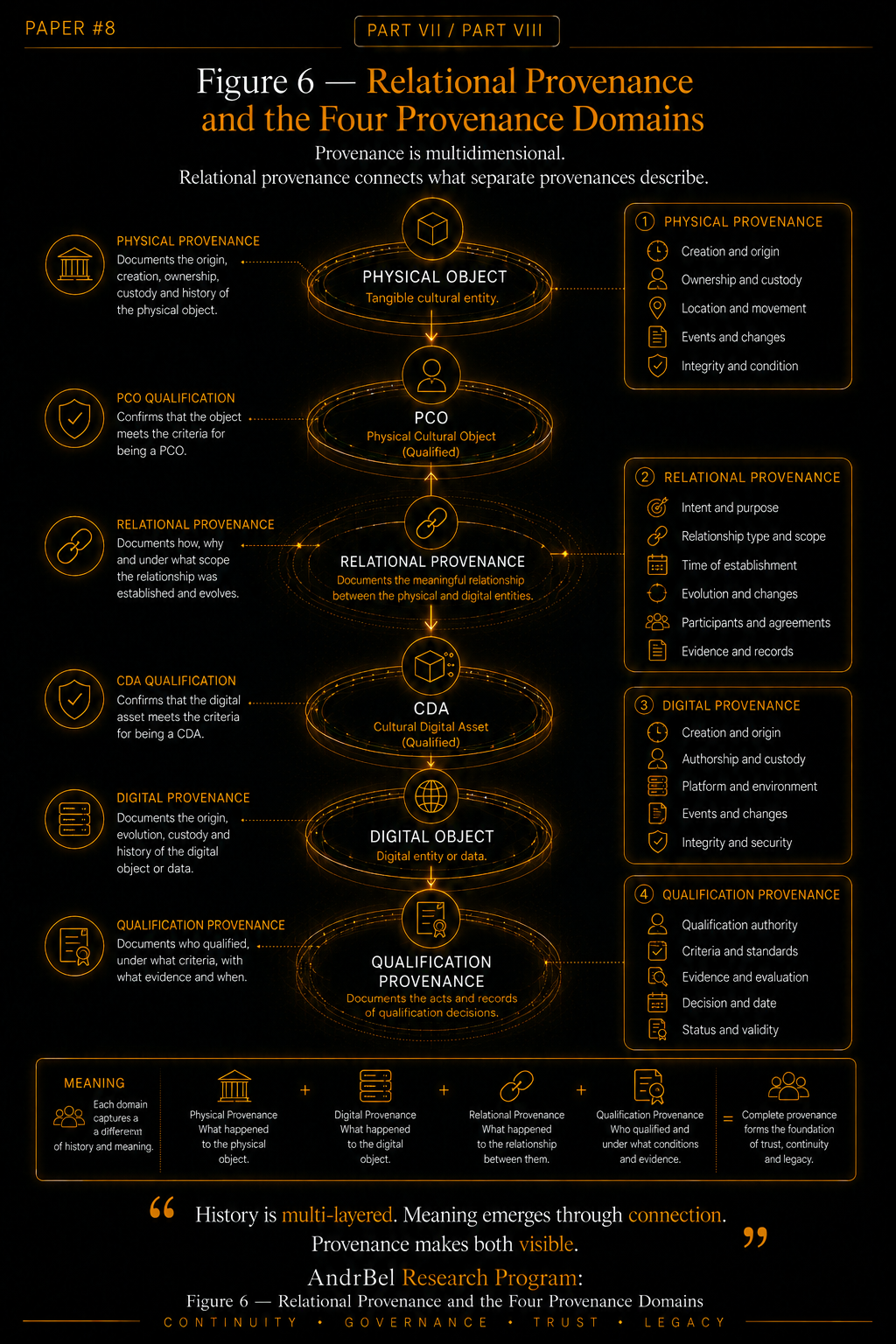
PART IX
Standardization and Institutional Implications
Defining the Boundary Between Cultural Judgment, Protocol Structure, and Standards Governance
Publication Metadata
Research Program: ANDRBEL Research Program
Framework Context: ADAS Framework Series
Research Type: Foundational Ontological Investigation
Protocol Function: Physical–Digital Ontology and Cultural Qualification Foundation
Future Standard Context: CDA Protocol v1.0
Institutional Context: CDA Standards Organization
Publication Position: PAPER #8 (DAP #0A)
Version: 1.0
Citation
Support independent artistic research in Cognitive Structuralism, conceptual painting, and long-term cultural infrastructure development.
[Support Research]
This publication forms part of the Demonstration and Validation Project (DAP) Research Series within the ANDRBEL Research Program.
The DAP Research Series provides the research and validation foundation for the development of the CDA Protocol and the future standards of the CDA Standards Organization.
All research models, validation methodologies, ontological classifications, diagrams, conceptual systems, terminologies, and written materials presented herein form part of the intellectual work of AndrBel.
© AndrBel, 2025–Present. All rights reserved.
For academic reference, citation is permitted with proper attribution.
Commercial implementation, derivative standards, or commercial reuse of the presented research requires prior written permission.