Work process
Cognitive Structuralism and ANDRBEL Research Program
An artistic research by AndrBel
Cognitive Structuralism
Exploring how cognition constructs perception and reality through structural models.
"Painting is not an image of reality.
It is a structural model of thinking."

Core Concept
Cognitive Structuralism is an artistic research framework that investigates how human cognition constructs perceived reality.
Rather than depicting the external world, the work focuses on the internal processes through which perception, meaning, and experience are formed.
Reality is understood as the result of structured cognitive interactions between three environments:
— Biological
— Social
— Internal
Reality is generated by cognitive structures.
Art is the materialization of these structures.
How the System Operates
It models the processes through which reality is constructed.
The diagram below represents a structural fragment of this system.
Process Model (Version 02)
generation of reality through cognitive processes
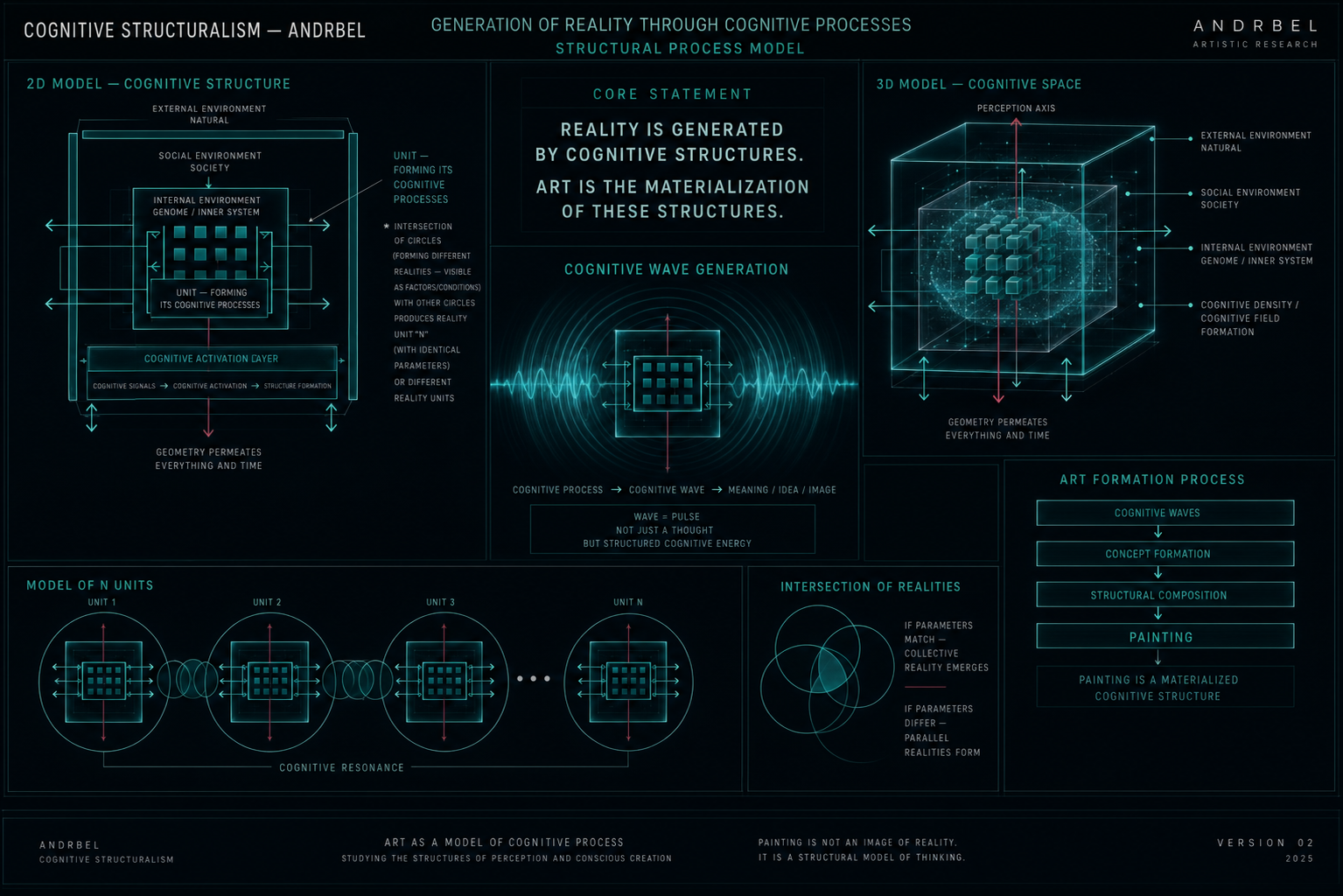
This diagram represents a structural fragment of the Cognitive Structuralism framework.
It illustrates how cognitive processes generate internal structures, which give rise to cognitive waves — impulses that lead to meaning, idea, and image formation.
These processes result in structural compositions that materialize as paintings.
Art as Cognitive Model
Within this framework, a painting is not conceived as a representation.
Each work functions as a cognitive model — a structured visualization of thinking processes.
Every painting captures:
— a cognitive state
— a structural configuration
— a moment of perception
Cognitive Process
Cognition → Structure → Perception → Reality → Art
Cognition generates structures.
Structures organize perception.
Perception produces reality.
Art materializes this process.
Geometry as Thinking Architecture
Geometry is not a stylistic element.
It functions as a structural framework of cognition — a system through which perception is organized and made visible.
Beyond Painting
Cognitive Structuralism is not limited to painting.
The same cognitive structures may be expressed through:
— visual form
— spatial environments
— sound structures
— movement
— algorithmic systems
Process Model (Version 02)
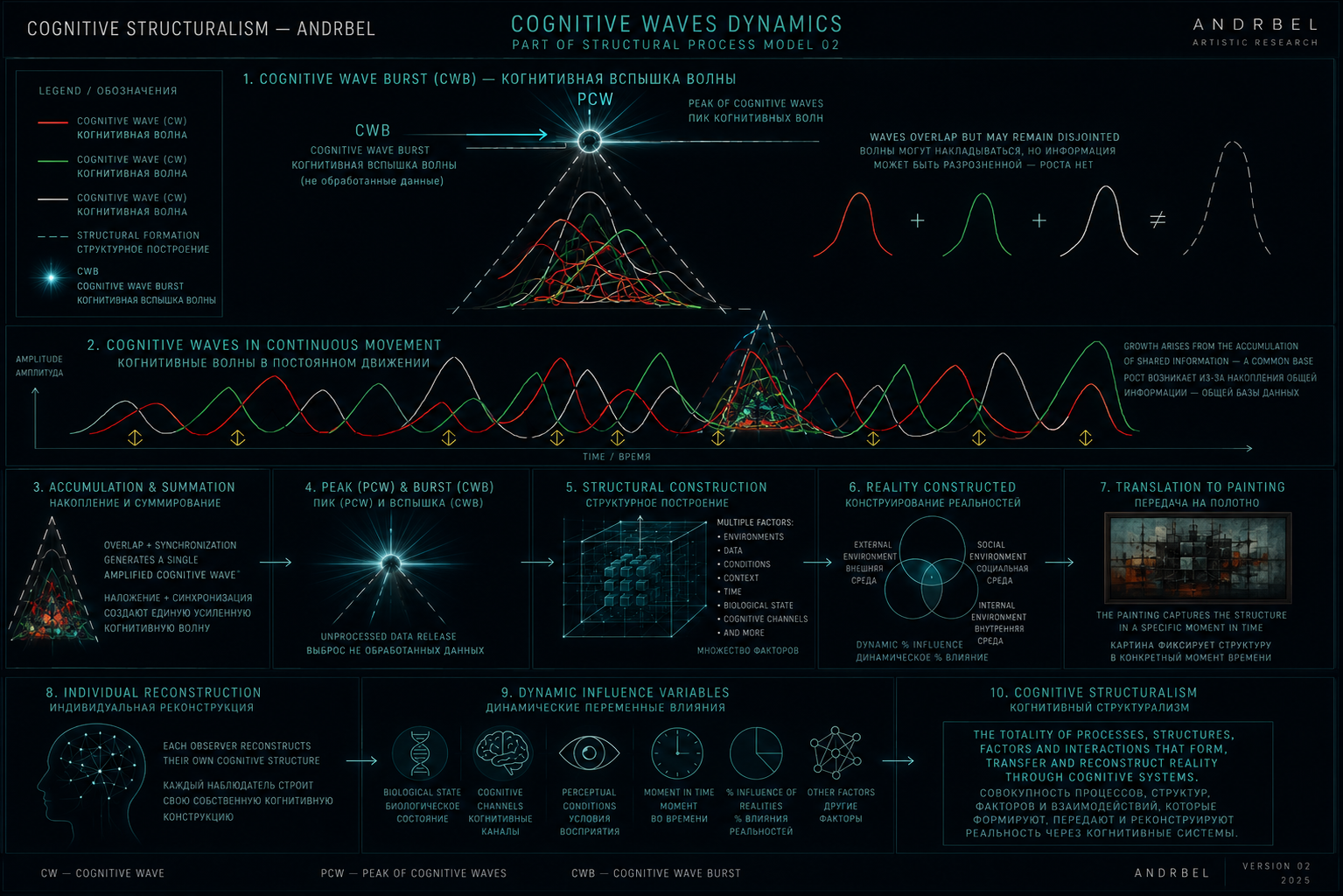
cognitive waves dynamics
Cognitive Structuralism — AndrBel
Cognitive Waves Dynamics
Within the framework of Cognitive Structuralism, cognitive processes generate continuous perceptual activations described as Cognitive Waves (CW).
These waves emerge through the interaction between:
- biological conditions
- social environments
- internal cognitive structures
- memory
- perception
- accumulated experience
- environmental stimuli
Cognitive Waves exist in constant movement and interaction.
As waves overlap and synchronize, they may begin to accumulate shared cognitive information.
This accumulation generates structural amplification.
Individual waves no longer function as isolated perceptual signals.
They progressively integrate into a larger cognitive formation.
Accumulation and Structural Growth
Not every overlap produces growth.
Cognitive Waves may intersect while remaining fragmented or structurally disconnected.
In such cases, information remains dispersed, and no amplified structure emerges.
Growth occurs only when waves accumulate around:
- shared information
- common perceptual structures
- related cognitive signals
- interconnected experiential data
This accumulation creates an intensified unified wave structure.
Within Cognitive Structuralism, this process is described as:
the transition from multiple Cognitive Waves (CW)
toward a structurally amplified cognitive formation.
Peak of Cognitive Waves (PCW)
As accumulation intensifies, the cognitive structure reaches a state of maximum perceptual density:
PCW — Peak of Cognitive Waves
At this stage:
- cognitive information becomes highly concentrated
- perceptual intensity increases
- structural tension accumulates
- internal cognitive pressure reaches critical density
However, the information remains:
unprocessed and structurally unresolved.
The Peak of Cognitive Waves does not yet produce meaning or final structure.
It produces:
- concentrated cognitive potential
- unstable perceptual energy
- unresolved structural data
Cognitive Wave Burst (CWB)
When cognitive density exceeds structural stability, the system generates:
CWB — Cognitive Wave Burst
The Cognitive Wave Burst represents:
the release of unprocessed cognitive information.
This is not yet interpretation.
Not yet image.
Not yet finalized meaning.
It is:
- raw perceptual material
- unresolved cognitive data
- structural potential awaiting organization
Structural Construction
Following the Cognitive Wave Burst, cognition begins constructing a perceptual structure from accumulated and unresolved data.
This structural formation is influenced by multiple variables:
- biological state
- cognitive channels
- perceptual conditions
- memory
- environmental influence
- social systems
- internal psychological structures
- temporal context
- dynamic influence of realities
Within Cognitive Structuralism, reality is not fixed.
Different realities exert different levels of influence at different moments in time.
Therefore:
the resulting cognitive structure is always dynamic, variable, and temporally conditioned.
The constructed structure becomes:
- a perceptual model
- a cognitive configuration
- a structural interpretation of reality
Painting as Structural Fixation
The transfer of this structure into painting fixes a specific cognitive configuration within a particular moment in time.
The artwork materializes:
- the cognitive structure
- the perceptual state
- the structural organization generated during that moment
a materialized cognitive structure.
Observer Reconstruction
Each observer encountering the painting reconstructs the structure differently.
Interpretation depends on:
- cognitive condition
- biological state
- perceptual systems
- memory
- environmental influence
- accumulated experience
- temporal context
- degree of overlap between cognitive structures
The viewer reconstructs:
an individual cognitive reality.
Terminology
Terminology
CW — Cognitive Wave
PCW — Peak of Cognitive Waves
CWB — Cognitive Wave Burst
Within Cognitive Structuralism:
Within Cognitive Structuralism:
- reality is generated through cognitive structures
- perception functions as structural organization
- paintings materialize cognitive constructions
- meaning emerges through interaction between structure and observer cognition
Cognitive Structuralism therefore studies:
how cognition structures, transfers, and reconstructs reality through perceptual systems.
Painting is a materialized cognitive structure.
Cognitive Structuralism — AndrBel

Cognitive Structuralism
Painting is not an image of reality.
It is a structural model of thinking through which reality becomes visible.
1
Reality is generated through cognitive structures
Reality as a result of cognitive organization.
2
Painting as a cognitive model
Cognition
↓
Structure
↓
Painting
The painting becomes a model of cognitive organization.
3
geometry as cognitive architecture
Geometry as the architecture of cognition.
4
Shared Reality Hypothesis
Individual Reality A
Individual Reality B
Individual Reality C
↓
Shared Reality
Objective reality as an area of intersection of many cognitive models.
5
Cognitive Waves Model
Experience
↓
Cognitive Waves
↓
Peak
↓
Burst
↓
Painting
The mechanism of emergence of artistic structure.
Cognitive Structuralism
Version 02
May 2025
Author: AndrBel
Support independent artistic research in Cognitive Structuralism, conceptual painting, and long-term cultural infrastructure development.
[Support Research]
© 2025 AndrBel. All rights reserved.
Cognitive Structuralism is an original research-based conceptual framework developed by AndrBel.
The theory explores the structural relationship between cognition, perception, and environment through artistic and interdisciplinary investigation.
Academic citation is permitted with proper attribution.
Suggested citation:
AndrBel, “Cognitive Structuralism: A Conceptual Framework of Perception and Environment,” 2025.
Any commercial use, derivative theoretical development, or institutional application of this framework requires prior written authorization from the author.
“I am not interested in depicting the world as it appears.
I am interested in how the mind constructs it.” — AndrBel
Projects




Cognitive Structuralism — AndrBel
Ongoing Artistic Research Framework
© AndrBel, 2025–Present
Cognitive Structuralism is a proprietary conceptual framework developed by AndrBel as part of his artistic and research practice.
The system includes original theoretical constructs, terminology, and structural models related to perception, cognition, and environment.
Unauthorized use, reproduction, or reinterpretation of the Cognitive Structuralism framework, in whole or in part, is strictly prohibited without prior written consent from the author.
Cognitive Structuralism forms part of the intellectual property of AndrBel and is developed within the broader institutional context of ARTHALL BEL4224.