PAPER #8
PAPER #8
Physical Cultural Objects and Cultural Digital Assets
ANDRBEL Research Program
Demonstration and Validation Project (DAP) Research Series
DAP #0A
AndrBel
Publication Metadata
Research Program: ANDRBEL Research Program
Framework Context: ADAS Framework Series
Research Type: Foundational Ontological Investigation
Protocol Function: Physical–Digital Ontology and Cultural Qualification Foundation
Future Standard Context: CDA Protocol v1.0
Institutional Context: CDA Standards Organization
Publication Position: PAPER #8 (DAP #0A)
Version: 1.0
Abstract
Previous investigations within the Demonstration and Validation Project (DAP) Research Series examined multiple classes of potential Cultural Digital Assets and progressively developed structural approaches to digital cultural qualification. In doing so, however, they exposed an underlying ontological problem. A digital object may represent, derive from, document, extend, or otherwise relate to a physical artwork, yet the cultural status of the physical object cannot simply be assumed. Nor can the cultural qualification of either object be automatically transferred to the other.
DAP #0A addresses this problem through the introduction and investigation of three physical-domain concepts: Physical Artistic Object (PAO), PCO Candidate, and Physical Cultural Object (PCO). The study examines how a physical artistic object may enter a cultural qualification process; how Cultural Relevance, Cultural Significance, Cultural Recognition, evidence, scope, provenance, governance, and continuity contribute to that process; and how qualification can remain structured without reducing cultural judgment to market value, popularity, institutional prestige, legal heritage designation, or universal ranking.
The investigation establishes that cultural recognition is attributable and scope-dependent rather than universally centralized. Museums, galleries, artists, researchers, communities, collectors, public institutions, and other cultural actors may exercise different forms of legitimate cultural authority within different mandates and scopes. Accordingly, conflicting recognition does not necessarily constitute logical contradiction, and cultural qualification requires preservation of attribution, evidence, scope, and qualification provenance.
The study further establishes that PCO qualification and CDA qualification are independent. A Physical Cultural Object does not automatically generate a Cultural Digital Asset, and a Cultural Digital Asset does not automatically qualify a related physical object as a PCO. A CDA may therefore exist without a PCO, a PCO may exist without a CDA, and a digital object may be qualified as a CDA before a related Physical Artistic Object receives PCO qualification.
This independence does not eliminate the cultural significance of physical–digital relationships. Instead, DAP #0A identifies a distinct relational cultural domain in which physical and digital cultural objects may be connected through source relationships, representation, derivation, authorization, provenance, governance, cultural dependency, qualification dependency, and continuity. The study therefore extends provenance beyond physical and digital histories to include Relational Provenance and Qualification Provenance.
The investigation also connects the emerging PCO–CDA architecture to earlier research on Artist Legacy Infrastructure and Artistic Continuity Infrastructure. Cultural continuity is shown to depend not only on material preservation but also on the continuity of identity, provenance, interpretation, governance, qualification, and institutional stewardship.
The principal conclusion of DAP #0A is that physical and digital cultural objects should be independently qualified while their relationships should be explicitly structured, evidenced, governed, and preserved. On this basis, the study proposes a three-domain architecture comprising a Physical Cultural Layer, Relational Cultural Layer, and Digital Cultural Layer.
The paper does not establish a universal judgment of artistic quality or cultural superiority, nor does it replace national heritage law or existing cultural authority. Instead, it establishes a structural foundation from which future CDA Protocol development may standardize terminology, qualification records, evidence structures, recognition scope, provenance, governance, continuity, interoperability, and protocol conformity while leaving cultural judgment attributable to the actors and institutions that exercise it.
Keywords
PART I
Research Problem and Central Research Question
1.1 The Hidden Physical Assumption in Digital Cultural Infrastructure
The development of Cultural Digital Asset theory initially focused on digital objects.
Within the ADAS Framework Series and subsequent Demonstration and Validation Project investigations, the central problem was whether different classes of digital objects could possess sufficient cultural, structural, governance, continuity, and infrastructural properties to qualify as Cultural Digital Assets.
This produced an expanding field of investigation around digital cultural objects.
Yet a significant category of digital objects does not exist independently from physical culture.
Digital cultural objects may originate from or relate to:
- paintings;
- sculptures;
- drawings;
- installations;
- manuscripts;
- physical artistic objects;
- documented cultural artifacts.
- What is the cultural status of the physical object?
A physical artwork is unquestionably a physical artistic object.
It does not necessarily follow, however, that every physical artwork already possesses formally established cultural status.
Consequently, a theory capable of qualifying digital cultural objects cannot silently assume that every related physical source object has already been culturally qualified.
1.2 From Artwork to Cultural Object
Consider a painting existing in an artist's studio.
The work may be:
- created and completed;
- documented by the artist;
- privately owned;
- unknown to museums;
- absent from scholarly research;
- commercially unsold;
- culturally unrecognized outside the artist's practice.
But is it already a Physical Cultural Object?
The question becomes more difficult when the same work is:
- included in an artist archive;
- documented within an institutional registry;
- researched;
- exhibited;
- recognized by a community;
- acquired by a museum;
- associated with a significant artistic practice;
- legally protected;
- or incorporated into long-term cultural infrastructure.
And who possesses the authority to make such a determination?
These questions reveal that the categories artwork and cultural object cannot simply be treated as synonymous.
1.3 The Problem of Cultural Authority
A second problem follows immediately.
If cultural qualification exists, who can legitimately recognize cultural significance?
Possible recognizing actors include:
- the artist;
- a museum;
- a gallery;
- a curator;
- a researcher;
- a university;
- a collector;
- an archive;
- a foundation;
- a community;
- a municipality;
- a ministry;
- a national authority;
- an international cultural institution.
None of these actors possesses identical authority.
A museum may recognize an object within its collection or institutional mandate.
A community may recognize an object as significant to its cultural memory.
A researcher may establish scholarly significance.
A state may establish a legal cultural-property designation.
A gallery may establish art-historical or market recognition within a particular professional context.
These recognitions may overlap.
They may also disagree.
Therefore the problem cannot be reduced to identifying one universal authority capable of declaring cultural status for every physical object.
The more precise question becomes:
- What kind of cultural authority can each recognizing entity legitimately exercise, within what mandate, and within what scope?
1.4 The Problem of Recognition Scope
The statement:
- This object is culturally recognized.
Recognition may occur at different levels and within different contexts.
An object may be recognized:
- individually;
- as part of a series;
- as part of an artist's corpus;
- within an artistic practice;
- by a specific institution;
- by a cultural community;
- locally;
- regionally;
- nationally;
- internationally;
- or within a legal jurisdiction.
A museum may recognize an object while another museum does not.
A national authority may legally protect an object without producing international cultural consensus.
Consequently:
- Recognition without attributable scope cannot adequately describe cultural status.
1.5 The Problem of Cultural Value
Cultural qualification is further complicated by several adjacent forms of value and recognition.
An artwork may:
- sell for millions of dollars;
- receive extensive media attention;
- accumulate a large public audience;
- enter a major private collection;
- become legally protected;
- become strongly associated with a particular territory.
The study must therefore distinguish among:
- Cultural Significance
- Economic Value
- Market Recognition
- Popularity
- Public Cultural Recognition
- Territorial Recognition
- Institutional Recognition
- Legal Cultural Status
- a market ranking;
- a popularity index;
- an institutional prestige hierarchy;
- or an imitation of cultural-property law.
1.6 The Original PCO–CDA Problem
The central problem becomes particularly visible when a digital object is created from a physical artwork.
Consider:
Physical Artwork
↓
Digital Representation
↓
Digital Cultural Qualification
If the digital object satisfies the structural requirements for CDA qualification, several possibilities arise.
Case A
PAO
↓
no CDA
A physical artistic object exists without a related Cultural Digital Asset.
Case B
PAO
↓
related CDA
A CDA exists in relation to a physical artistic object that has not itself received PCO qualification.
Case C
PCO
↓
no CDA
A culturally qualified physical object exists without a corresponding CDA.
Case D
PCO
↕
CDA
Both physical and digital objects are independently qualified and structurally related.
Case E
CDA
A Cultural Digital Asset exists without any physical source object.
These cases demonstrate that neither physical nor digital cultural qualification can be treated as universally dependent on the other.
1.7 The Reverse Cultural Influence Problem
A further problem emerges when digital cultural infrastructure affects the physical object itself.
Suppose a physical artwork has not received PCO qualification.
A related CDA is subsequently created and becomes part of:
- a documented registry;
- an institutional archive;
- a research program;
- a provenance system;
- a cultural collection;
- a continuity infrastructure.
- documentation;
- visibility;
- provenance evidence;
- research;
- cultural recognition;
- institutional relationships.
But its cultural context has.
This raises a crucial question:
- Can the existence of a CDA influence the later cultural qualification of a related physical object without automatically transferring CDA status into PCO status?
1.8 The Missing Relational Domain
If PCO and CDA are independently qualified, the relationship between them cannot simply be encoded as:
PCO ID
+
CDA ID
The relationship itself may contain culturally and institutionally significant information.
For example:
- Which object originated first?
- Is the digital object a representation or derivative?
- Who authorized its creation?
- Does one object's cultural meaning depend on the other?
- Does one qualification depend on the other?
- How was the relationship established?
- Can it be disputed?
- Can it change?
- Who governs the relationship?
- How is it preserved over time?
DAP #0A therefore investigates whether cultural infrastructure requires three rather than two structural layers:
PHYSICAL CULTURAL LAYER
↕
RELATIONAL CULTURAL LAYER
↕
DIGITAL CULTURAL LAYER
1.9 The Continuity Problem
The physical–digital relationship also introduces a temporal problem.
Physical preservation alone does not guarantee cultural continuity.
A physical artwork may survive materially while losing:
- attribution;
- provenance;
- documentation;
- interpretation;
- governance;
- qualification history;
- institutional context.
Therefore DAP #0A asks whether cultural continuity requires preservation across multiple dimensions rather than preservation of the object alone.
This connects the investigation directly to earlier research on Artist Legacy Infrastructure and Artistic Continuity Infrastructure, where continuity is treated as a governance and institutional problem rather than solely as archival preservation.
1.10 Standardization Without Standardizing Culture
The investigation ultimately produces a standards problem.
If a future CDA Protocol includes a physical cultural layer, what can it legitimately standardize?
It may potentially standardize:
- terminology;
- object identification;
- qualification procedures;
- evidence structures;
- Recognition Records;
- recognition scope;
- provenance;
- governance;
- qualification history;
- review;
- versioning;
- interoperability.
- artistic quality;
- aesthetic merit;
- cultural superiority;
- universal cultural meaning;
- cultural taste.
- The objective is not to standardize culture. The objective is to standardize the infrastructure through which cultural qualification can be attributed, evidenced, governed, preserved, and made interoperable.
1.11 Central Research Question
The investigation is therefore organized around the following Central Research Question:
- What is the relationship between a Physical Cultural Object and a Cultural Digital Asset, and where does cultural status structurally emerge?
Physical Objecthood
What distinguishes a Physical Artistic Object from a Physical Cultural Object?
Qualification
Under what structural conditions may a physical artistic object become culturally qualified?
Recognition
Who may legitimately recognize cultural significance, and within what mandate and scope?
Plurality
How should conflicting or overlapping cultural recognitions be represented?
Value
How should cultural significance be separated from market value, popularity, prestige, and legal designation?
Physical–Digital Independence
Does PCO qualification depend on CDA qualification, or CDA qualification on PCO qualification?
Relationship
How should relationships between physical and digital cultural objects be classified and recorded?
Provenance
How can the relationship between a particular PCO and a particular CDA be evidenced over time?
Governance
Who may create, modify, challenge, maintain, or withdraw qualification and relationship records?
Continuity
What must survive for a cultural object to remain culturally intelligible across generations?
Standardization
Which elements of this architecture can legitimately become part of CDA Protocol without turning the Protocol into an authority over culture itself?
1.12 Research Proposition
DAP #0A begins with the proposition that physical and digital cultural qualification should not be assumed to constitute a single inherited status.
Instead, the investigation tests whether a more coherent architecture can be established through:
Independent Object Qualification
+
Attributable Cultural Recognition
+
Structured Evidence
+
Recognition Scope
+
Relational Provenance
+
Distributed Governance
+
Long-Term Continuity
The proposition is not treated as a predetermined conclusion.
Its validity must emerge from the investigation.
1.13 Position of DAP #0A in the DAP Research Series
DAP #0A occupies an unusual position within the research chronology.
Chronologically, the investigation was developed after DAP #1–#7.
Conceptually, however, it addresses an ontological assumption located between the foundational work of DAP #0 and the later object-specific investigations.
Its designation DAP #0A therefore represents conceptual placement rather than chronological production order.
Chronological Research Sequence
DAP #0
↓
Research Design Workshop
↓
Between DAP #0 and DAP #1
↓
DAP #1
↓
DAP #2
↓
DAP #3
↓
DAP #4
↓
DAP #5
↓
DAP #6
↓
DAP #7
↓
DAP #0A
Conceptual Position
DAP #0
↓
DAP #0A
↓
DAP #1–#7
This distinction preserves the actual research chronology.
DAP #0A does not retroactively claim to have provided the theoretical basis from which DAP #1–#7 were originally derived.
Rather, the accumulated investigations of DAP #1–#7 made it possible to identify a previously implicit physical-cultural assumption requiring separate investigation.
This follows the Research Chronology Principle already established for the research program: later research may use and reinterpret earlier findings, but earlier research cannot retroactively derive its findings from research that did not yet exist.
1.14 Research Objective
The objective of DAP #0A is therefore not to determine which artworks are culturally important.
Its objective is to establish whether a reproducible structural architecture can describe:
Physical Artistic Object
↓
Cultural Qualification Process
↓
Physical Cultural Object
↕
Physical–Digital Relationship
Digital Object
↓
Cultural Digital Qualification
↓
Cultural Digital Asset
while preserving the independence of cultural judgment, institutional mandates, legal systems, and cultural plurality.
If such an architecture can be established, DAP #0A may provide a foundational physical–digital ontology for subsequent DAP investigations, Comparative DAP Analysis, and the eventual development of CDA Protocol v1.0.
PART II
Research Object, Scope and Method
2.1 Research Object
The primary research object of DAP #0A is the structural relationship between physical artistic objects, physical cultural qualification, and Cultural Digital Assets.
The investigation does not begin from the assumption that every physical artwork is already a cultural object.
Instead, it distinguishes between:
Physical Artistic Object (PAO)
and
Physical Cultural Object (PCO)
and investigates the structural transition that may occur between them.
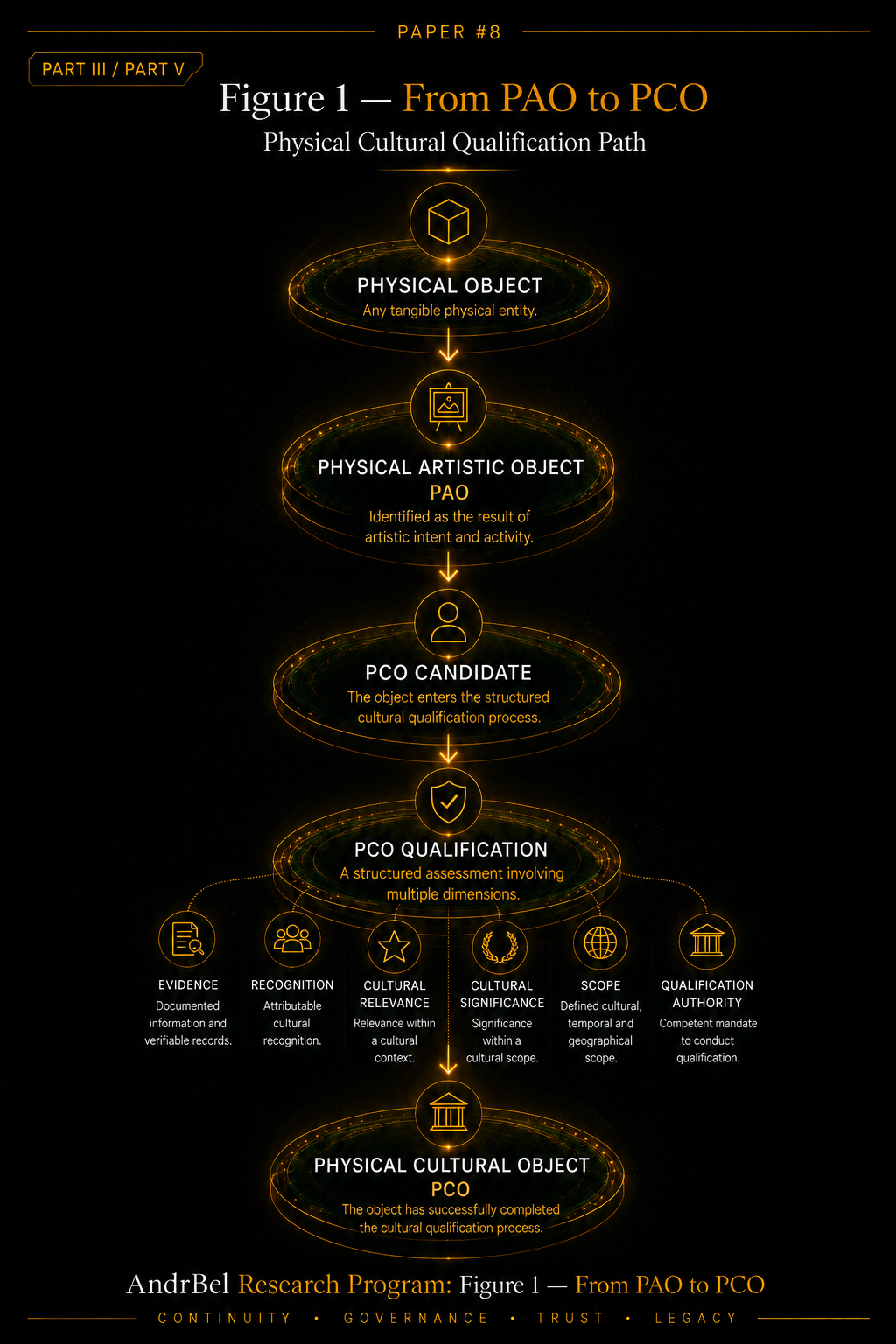
The initial physical-domain sequence examined by the study is therefore:
Physical Object
↓
Physical Artistic Object (PAO)
↓
PCO Candidate
↓
PCO Qualification
↓
Physical Cultural Object (PCO)
The study then investigates how this physical qualification architecture interacts with the digital cultural domain:
PHYSICAL DOMAIN
PAO
↓
PCO Candidate
↓
PCO
↕
Cultural Relationship
↕
DIGITAL DOMAIN
Digital Object
↓
CDA Qualification
↓
CDA
The research object is consequently not the physical artwork alone and not the Cultural Digital Asset alone.
It is the qualification architecture and relational infrastructure connecting physical and digital cultural objects.
2.2 Primary Unit of Investigation
The primary unit of investigation is an identifiable physical artistic object.
Examples include:
- a painting;
- a sculpture;
- a drawing;
- a physical installation;
- a mixed-media artwork;
- another identifiable physical object produced within artistic practice.
- authorship;
- identity;
- physical provenance;
- documentation;
- recognition;
- cultural significance evidence;
- institutional relationships;
- market history;
- legal context;
- related digital objects.
The study therefore asks:
- Under what structural conditions may an identifiable Physical Artistic Object be qualified as a Physical Cultural Object?
2.3 Secondary Unit of Investigation
The secondary unit of investigation is the relationship between a physical artistic or cultural object and a digital cultural object.
The relationship itself may contain information that cannot be adequately represented within either object's independent record.
For example:
Physical Object
│
├── source relationship
├── representation
├── derivation
├── authorization
├── provenance
├── cultural dependency
├── qualification dependency
└── governance
│
▼
Digital Object
DAP #0A therefore treats the physical–digital relationship as a distinct analytical object.
This becomes particularly important where:
- a CDA derives from a physical artwork;
- a CDA represents a physical artwork;
- physical and digital objects develop in parallel;
- the digital object affects recognition of the physical object;
- the physical and digital components operate as a hybrid cultural system;
- provenance or governance must be preserved across both domains.
2.4 Research Scope: Physical Artistic Objects
The term Physical Cultural Object could potentially encompass a very broad field.
Possible examples outside contemporary artistic practice may include:
- archaeological artifacts;
- historical objects;
- sacred objects;
- ethnographic objects;
- architectural elements;
- manuscripts;
- memorial objects;
- culturally significant everyday objects;
- objects of indigenous cultural authority;
- objects protected as national heritage.
The present investigation develops and tests the PCO concept primarily through physical artistic objects.
Accordingly:
- The validated scope of DAP #0A is narrower than the potential future scope of the term Physical Cultural Object.
PAO
↓
PCO Candidate
↓
PCO
should therefore be understood as the qualification pathway investigated for physical artistic objects, rather than as a universal ontological sequence applicable to every possible form of physical cultural heritage.
This distinction is essential.
An archaeological artifact, for example, need not first constitute a Physical Artistic Object in order eventually to be recognized within some future PCO architecture.
Such cases require separate investigation.
2.5 Why the Scope Is Deliberately Restricted
The restriction is methodological rather than conceptual.
DAP #0A emerged from questions generated by the previous investigation of Cultural Digital Assets associated with artistic practice.
The immediate problem was not:
- What constitutes every possible physical cultural object?
- What happens when a Cultural Digital Asset relates to a physical artwork whose own cultural qualification cannot simply be assumed?
- physical cultural qualification;
- recognition authority;
- evidence;
- scope;
- provenance;
- governance;
- physical–digital relationships;
- continuity.
DAP #0A intentionally avoids that move.
2.6 Research Boundary: Cultural Qualification Is Not Cultural Judgment Automation
The study investigates how cultural qualification may be structured.
It does not attempt to develop an algorithm for determining cultural worth.
This distinction defines one of the principal methodological boundaries of the research.
DAP #0A does not ask:
- How culturally good is this artwork?
- How important is this artwork compared with another artwork?
- Which institution possesses the final truth about the object's cultural meaning?
Who made the cultural claim?
↓
Under what mandate?
↓
At what scope?
↓
Using what evidence?
↓
Through what qualification procedure?
↓
How is the resulting record governed?
↓
How can it be reviewed?
↓
How can it remain traceable over time?
The research therefore investigates cultural qualification infrastructure, not automated cultural judgment.
2.7 Methodological Foundation
DAP #0A operates within the broader methodological architecture developed through the ANDRBEL Research Program, the ADAS Framework Series, the AndrBel Framework Methodology, and the Demonstration and Validation Project methodology.
The DAP Research Series is designed to investigate concrete objects or object classes, identify structural properties and tensions, and progressively contribute comparable findings toward the evolving theory of Cultural Digital Assets and eventual protocol development.
The present paper therefore uses DAP not as a certification procedure but as a research and validation methodology.
This distinction is important:
DAP Investigation
≠
Protocol Certification
DAP investigates.
Future protocol architecture may later translate sufficiently validated findings into normative structures.
The DAP Papers template likewise treats individual investigations as contributions to a continuing series supporting comparative structural analysis and the evolution of CDA theory rather than as self-contained final standards.
2.8 Research Chronology Method
DAP #0A uses a specific chronology rule.
The investigation was developed after DAP #1–#7.
It may therefore:
- examine problems revealed by those investigations;
- compare assumptions appearing across them;
- use their established findings as prior research;
- identify a missing ontological layer exposed by their cumulative development.
The methodological rule is:
Research A
produces Findings A
↓
Research B
may use Findings A
but
Research A
cannot retroactively derive its findings
from Research B
This Research Chronology Principle has already been explicitly established within the research program.
Accordingly, the conceptual placement of DAP #0A between DAP #0 and DAP #1 does not alter its chronological position after DAP #7.
2.9 Retrospective Foundational Investigation
This produces a particular methodological category for DAP #0A.
It is a retrospective foundational investigation.
The study does not merely continue the sequence by testing another digital object.
Instead, it returns to an assumption that became visible through accumulated research.
The methodological movement can be represented as:
DAP #0
↓
DAP #1–#7
↓
Accumulated Structural Findings
↓
Previously Implicit Assumption Identified
↓
DAP #0A
↓
Foundational Re-investigation
The result may subsequently influence later research:
DAP #0A
↓
DAP #8
↓
DAP #9
↓
Comparative DAP Analysis
but it does not rewrite the historical origin of DAP #1–#7.
2.10 Research Procedure
DAP #0A proceeds through a multi-stage structural investigation.
Stage 1 — Object Distinction
The study first distinguishes:
Physical Artistic Object
≠
Physical Cultural Object
This prevents cultural qualification from being assumed at the beginning of the investigation.
Stage 2 — Cultural Concept Analysis
The study examines the role of:
- Cultural Objecthood;
- Cultural Relevance;
- Cultural Significance;
- Cultural Recognition;
- Cultural Status;
- PCO Qualification.
Stage 3 — Recognition Analysis
The investigation examines:
- recognizing entities;
- institutional mandates;
- cultural authority;
- recognition scope;
- conflicting recognition;
- recognition provenance.
The study investigates how recognition and evidence may contribute to a formal PCO Qualification Record without reducing cultural qualification to a universal centralized judgment.
Stage 5 — Context Separation
The research separates cultural qualification from adjacent domains including:
- economic value;
- market recognition;
- popularity;
- public recognition;
- territorial affiliation;
- national recognition;
- legal cultural heritage status.
The investigation tests multiple physical–digital configurations:
PAO → no CDA
PAO → CDA
PCO → no CDA
PCO ↔ CDA
CDA without PCO
CDA before PCO
Stage 7 — Relationship Analysis
The study investigates different relationship structures and distinguishes:
- source relationship;
- cultural dependency;
- qualification dependency;
- governance dependency.
The research distinguishes:
Physical Provenance
Digital Provenance
Relational Provenance
Qualification Provenance
Stage 9 — Governance Analysis
The study investigates distributed authority over:
- identity;
- evidence;
- attribution;
- recognition;
- qualification;
- provenance;
- custodianship;
- correction;
- challenge;
- withdrawal.
The study tests cultural continuity across:
- material;
- identity;
- provenance;
- interpretation;
- governance;
- qualification;
- institutional dimensions.
Finally, the investigation distinguishes between what a future protocol may structurally standardize and what must remain outside normative standardization.
2.11 Analytical Method: Structural Decomposition
The primary analytical technique used throughout DAP #0A is structural decomposition.
Complex statements are separated into distinct components.
For example:
“This painting is a culturally important object.”
is decomposed into questions concerning:
Object Identity
+
Claim
+
Recognizing Entity
+
Mandate
+
Evidence
+
Recognition Scope
+
Qualification Procedure
+
Record
+
Governance
+
Time
Likewise:
“This digital work represents that painting.”
is decomposed into:
Physical Identity
+
Digital Identity
+
Relationship Type
+
Source
+
Authorization
+
Creation Event
+
Provenance
+
Rights Context
+
Governance
Structural decomposition prevents multiple independent claims from being hidden inside a single cultural statement.
2.12 Analytical Method: Boundary Testing
The study also uses boundary cases to test whether proposed concepts remain coherent under difficult conditions.
Examples include:
- a culturally unknown artwork with a qualified related CDA;
- an inexpensive but culturally significant object;
- an expensive but weakly culturally evidenced object;
- conflicting museum recognition;
- strong community recognition without institutional recognition;
- national recognition without international recognition;
- legal heritage status without equivalent broader cultural recognition;
- PCO qualification without CDA;
- CDA qualification without PCO.
They function as conceptual stress tests.
Their purpose is to expose hidden assumptions, category errors, and inappropriate dependencies.
2.13 Analytical Method: Independence Testing
A recurring methodological operation is the testing of assumed dependencies.
For each relationship, DAP #0A asks whether:
- A requires B
- A and B may exist independently
A and B are independently constituted
but relationally influential
This method is particularly important for:
Cultural Significance ↔ Economic Value
Recognition ↔ Qualification
PCO ↔ Legal Heritage Status
PCO ↔ CDA
Ownership ↔ Governance
Physical Survival ↔ Cultural Continuity
The method prevents correlation, association, or historical convention from being mistaken for structural necessity.
2.14 Analytical Method: Relational Analysis
Where independence is established, the investigation does not assume isolation.
Instead, it examines whether independent entities participate in meaningful relationships.
This produces the analytical distinction:
- independence does not imply absence of relationship.
Independent Qualification
+
Relational Interaction
can coexist.
This distinction becomes the methodological basis for investigating the Relational Cultural Layer.
2.15 Analytical Method: Temporal Analysis
Cultural qualification and recognition are not assumed to be static.
The study therefore examines:
- when recognition occurred;
- when qualification occurred;
- which evidence existed at the time;
- whether scope changed;
- whether recognition was withdrawn;
- whether attribution changed;
- whether governance authority changed;
- whether later evidence modified the record.
- versioning;
- qualification provenance;
- recognition history;
- governance history.
2.16 Analytical Method: Role and Authority Separation
DAP #0A distinguishes actors according to function rather than prestige.
A single actor may occupy several roles, but the roles themselves remain analytically distinct.
The study therefore separates:
Cultural Recognition Authority
↓
PCO Qualification Authority
↓
Record Custodian
↓
Protocol Conformity Authority
↓
Standards Steward
This prevents recognition, qualification, record maintenance, conformity assessment, and standards governance from collapsing into a single institutional power.
The distinction is particularly important for the future role of CDA Standards Organization.
2.17 Evidence as Structured Support
Evidence within DAP #0A is not treated as a universal numerical score of cultural worth.
Instead, evidence supports attributable claims.
Possible evidence may include:
- authorship documentation;
- archival records;
- exhibition history;
- scholarly research;
- collection history;
- institutional records;
- community documentation;
- publications;
- provenance;
- legal records;
- documented cultural use;
- long-term public memory.
Therefore:
Evidence
≠
Cultural Value Score
Evidence is contextual, attributable, and claim-dependent.
2.18 Non-Scalar Research Design
DAP #0A deliberately tests whether cultural qualification requires hierarchical levels.
The research considers but does not assume models such as:
PCO Level 1
PCO Level 2
PCO Level 3
...
Instead, the investigation compares such scalar systems with a multidimensional model capable of representing:
- Qualification Status;
- Recognition;
- Scope;
- Evidence;
- Provenance;
- Governance;
- Continuity;
- contextual information.
The final choice between these alternatives must emerge from the investigation.
2.19 Relationship to Artist Legacy Infrastructure and Artistic Continuity Infrastructure
DAP #0A also draws upon earlier research concerning the continuity of artistic practice.
That research established that preservation cannot be reduced to storage alone.
Long-term artistic continuity involves:
- identity;
- documentation;
- governance;
- succession;
- custodianship;
- institutional responsibility.
Instead, it tests whether its continuity logic becomes relevant when the unit of analysis shifts from artistic practice as a whole to individual physical and digital cultural objects.
The investigation therefore provides a potential bridge between:
Artist Legacy Infrastructure
↓
Artistic Continuity Infrastructure
and
ADAS
↓
CDA
↓
DAP
Whether this bridge is structurally supported is treated as an outcome of the investigation rather than an initial assumption.
2.20 Relationship to CDA Protocol Development
DAP #0A is a research document.
It is not CDA Protocol v1.0.
Accordingly, its conclusions are not automatically normative requirements.
The methodological translation pathway is:
Research Observation
↓
Analysis
↓
Research Finding
↓
Protocol Implication
↓
Comparative DAP Analysis
↓
Structural Knowledge Matrix
↓
Research Consolidation
↓
Protocol-Ready Finding
↓
Normative Translation
↓
CDA Protocol
This separation is fundamental.
A finding may be theoretically valid within DAP #0A while still requiring comparison against other DAP investigations before it can become a general protocol rule.
2.21 Relationship to CDA Standards Organization
The institutional architecture of CDA Standards Organization distinguishes research, standardization, and implementation and places long-term stewardship of the CDA Protocol within an independent standards environment rather than within a commercial implementation entity.
DAP #0A operates on the research side of that boundary.
It may produce concepts relevant to future standards.
It does not itself authorize:
- legal cultural designation;
- universal PCO recognition;
- mandatory certification;
- governmental cultural status;
- institutional accreditation.
The purpose of the research is to investigate a common framework capable of supporting distributed cultural authority while preserving interoperability.
2.22 Voluntary Application Boundary
The proposed standards architecture is intended for voluntary use across the cultural ecosystem.
Potential future users may include:
- artists;
- artist estates;
- museums;
- galleries;
- archives;
- collectors;
- auction houses;
- foundations;
- universities;
- municipalities;
- ministries;
- community organizations;
- cultural registries;
- independent platforms.
Accordingly:
- Protocol conformity should describe conformity with a shared structural method, not agreement with a universal cultural judgment.
2.23 Exclusions from the Present Study
DAP #0A does not attempt to resolve comprehensively:
- archaeological cultural objects;
- sacred cultural objects;
- indigenous cultural authority;
- contested heritage;
- restitution disputes;
- architectural heritage;
- monuments;
- anonymous historical objects;
- mass-produced cultural objects;
- natural-cultural objects;
- all forms of intangible cultural heritage;
- jurisdiction-specific cultural-property law.
- a universal PCO threshold;
- universal accreditation requirements for Qualification Authorities;
- a global PCO registry architecture;
- mandatory technical implementation;
- a universal cultural-value metric.
2.24 Research Limitations at the Method Stage
Three methodological limitations should therefore be acknowledged before the substantive investigation begins.
First
The study develops PCO theory primarily through artistic objects.
Generalization beyond this domain requires further validation.
Second
The investigation is structural and conceptual, not statistical.
It does not claim population-level empirical validation across the global cultural sector.
Third
The study establishes an architecture for qualification but does not initially assume a final universal threshold for when evidence becomes sufficient for PCO qualification.
That threshold is itself part of the broader research and protocol-development problem.
These limitations constrain the claims of the paper without reducing the value of its structural findings.
2.25 Research Integrity Principle
The methodological position of DAP #0A can therefore be summarized as follows:
- The study does not seek to determine culture through a standard. It investigates whether the claims, evidence, authorities, relationships, provenance, governance, and continuity surrounding physical and digital cultural objects can be represented through a reproducible structural framework without replacing the cultural judgments from which those records originate.
2.26 Methodological Sequence
The complete methodological movement of Paper #8 can now be represented as:
PHYSICAL ARTISTIC OBJECT
↓
Object Distinction
↓
Cultural Concept Analysis
↓
Recognition Analysis
↓
Scope Analysis
↓
Evidence Analysis
↓
Qualification Analysis
↓
Context Separation
↓
PCO Qualification Architecture
↓
Physical–Digital Independence Testing
↓
Relationship Analysis
↓
Provenance Analysis
↓
Governance Analysis
↓
Continuity Analysis
↓
Standardization Boundary Analysis
↓
Research Findings
↓
Protocol Implications
This sequence establishes the methodological foundation for the substantive investigation that follows.
PART III
Structural Ontology: From Physical Artistic Object to Physical Cultural Object
From Physical Artistic Object to Physical Cultural Object
3.1 The Ontological Problem
The first structural problem addressed by DAP #0A is deceptively simple:
- When does a physical artwork become a Physical Cultural Object?
- museum acquisition;
- scholarly recognition;
- public visibility;
- market circulation;
- legal protection;
- institutional documentation.
This creates a fundamental distinction between:
- the existence of an object as an artwork
- the qualification of that object as a cultural object within a structured cultural framework.
Physical Artwork
=
Physical Cultural Object
and instead begins from a differentiated ontology.
The working physical-domain architecture is:
Physical Object
↓
Physical Artistic Object (PAO)
↓
PCO Candidate
↓
PCO Qualification
↓
Physical Cultural Object (PCO)
This sequence does not describe increasing artistic quality.
It describes different structural states of identification and cultural qualification.
3.2 Physical Object
The broadest category is the physical object itself.
A physical object is a materially instantiated entity possessing sufficient physical identity to be distinguished from other objects.
Within the present investigation, this category functions only as the ontological starting point.
DAP #0A does not attempt to construct a universal theory of physical objects.
Its concern begins when a physical object exists within an artistic practice.
Thus:
Physical Object
↓
Artistic Relationship
↓
Physical Artistic Object
The artistic relationship may arise through:
- creation by an artist;
- incorporation into an artistic practice;
- deliberate artistic transformation;
- documented artistic authorship or attribution.
3.3 Physical Artistic Object (PAO)
DAP #0A introduces:
Physical Artistic Object (PAO)
as the baseline physical-artistic category.
A provisional definition is:
- A Physical Artistic Object (PAO) is an identifiable physical object created, constituted, or intentionally incorporated as an object of artistic practice, without presuming that it has undergone formal cultural qualification as a Physical Cultural Object.
It tells us:
- this is an artistic object.
- this object holds qualified cultural status.
PAO
=
artistic objecthood established
PCO
=
cultural qualification additionally established
This distinction is necessary because otherwise the PCO concept would add no structural information.
If every artwork were automatically a PCO, the term PCO would merely rename “artwork.”
DAP #0A rejects that redundancy.
3.4 PAO Is Not a Judgment of Artistic Quality
PAO does not mean:
- good artwork;
- successful artwork;
- professional artwork;
- museum-quality artwork;
- culturally important artwork.
The category identifies the object's position within artistic practice.
Thus:
PAO Status
≠
Aesthetic Merit
≠
Market Success
≠
Institutional Prestige
This distinction is important because cultural qualification must not begin by embedding an unacknowledged aesthetic judgment into the ontology itself.
3.5 PAO and Authorship
In the principal cases examined by DAP #0A, PAO identity normally involves an identifiable artistic authorship or attribution.
For example:
Artist
↓
creates Painting A
↓
Painting A = PAO
However, authorship and object identity remain separate attributes.
A later attribution dispute does not necessarily eliminate the object's identity as an artistic object.
For example:
Object Identity:
Stable
Attribution:
Artist X
↓
later disputed
↓
Workshop of X
The object remains identifiable even while authorship information changes.
Therefore:
- Object identity should not be collapsed into current attribution.
3.6 PAO Before Recognition
The PAO category is especially important for living artistic practices.
A work may be:
- completed;
- documented;
- catalogued;
- stored in the studio;
For example:
Artist creates Painting A
↓
PAO established
↓
No museum recognition
No market history
No research recognition
No public recognition
DAP #0A does not treat this state as deficient.
It is simply:
- an artistic object whose wider cultural qualification has not yet been established.
3.7 The Need for an Intermediate Qualification State
If PAO and PCO are different categories, a transition must exist between them.
But qualification cannot occur instantaneously as an unexplained label.
A physical artwork may enter a formal assessment process before a final PCO determination is made.
This produces the intermediate procedural category:
- PCO Candidate
PAO
↓
Qualification Initiation
↓
PCO Candidate
↓
Assessment
↓
Qualification Decision
This intermediate state is necessary for transparency.
Without it, a registry could only describe an object as:
Not PCO
or:
PCO
and would lose the important state:
- formal cultural qualification is underway.
3.8 PCO Candidate
A provisional definition is:
- A PCO Candidate is an identifiable Physical Artistic Object that has formally entered a PCO qualification process but for which active PCO qualification has not yet been established.
- procedural status
- cultural rank.
PCO Candidate
≠
partially qualified PCO
PCO Candidate
≠
lower-level PCO
PCO Candidate
≠
probably culturally important
It means only that a formal qualification claim or process exists.
3.9 Entry into Candidate Status
Candidate status requires an attributable qualification initiation.
The object does not become a PCO Candidate simply because:
- the artist hopes it will become culturally important;
- the work receives media attention;
- it has a high market price;
- someone informally calls it culturally significant.
A future qualification record may therefore require information such as:
Candidate Object ID
Qualification Initiator
Initiation Date
Qualification Basis
Initial Cultural Claim
Available Evidence
Proposed Recognition Scope
Applicable Procedure
The exact normative fields belong to later Protocol development.
The structural requirement established here is simpler:
- Candidate status must be attributable to an identifiable qualification event.
3.10 Candidate Status Does Not Presume a Positive Outcome
A PCO Candidate may eventually become:
Qualified PCO
but may also become:
Not Qualified
or:
Insufficient Evidence
or:
Withdrawn
or:
Assessment Suspended
Therefore Candidate status must never function as a cultural badge.
This matters particularly for:
- artist websites;
- galleries;
- marketplaces;
- registries.
- “PCO Candidate”
- “almost officially culturally important.”
3.11 From Candidate to Qualification
The transition from PCO Candidate to PCO cannot be reduced to one cultural signal.
DAP #0A instead identified several conceptual domains that need to be distinguished.
At minimum:
Object Identity
↓
Cultural Relevance
↓
Cultural Significance
↓
Cultural Recognition
↓
Evidence
↓
Recognition Scope
↓
Qualification Decision
This does not yet constitute the final CDA Protocol qualification test.
Paper #8 establishes the architecture necessary for such a test.
The final normative threshold remains a later research and protocol-development question.
3.12 Cultural Objecthood
Before defining the specific qualification concepts, DAP #0A distinguishes Cultural Objecthood from PCO Qualification.
Cultural Objecthood addresses the broader theoretical question:
- Under what conditions can an object meaningfully participate in a cultural system?
- Has this object been formally qualified as PCO under the proposed framework?
Therefore:
Cultural Objecthood
≠
PCO Qualification Record
Cultural Objecthood is primarily explanatory and theoretical.
PCO Qualification is procedural and record-based.
For this reason, Cultural Objecthood should not compete with PCO Qualification as a parallel normative status.
3.13 Cultural Relevance
DAP #0A requires a more precise concept to describe the relationship between an object and a cultural context.
It therefore uses:
- Cultural Relevance
- Cultural Relevance is an evidenced relationship connecting an object to an artistic, historical, social, institutional, territorial, community, research, or other identifiable cultural context.
- membership in an artistic series;
- relationship to an artist's established practice;
- association with a cultural movement;
- participation in a historically meaningful event;
- significance to a community;
- connection to an institutional collection;
- documented educational or research use.
What cultural context is this object meaningfully connected to?
It does not yet answer:
Why is that relationship sufficiently significant to support PCO qualification?
That requires another concept.
3.14 Cultural Relevance Is Not Recognition
An object can be culturally relevant before another institution formally recognizes it.
For example:
Artist develops a documented body of work
↓
Object belongs to that practice
↓
Cultural Relevance exists
even if:
Museum Recognition:
None
Therefore:
Cultural Relevance
≠
Cultural Recognition
Recognition may later provide evidence of relevance.
But recognition is not the only source from which cultural relationship can arise.
3.15 Cultural Relevance Is Not PCO Status
Similarly:
Cultural Relevance
≠
PCO Qualification
Otherwise virtually every artwork linked to an artistic practice could immediately become PCO.
Cultural Relevance is necessary to explain where the object participates culturally.
PCO qualification requires a stronger structural basis.
3.16 Cultural Significance
The next category is:
- Cultural Significance
A working definition is:
- Cultural Significance is the attributable and evidenced importance of an object within one or more identifiable cultural contexts.
Cultural Significance answers:
- Why does this object's cultural relationship matter?
Potential significance may arise through:
- artistic contribution;
- historical importance;
- research importance;
- institutional importance;
- community significance;
- territorial significance;
- symbolic significance;
- educational significance.
DAP #0A does not claim that one universal taxonomy of Cultural Significance has already been finalized.
3.17 Relevance vs Significance
The distinction can be illustrated:
Object depicts City X
↓
Cultural Relevance to City X
But this does not automatically establish:
Significant cultural object of City X
Additional evidence may be required to establish why the relationship matters.
Thus:
Cultural Relevance
answers:
Where / how is the object culturally connected?
Cultural Significance
answers:
Why does that connection matter?
This separation is essential for preventing cultural association from being mistaken for cultural qualification.
3.18 Cultural Significance Is Contextual
DAP #0A does not treat Cultural Significance as a single universal quantity.
An object may possess:
Community Significance:
Strong
International Research Significance:
Limited
or:
Historical Significance:
Strong
Public Recognition:
Low
These states are coherent.
Therefore Cultural Significance should be understood as:
contextual and multidimensional
rather than:
one universal score.
This principle later supports the rejection of PCO ranking levels.
3.19 Cultural Significance Is Not Aesthetic Quality
An important boundary follows.
A work may be culturally significant because it:
- documents a historical event;
- represents a controversial cultural moment;
- becomes an important community symbol;
- influences later practice;
Therefore:
Cultural Significance
≠
Aesthetic Merit
The PCO framework does not require the standard to determine whether an artwork is beautiful, sophisticated, or artistically superior.
This distinction becomes one of the core Standardization Boundaries later in the paper.
3.20 Cultural Significance Is Not Economic Value
Likewise:
Cultural Significance
≠
Market Price
A low-value physical object may be culturally significant.
A very expensive object may possess high market recognition without that price independently establishing cultural qualification.
Economic data may sometimes become contextual evidence.
It cannot function as the definition of Cultural Significance.
3.21 Cultural Recognition
A third major concept is:
- Cultural Recognition
- Cultural Recognition is an attributable acknowledgment by an identifiable actor or institution that an object possesses Cultural Relevance, Cultural Significance, or a defined cultural role within a stated scope.
Recognizing Entity
+
Recognition Claim
+
Recognition Scope
+
Basis / Evidence
+
Time
This is substantially more precise than simply saying:
“The artwork is recognized.”
3.22 Recognition Is an Act, Not an Intrinsic Object Property
Recognition originates from an actor.
Therefore:
Object
does not
recognize itself
Instead:
Entity
↓
makes Cultural Recognition Claim
↓
concerning Object
This means Cultural Recognition is relational.
It links:
- recognizing actor;
- object;
- context;
- scope;
- evidence.
3.23 Recognition Does Not Automatically Create PCO
A museum may recognize an object.
A curator may recognize it.
A community may recognize it.
But:
Recognition
≠
automatic PCO Qualification
Recognition is an important component of cultural qualification.
The complete qualification process additionally needs:
- object identity;
- evidence;
- scope;
- procedural attribution;
- qualification decision;
- record.
3.24 Recognition Can Precede Qualification
Recognition may exist for years before the PCO framework is applied.
For example:
Museum acquires Artwork A
↓
Institutional Recognition
↓
Years later
↓
PCO Qualification Process
The qualification process can use the earlier recognition as evidence.
This demonstrates why Recognition Provenance and Qualification Provenance must remain separable.
3.25 Recognition May Follow Qualification
The reverse chronology is also possible.
An artist or archive may initiate a structured PCO qualification process.
Later:
- museum recognition;
- research recognition;
- public recognition;
Thus:
PCO Qualification
does not terminate
Recognition evolution
The cultural profile of a PCO may continue to develop after qualification.
3.26 Cultural Status
The Full Research Record repeatedly used the expression:
- Cultural Status
If Cultural Status is used as another formal state alongside:
- Cultural Relevance;
- Cultural Significance;
- Cultural Recognition;
- PCO Qualification Status;
Therefore Paper #8 adopts the following editorial distinction:
- Cultural Status may be used descriptively as a broad explanatory term referring to an object's current cultural condition, but it is not introduced as an independent normative qualification category.
- PCO Qualification Status
3.27 PCO Qualification
We can now define the central procedural concept.
A provisional research definition is:
- PCO Qualification is the structured and attributable process through which an eligible physical artistic object is assessed against defined cultural, evidentiary, recognition, scope, and record requirements in order to determine whether it holds active status as a Physical Cultural Object within the proposed CDA Standards framework.
- procedure;
- evidence;
- attribution;
- qualification architecture.
3.28 Qualification Is Not Recognition
This distinction deserves explicit formulation:
Recognition
=
cultural actor acknowledges significance
Qualification
=
structured process determines
whether PCO requirements are satisfied
A museum may provide Recognition.
A separate Qualification Authority may perform PCO qualification.
Or one institution may perform both roles.
But the roles remain analytically distinct.
This becomes central in later sections on authority and conformity.
3.29 Qualification Is Not Certification
Similarly:
PCO Qualification
≠
CDA Standards Organization Certification
DAP #0A does not establish a universal centralized certification system.
Qualification identifies the object's status within the proposed cultural qualification framework.
Conformity and possible future certification remain separate institutional issues.
3.30 Qualification Is Not Legal Designation
Likewise:
PCO Qualification
≠
Legal Heritage Designation
A PCO may possess no special legal heritage status.
A legally protected heritage object may never have undergone PCO qualification.
The physical-cultural ontology is therefore separate from legal cultural-property ontology.
3.31 Qualification Requires a Decision
A collection of evidence alone does not automatically turn a candidate into a PCO.
A decision event is necessary.
Conceptually:
PCO Candidate
↓
Evidence
↓
Assessment
↓
Qualification Decision
↓
PCO Qualification Status
The decision must be attributable.
This means the record should eventually be able to answer:
- Who made the decision?
- Under what mandate?
- On what evidence?
- At what date?
- Under which qualification framework or Protocol version?
3.32 Qualification Requires a Record
Without a persistent record, qualification becomes difficult to audit or preserve.
Therefore PCO qualification requires more than an informal statement.
The emerging architecture is:
Qualification Decision
↓
PCO Qualification Record
The record preserves:
- object identity;
- qualification basis;
- evidence references;
- recognizing actors;
- scope;
- decision;
- history;
- governance;
- later changes.
It documents the qualification of the object.
3.33 PCO Qualification Record vs PCO
This distinction should remain explicit:
PCO
=
physical cultural object
PCO Qualification Record
=
structured information documenting
why and how PCO status exists
The record may be digital.
The PCO remains physical.
This distinction becomes particularly important once the paper moves into CDA ontology.
A digital PCO record should not accidentally be treated as the CDA itself.
3.34 Physical Cultural Object (PCO)
With the preceding distinctions in place, DAP #0A can formulate a consolidated working definition.
- A Physical Cultural Object (PCO) is an identifiable physical object within the validated artistic-object scope of DAP #0A whose cultural qualification has been established through an attributable, evidenced, scoped, and versionable qualification process and recorded within a structured PCO Qualification Record.
Identifiable
The object must possess sufficient identity to remain distinguishable over time.
Physical
PCO concerns a materially instantiated object.
Culturally Qualified
Its status is not inferred automatically from artistic existence.
Attributable
The qualification decision has an identifiable authority and history.
Evidenced
The qualification relies on recordable cultural and contextual support.
Scoped
Recognition and Cultural Significance are not treated as universally absolute.
Versionable
Qualification may later be reviewed, challenged, modified, suspended, or withdrawn.
3.35 What PCO Does Not Mean
Within Paper #8:
- PCO does not mean “important artwork” in ordinary promotional language.
- museum masterpiece;
- national treasure;
- expensive artwork;
- famous artwork;
- legally protected heritage;
- universally recognized artwork.
- a defined cultural qualification condition within the proposed structural framework.
3.36 PCO Qualification Does Not Freeze Cultural Meaning
Once an object becomes PCO, its cultural meaning does not become permanently fixed.
New:
- interpretations;
- research;
- recognition;
- disputes;
Therefore:
PCO Qualification
≠
Final Interpretation
The record may remain active while cultural understanding evolves.
This is one reason why qualification must be versionable and recognition records must remain plural.
3.37 PCO Qualification Does Not Freeze Attribution
Similarly, an object can remain historically identifiable while attribution changes.
For example:
PCO Identity:
persistent
Attribution:
Artist X
↓
later disputed
Depending on the importance of attribution to the qualification basis, this may:
- update metadata;
- trigger reassessment;
- suspend qualification;
This illustrates the distinction between:
object identity
and:
qualification-critical claims.
3.38 Qualification Status
The study therefore distinguishes the object class:
PCO
from the lifecycle condition:
PCO Qualification Status
Potential statuses may include:
Candidate
Under Assessment
Qualified / Active
Conditionally Qualified
Disputed
Suspended
Withdrawn
Superseded
The exact state vocabulary requires later normative refinement.
The key finding is:
- qualification is a lifecycle, not a permanent binary declaration disconnected from time.
3.39 Non-Scalar Qualification
The ontology also rejects the idea that PCO status should be treated as a quantity.
A physical cultural object is not:
25% PCO
or:
Level 5 PCO
Different PCOs may have radically different:
- recognition;
- cultural contexts;
- provenance;
- territorial reach;
- economic value;
- continuity conditions.
They do not create different degrees of PCO objecthood.
Therefore:
- PCO Qualification is non-scalar.
3.40 The Multidimensional Cultural Profile
Once active PCO qualification is established, the cultural condition of the object can be represented through multiple dimensions.
For example:
PCO
├── Cultural Significance Profile
├── Recognition Profile
├── Recognition Scope
├── Evidence Profile
├── Provenance Profile
├── Governance Profile
├── Continuity Profile
├── Legal Context
├── Public Recognition Context
├── Economic Context
└── Physical–Digital Relationships
The PCO label itself should not attempt to compress all of these dimensions into one rank.
This is an important ontological consequence.
3.41 Cultural Potential
During the Full Research Record, another concept appeared:
Cultural Potential
It describes the possibility that an object may later acquire or reveal cultural significance.
The concept remains theoretically useful.
However, Paper #8 should not promote Cultural Potential into the mandatory normative architecture.
Why?
Because virtually any artistic object may possess uncertain future cultural potential.
The category does not produce a sufficiently bounded standards condition.
Therefore:
- Cultural Potential remains an explanatory research concept rather than a PCO qualification status.
3.42 The Refined Conceptual Hierarchy
The publication version can therefore simplify the earlier conceptual field.
Explanatory Research Concepts
Cultural Objecthood
Cultural Potential
Cultural Status
These help explain the theory.
Core Analytical Concepts
Cultural Relevance
Cultural Significance
Cultural Recognition
Recognition Scope
Evidence
These describe the cultural basis of qualification.
Core Procedural Concepts
PAO
PCO Candidate
PCO Qualification
PCO Qualification Status
PCO Qualification Record
PCO
These form the candidate normative architecture.
This three-layer distinction removes much of the terminological ambiguity present during the exploratory stages of DAP #0A.
3.43 The Physical Cultural Qualification Model
The full physical-artistic qualification architecture can now be expressed as:
PHYSICAL OBJECT
↓
artistic constitution
↓
PHYSICAL ARTISTIC OBJECT (PAO)
↓
qualification initiated
↓
PCO CANDIDATE
↓
Cultural Relevance
+
Cultural Significance
+
Cultural Recognition
+
Evidence
+
Recognition Scope
+
Attributable Assessment
↓
PCO QUALIFICATION DECISION
↓
PCO QUALIFICATION RECORD
↓
PHYSICAL CULTURAL OBJECT (PCO)
↓
ongoing
Recognition / Provenance /
Governance / Continuity /
Review / Versioning
This is the core structural ontology established by PART III.
3.44 What Changes Between PAO and PCO
The difference between PAO and PCO is not a physical transformation.
The paint does not change.
The marble does not change.
The canvas does not change.
What changes is the cultural infrastructure surrounding the identified object.
The transition may involve:
Artistic Object Identity
+
Cultural Context
+
Evidence
+
Recognition
+
Defined Scope
+
Qualification Decision
+
Persistent Record
Therefore:
- The transition from PAO to PCO is primarily a change in qualified cultural relationship and institutional legibility, not a change in material substance.
3.45 PCO as Object-Referential but Relationally Constituted
This allows a more precise ontological formulation.
PCO qualification belongs to an identifiable object.
Therefore PCO is:
- object-referential.
- evidence;
- recognition;
- context;
- authority;
- scope;
- continuity.
- relationally constituted.
- A Physical Cultural Object is object-referential in identity but relationally constituted in cultural qualification.
3.46 The Physical Cultural Layer
PART III consequently establishes the preliminary architecture of the Physical Cultural Layer:
PHYSICAL CULTURAL LAYER
Physical Object
↓
PAO
↓
PCO Candidate
↓
PCO Qualification
↓
PCO
↓
PCO Qualification Record
↓
Recognition
Provenance
Governance
Continuity
This layer can operate independently from the digital domain.
A physical cultural object does not require a CDA in order to be a PCO.
That independence will become a central question in PART VI.
3.47 Scope Safeguard
One final qualification is necessary.
The sequence:
PAO
↓
PCO Candidate
↓
PCO
is supported by DAP #0A within the investigated field of physical artistic objects.
Paper #8 does not claim that:
Every possible physical cultural object
must first be PAO
Future cases such as:
- archaeological artifacts;
- sacred objects;
- historical artifacts;
Therefore the present ontology should be understood as:
- the validated Physical Artistic Object → Physical Cultural Object pathway within DAP #0A, not yet as the universal ontology of all physical cultural heritage.
3.48 Part III Synthesis
PART III establishes the basic physical ontology required for the remainder of Paper #8.
The investigation rejects the assumption:
Artwork
=
Cultural Object
and replaces it with:
PHYSICAL ARTISTIC EXISTENCE
↓
PAO
↓
FORMAL QUALIFICATION PROCESS
↓
PCO Candidate
↓
CULTURAL QUALIFICATION
↓
PCO
The conceptual structure surrounding this transition is:
Cultural Relevance
↓
Cultural Significance
↓
Cultural Recognition
↓
Evidence + Scope
↓
Qualification
without treating this as a simple mechanical ladder.
Three distinctions become particularly important:
- Cultural Relevance is not Cultural Significance.
- Cultural Recognition is not PCO Qualification.
- PCO Qualification is not a universal ranking of cultural worth.
- A Physical Cultural Object is an identifiable physical artistic object whose cultural qualification has been established through an attributable, evidenced, scoped, and versionable process while leaving substantive cultural judgment attributable to the cultural actors from which that judgment originates.
PART IV
Framework Investigation Results: Recognition, Authority and Cultural Context
Cultural Recognition, Scope, Conflict, and the Boundaries of PCO Qualification
4.1 Why Recognition Requires Structural Analysis
PART III established that a Physical Artistic Object does not become a Physical Cultural Object merely because it exists as an artwork.
The transition:
PAO
↓
PCO Candidate
↓
PCO
requires a cultural qualification architecture involving:
- Cultural Relevance;
- Cultural Significance;
- evidence;
- Cultural Recognition;
- Recognition Scope;
- attributable qualification.
Yet the statement:
“This object is culturally recognized.”
is insufficient by itself.
It does not identify:
- who recognizes the object;
- what authority that actor possesses;
- what exactly is being recognized;
- within what scope;
- on what evidence;
- whether other actors agree;
- whether the recognition is current, disputed, or historical.
The fundamental structure is:
Recognizing Entity
↓
Recognition Claim
↓
Object / Series / Corpus / Practice
↓
Recognition Scope
↓
Evidence / Basis
↓
Recognition Record
4.2 Cultural Recognition
For the purposes of DAP #0A:
- Cultural Recognition is an attributable acknowledgment by an identifiable actor or institution that an object possesses Cultural Relevance, Cultural Significance, or a defined cultural role within a stated scope.
Recognition is:
- relational;
- attributable;
- contextual;
- scope-dependent;
- historically situated.
- dimensions;
- material;
- weight.
Therefore:
Cultural Recognition
≠
Intrinsic Object Property
Instead:
Entity
recognizes
Object
within
Defined Scope
4.3 Recognition Does Not Equal Qualification
Recognition and qualification perform different functions.
A museum may recognize an artwork as culturally significant.
A researcher may establish its relevance to a particular artistic development.
A community may consider it an important cultural symbol.
These recognitions may all contribute evidence to PCO assessment.
But no individual recognition automatically produces PCO qualification.
Therefore:
Recognition
↓
may support
Qualification
but
Recognition
≠
Qualification
This distinction prevents a single cultural statement from being transformed automatically into a formal standards status.
4.4 The Recognition Authority Problem
If recognition contributes to cultural qualification, the next question is:
- Who can legitimately recognize cultural significance?
- Artist;
- Artist Estate;
- Curator;
- Museum;
- Gallery;
- Archive;
- Researcher;
- University;
- Collector;
- Foundation;
- Community;
- Municipality;
- Public Cultural Authority;
- State;
- International Institution.
Their forms of authority differ.
The problem is therefore not:
- Who is the highest cultural authority?
- What kind of cultural authority can each actor legitimately exercise?
4.5 Authority Follows Mandate
A central result of the investigation is:
- Cultural authority should be evaluated in relation to mandate rather than institutional prestige alone.
Artist
may possess exceptional authority concerning:
- authorship;
- intention;
- series membership;
- artistic practice;
- creation history.
may possess institutional authority concerning:
- collection significance;
- exhibition context;
- art-historical interpretation;
- institutional acquisition.
may possess authority concerning:
- scholarship;
- documentation;
- historical analysis;
- comparative research.
may possess authority concerning:
- community memory;
- symbolic significance;
- living cultural relationships;
- local cultural meaning.
may possess authority concerning:
- public cultural policy;
- legal cultural-property status;
- heritage protection.
Thus:
Authority
=
Mandate + Context + Competence + Attribution
rather than:
Authority
=
Institutional Prestige
4.6 Artist Recognition
The artist is a particularly important case.
The artist can provide primary evidence concerning:
- authorship;
- artistic intention;
- relation to a series;
- place within practice;
- creation chronology;
- conceptual structure.
However:
Artist Recognition does not automatically constitute independent external cultural recognition.
If an artist declares:
“This is one of the most important cultural works of my generation,”
the statement is culturally relevant as:
- authorial testimony;
- self-positioning;
- artistic interpretation.
independent institutional recognition.
The record must preserve the source of authority.
4.7 Museum Recognition
Museum Recognition may be especially strong where the institution possesses:
- relevant curatorial expertise;
- collection mandate;
- research capability;
- institutional accountability.
A museum may legitimately say:
this work is significant within our collection, exhibition program, research domain, or institutional interpretation.
It does not automatically follow that:
every museum must recognize the same object identically.
Thus:
Museum Recognition
≠
Universal Recognition
A major museum may carry substantial institutional authority.
Its recognition remains attributable to that museum.
4.8 Gallery Recognition
Gallery Recognition is legitimate within certain domains.
A gallery may possess:
- long-term knowledge of an artist;
- exhibition history;
- archival material;
- professional expertise;
- market context;
- curatorial practice.
However, its relationship to:
- representation;
- sale;
- ownership;
- economic interest;
Thus:
- Commercial interest does not invalidate cultural recognition automatically, but it changes the context in which that recognition must be interpreted.
4.9 Curatorial Recognition
Curators may contribute:
- interpretation;
- comparative assessment;
- exhibition context;
- historical positioning.
the curator,
and where relevant:
the institution or project through which the recognition was expressed.
A curator's judgment may be influential without becoming universal cultural truth.
The Protocol therefore needs to preserve:
Curator
+
Institutional Context
+
Recognition Claim
+
Scope
4.10 Research Recognition
Research bodies and individual scholars may establish Cultural Recognition through:
- publication;
- comparative study;
- historical analysis;
- documentation;
- theoretical investigation.
- market;
- public;
- museum;
It demonstrates that cultural qualification does not have to begin with market or museum validation.
4.11 Collector Recognition
Collectors may possess deep knowledge of:
- artist practices;
- collection histories;
- provenance;
- market development.
Therefore:
Collector Recognition
=
possible Cultural Recognition
Ownership
≠
automatic Recognition Authority
The collection context and the collector's relationship to the object must remain visible.
4.12 Community Recognition
Community Recognition presents one of the strongest reasons for rejecting a purely institutional hierarchy.
An object may possess strong Cultural Significance for:
- a local community;
- a cultural group;
- a social movement;
- a territorial community;
Therefore:
- Institutional invisibility does not imply cultural insignificance.
However, community recognition also raises questions concerning:
- representation;
- mandate;
- internal disagreement;
- customary authority.
4.13 Public Cultural Recognition
DAP #0A distinguishes:
- Public Cultural Recognition
popularity.
This distinction is necessary because an object may attract enormous temporary attention without establishing durable cultural significance.
Indicators such as:
- social media views;
- media mentions;
- search volume;
- audience size;
attention.
They do not automatically establish:
sustained cultural recognition.
4.14 Attention vs Public Cultural Recognition
The distinction can be expressed as:
Attention
=
visibility / audience response
Public Cultural Recognition
=
persistent public cultural relationship
Public Cultural Recognition may be supported by:
- long-term public memory;
- recurring reference;
- educational incorporation;
- symbolic use;
- durable cultural association;
- intergenerational recognition.
Popularity
≠
Public Cultural Recognition
although popularity may contribute contextual evidence.
4.15 Recognition Does Not Require Positive Sentiment
An important result follows.
Public or institutional recognition may be:
- positive;
- negative;
- contested;
- ambivalent.
- controversial;
- censored;
- politically disputed;
- publicly rejected;
- historically condemned.
Recognition
≠
Approval
A negative cultural response may still demonstrate that the object possesses an important role in public cultural memory.
4.16 Recognition Scope
Recognition must always answer:
Within what domain is the recognition being asserted?
DAP #0A identifies several relevant scope families.
Object-Level Scope
Recognition concerns one specific object.
Series-Level Scope
Recognition concerns a defined artistic series.
Corpus-Level Scope
Recognition concerns a broader group of works.
Practice-Level Scope
Recognition concerns the artist's practice as a whole.
Institutional Scope
Recognition exists within a defined institutional environment.
Community Scope
Recognition exists within an identifiable community.
Territorial Scope
Recognition exists within a geographic-cultural context.
National Scope
Recognition concerns a national cultural context.
Transnational Scope
Recognition operates across linked national or cultural environments.
International Scope
Recognition is independently evidenced across multiple cultural contexts.
Legal Scope
Recognition derives from a legally competent authority under a defined jurisdiction.
These categories describe different relationships.
They do not form one cultural hierarchy.
4.17 Object-Level Recognition
Object-Level Recognition is the most direct form relevant to PCO qualification.
For example:
Museum X recognizes Painting A as historically significant.
This claim concerns:
Painting A
not necessarily:
- the entire series;
- every work by the artist;
- the artist's total practice.
4.18 Series-Level Recognition
A series may possess strong Cultural Significance.
For example:
Series X
=
recognized as an important phase
of Artist A's practice
This may strengthen the Cultural Relevance of works within the series.
But:
Series Recognition
≠
automatic PCO qualification
of every series object
Individual objects still possess:
- identity;
- provenance;
- condition;
- authorship;
- qualification history.
4.19 Corpus-Level Recognition
The same applies at corpus level.
A body of work may be recognized collectively.
This may establish substantial contextual significance.
But corpus recognition does not eliminate object-level traceability.
Thus:
- Collective cultural recognition may contextualize individual qualification without erasing individual object identity.
4.20 Practice-Level and Artist-Level Recognition
An artist may become culturally recognized.
Their practice may enter:
- museum collections;
- scholarly discourse;
- cultural history.
New or previously unassessed works by the artist begin within an already established cultural environment.
However:
Recognized Artist
≠
Every Artwork Is PCO
Artist-Level Recognition supports:
- presumption of Cultural Relevance
automatic PCO status.
This is a key finding.
4.21 Presumption of Cultural Relevance
The concept can be expressed as:
Artist / Practice / Series Recognition
↓
Contextual evidence
↓
Presumption of Cultural Relevance
This means the object does not begin assessment in a cultural vacuum.
But the presumption remains rebuttable.
For example:
- authorship may be disputed;
- the object may not belong to the recognized corpus;
- provenance may be false;
- the work may fall outside the relevant artistic context.
- context may propagate; qualification does not.
4.22 Future Works of Recognized Artists
This distinction becomes particularly important for living artists.
Suppose Artist A is internationally recognized.
They create a new painting tomorrow.
The new object may immediately possess strong Cultural Relevance because of:
- artist identity;
- practice history;
- series membership.
Therefore:
Recognized Artist
+
New PAO
=
strong contextual relevance
not
automatic PCO
This prevents PCO from becoming a blanket status attached to the artist's name.
4.23 Institutional Scope
A work may have recognized status within one institution.
For example:
Institution A:
recognized
Institution B:
not assessed
There is no contradiction.
Likewise:
Institution A:
recognized
Institution B:
not recognized
may or may not constitute a genuine conflict.
The distinction depends on:
- whether both institutions assessed the same claim;
- whether their scopes overlap;
- whether they apply different mandates.
4.24 Difference of Recognition vs Genuine Conflict
DAP #0A concludes that not every difference constitutes conflict.
Consider:
Museum A:
Recognized within modern-art collection
Community B:
Not assessed
There is no conflict.
Similarly:
Community A:
Strong symbolic significance
Research Institution B:
No evidence of national historical significance
These claims may concern different dimensions.
A conflict exists only when:
- two materially overlapping claims concerning the same object, domain, and scope cannot both be maintained without contradiction.
4.25 Recognition Conflict Types
The investigation supports several useful distinctions.
Scope Difference
Two actors make claims at different scopes.
Interpretive Difference
Both recognize the object but interpret its meaning differently.
Evidentiary Conflict
The actors disagree about the evidence.
Attribution Conflict
The dispute concerns authorship or identity.
Authority Conflict
The actors disagree over who legitimately possesses the relevant mandate.
Qualification-Critical Conflict
The dispute materially undermines an element necessary for PCO qualification.
These types should not be collapsed into one generic field:
- Conflict: Yes.
4.26 Structured Disagreement
The presence of conflict does not always require the system to choose a winner.
For example:
Curatorial Interpretation A
+
Community Interpretation B
may legitimately coexist.
Therefore:
- A cultural infrastructure must be able to preserve disagreement without manufacturing artificial consensus.
4.27 Qualification-Critical Conflict
Some conflicts are more serious.
Suppose an object was qualified based on the claim:
created by Artist A.
Later strong evidence establishes:
the object is not by Artist A.
If attribution was essential to its Cultural Significance basis, the conflict may materially affect PCO qualification.
Possible consequences include:
- reassessment;
- suspension;
- qualification revision;
- withdrawal.
Conflict
↓
affects qualification
only when
qualification-critical
This distinction protects the system from both extremes:
- ignoring serious evidence;
- destabilizing qualification because of every interpretive disagreement.
4.28 Recognition Withdrawal
Recognition may later be withdrawn.
A museum may revise attribution.
A research body may retract a conclusion.
A community may change its formal position.
Withdrawal affects:
current Recognition Status.
It should not erase:
historical Recognition Provenance.
Therefore:
Recognition 2028:
Active
Recognition 2035:
Withdrawn
should remain reconstructable.
The historical fact:
recognition existed in 2028
remains culturally and institutionally relevant.
4.29 Cultural History Requires Versioned Recognition
Recognition therefore requires temporal representation.
A useful conceptual structure is:
Recognition Record
↓
Version 1
↓
Review
↓
Version 2
↓
Current Status
This does not mean culture is reduced to database mechanics.
It means that institutional claims about culture are preserved with historical accountability.
4.30 Territorial Cultural Recognition
One of the questions that initiated DAP #0A concerned territorial cultural status.
Can a work become culturally significant because:
- the artist was born in a place;
- lived there;
- worked there;
- created the object there?
- Cultural Affiliation Evidence
Thus:
Birthplace
≠
automatic territorial cultural status
and:
Citizenship
≠
automatic national cultural status
4.31 Cultural Affiliation
Cultural Affiliation describes an evidenced cultural relationship between:
- artist;
- object;
- practice;
Relevant relationships may include:
- birthplace;
- residence;
- sustained professional activity;
- site of creation;
- community participation;
- historical influence;
- institutional incorporation;
- public memory.
4.32 Cultural Affiliation May Be Plural
An artist may legitimately participate in several cultural contexts.
For example:
Country A
=
birth / formative context
Country B
=
long-term practice
City C
=
major institutional context
Transnational Network D
=
research / cultural influence
Nothing requires one affiliation to erase the others.
Therefore:
- Cultural Affiliation should be non-exclusive unless the evidence specifically supports an exclusive claim.
4.33 Local and Municipal Recognition
A municipality or local cultural body may recognize an object as significant to:
- local history;
- civic identity;
- local artistic development.
National Recognition:
None
or:
International Recognition:
None
The object's cultural significance does not become invalid because its scope is local.
This reinforces the principle:
scope breadth is not cultural rank.
4.34 Regional and National Recognition
Regional or National Cultural Recognition requires a stronger relationship than mere geographic association.
For example:
artist born in Country X
does not automatically mean:
every artwork is nationally culturally significant to Country X.
National Cultural Recognition requires an attributable actor or cultural process capable of establishing the relevant national scope.
This may include:
- national museum;
- cultural institution;
- recognized research body;
- public authority;
- sustained national cultural reception.
4.35 Transnational Recognition
Transnational Cultural Recognition describes cultural significance operating across specifically connected cultural or territorial contexts.
For example:
Country A
↔
Country B
↔
Diaspora Community
The relationship is not merely “international visibility.”
It reflects a meaningful cultural structure crossing national boundaries.
4.36 International Recognition
International Recognition should not be defined simply as:
online visibility in several countries.
A more defensible structure involves independently attributable recognition across multiple cultural contexts.
Even then:
International Recognition
≠
Universal Recognition
International scope is broad.
It is not absolute.
4.37 Economic Value
The question:
Can a $1 PCO and a $10 million PCO both exist?
is answered affirmatively.
PCO qualification does not measure price.
Thus:
PCO A
Market Value: $1
PCO B
Market Value: $10,000,000
PCO Qualification:
Active for both
is structurally possible.
Their economic profiles differ.
Their object class does not.
4.38 Economic Value Is a Separate Domain
Relevant economic information may include:
- sale price;
- appraisal;
- insurance value;
- transaction history;
- scarcity;
- market liquidity.
But:
Economic Value
≠
Cultural Significance
and:
Economic Value
≠
PCO Qualification
This separation prevents PCO from becoming an investment-grade classification.
4.39 Market Recognition
Market Recognition itself may become culturally relevant.
For example, an historically significant sale may:
- transform public perception;
- alter institutional collection strategies;
- become part of the history of an artistic movement.
Cultural Significance Evidence.
But the logic is:
Market Event
↓
Documented Cultural Consequence
↓
Cultural Evidence
not:
High Price
↓
Automatic PCO
4.40 Economic Independence as a Cultural Safeguard
This distinction has institutional importance.
If PCO qualification were based on price:
- wealthy markets could manufacture cultural status;
- emerging artists would be structurally disadvantaged;
- speculative price manipulation could affect qualification.
It is a safeguard against transformation of cultural standards into market-ranking infrastructure.
4.41 Legal Cultural Heritage vs PCO
Another critical boundary concerns law.
A state or competent legal authority may classify an object as:
- protected cultural property;
- national heritage;
- restricted cultural object;
- protected monument or artifact.
But they remain legal statuses.
Therefore:
Legal Heritage Status
≠
PCO Qualification
The reverse is equally true:
PCO Qualification
≠
Legal Heritage Status
4.42 Four Legal–Cultural Configurations
The framework must therefore permit:
Case 1
PCO Qualified
+
Legal Heritage Status
Case 2
PCO Qualified
+
No Legal Heritage Status
Case 3
No PCO Qualification
+
Legal Heritage Status
Case 4
Neither Status
All four are structurally coherent.
This avoids converting a voluntary cultural standard into an imitation of state law.
4.43 Legal Recognition as Evidence
Legal designation may support PCO assessment by providing evidence of:
- public recognition;
- national significance;
- historical importance.
Authority
+
Jurisdiction
+
Legal Basis
+
Effective Date
+
Status
The source of legal authority remains external to CDA Standards Organization.
4.44 Cultural Qualification Does Not Create Legal Consequences
PCO qualification alone does not automatically determine:
- ownership;
- export restriction;
- import restriction;
- taxation;
- restitution;
- copyright;
- conservation obligations.
A future CDA Protocol may structure legal information.
It does not create the law from which that information derives.
4.45 Recognition Domains Must Remain Distinct
The investigation therefore reveals several recognition domains:
Authorial Recognition
Curatorial Recognition
Institutional Recognition
Research Recognition
Community Recognition
Public Cultural Recognition
Territorial Recognition
National Recognition
Market Recognition
Legal Recognition
These domains can influence one another.
They should not be collapsed.
For example:
Market Recognition
≠
Museum Recognition
Museum Recognition
≠
Community Recognition
Legal Recognition
≠
Public Cultural Recognition
The multidimensional structure preserves the provenance of cultural claims.
4.46 Cultural Recognition as a Network
Instead of representing Cultural Recognition as:
Recognized:
YES / NO
DAP #0A supports a network model:
Museum
│
Research ──────── Object ─────── Community
│
Curator
│
Public / Territory
Each link may contain:
- scope;
- evidence;
- date;
- status;
- interpretation.
4.47 Recognition Does Not Need to Be Uniform
A PCO may possess:
Museum Recognition:
Strong
Community Recognition:
Strong
Public Recognition:
Low
Market Recognition:
Minimal
Legal Heritage Status:
None
Another may possess:
Museum Recognition:
Limited
Community Recognition:
Not Assessed
Public Recognition:
High
Market Recognition:
Strong
Legal Heritage Status:
Protected
Both structures may be legitimate.
There is no necessary universal cultural template.
4.48 The Problem with a Single Cultural Status Field
This multidimensional analysis also explains why a field such as:
Cultural Status:
High
would be conceptually weak.
It would compress:
- different recognition domains;
- different scopes;
- different evidence;
- different authorities;
Therefore the publication architecture reinforces the decision already made in PART III:
- Cultural Status should remain an explanatory concept rather than an independent universal ranking field.
4.49 Recognition Profile
A future PCO record may therefore contain a:
- Recognition Profile
Conceptually:
PCO Recognition Profile
├── Recognition Record A
│ Museum
│ Institutional Scope
│
├── Recognition Record B
│ Community
│ Community Scope
│
├── Recognition Record C
│ Research Institution
│ Research Scope
│
└── Recognition Record D
Municipality
Territorial Scope
This profile does not calculate a universal total.
It preserves structured plurality.
4.50 No Recognition Score
DAP #0A finds no adequate basis for creating:
Recognition Score:
82/100
Such a score would require arbitrary weighting.
For example:
- How many points is Community Recognition worth relative to Museum Recognition?
Therefore:
- Recognition should be represented structurally rather than numerically aggregated into a universal cultural score.
4.51 No Institutional Prestige Ladder
For the same reason, the proposed framework should not encode:
International Museum
>
Regional Museum
>
Community Organization
as universal cultural hierarchy.
The institutions possess different mandates.
Their recognition must be evaluated according to:
- scope;
- competence;
- relevance;
- evidence.
4.52 Recognition and the PCO Qualification Decision
Recognition is therefore neither:
- irrelevant;
- sufficient by itself.
Cultural Relevance
+
Cultural Significance
+
Recognition
+
Evidence
+
Scope
↓
PCO Qualification Assessment
A Qualification Authority must be able to evaluate the complete evidentiary structure.
This question becomes the focus of PART V.
4.53 Minimum Recognition Threshold Remains Open
DAP #0A establishes that recognition matters.
It does not yet establish a universal formula such as:
1 Museum
+
2 Curators
=
PCO
or:
3 independent entities required
Such rules would be arbitrary without further validation.
Therefore the precise minimum recognition threshold remains an open normative question.
This is important to state clearly.
4.54 Independent Recognition Requirement Remains Open
Similarly, the study does not yet conclude that every PCO must have independent third-party recognition.
An artist or estate may initiate qualification before institutional recognition exists.
Whether active PCO qualification ultimately requires at least one independent recognition source remains an unresolved Protocol-level issue.
The present paper establishes the architecture necessary to represent independence and conflicts of interest.
It does not prematurely establish the final threshold.
4.55 Recognition Authority and Qualification Authority
The distinction developed here prepares another important institutional separation:
Cultural Recognition Authority
≠
PCO Qualification Authority
A Recognizing Entity contributes cultural judgment.
A Qualification Authority determines whether the complete qualification architecture is satisfied.
These may be:
- the same entity;
- different entities.
4.56 Research Result: Distributed Cultural Authority
The accumulated analysis produces one of the principal findings of Paper #8:
- Cultural authority is distributed rather than universally centralized.
all cultural claims are equally reliable.
It means their reliability must be assessed through:
- mandate;
- evidence;
- competence;
- attribution;
- scope.
4.57 Research Result: Scoped Cultural Recognition
A second major result is:
- Cultural Recognition is meaningful only when its scope is identifiable.
“universally recognized cultural object”
unless such a claim itself has clearly defined evidentiary meaning.
Recognition should instead remain attributable and scoped.
4.58 Research Result: Structured Plurality
A third result is:
- Multiple cultural recognitions and interpretations may coexist without preventing structured qualification.
- dissent;
- plurality;
- historical change.
4.59 Research Result: Context Separation
A fourth major result is that several domains frequently treated as cultural status proxies must remain separate:
Cultural Significance
≠ Economic Value
≠ Popularity
≠ Institutional Prestige
≠ Nationality
≠ Legal Heritage Status
Each may supply context or evidence.
None should automatically substitute for cultural qualification.
4.60 Framework Investigation Model
The consolidated recognition architecture can be represented as:
CULTURAL OBJECT
│
▼
CULTURAL RELEVANCE
│
▼
CULTURAL SIGNIFICANCE
│
┌───────────────┼───────────────┐
│ │ │
▼ ▼ ▼
ARTIST MUSEUM COMMUNITY
│ │ │
▼ ▼ ▼
Recognition Recognition Recognition
│ │ │
└───────────────┼───────────────┘
│
▼
RECOGNITION PROFILE
│
▼
Scope + Evidence
│
▼
PCO QUALIFICATION
Around this architecture exist contextual but separate domains:
Market
Public Attention
Territory
Law
which may contribute evidence without automatically controlling qualification.
4.61 Part IV Synthesis
PART IV establishes that Cultural Recognition cannot be represented as a single universal Recognized / Not Recognized property.
Instead:
Recognition is an attributable, scoped, evidentiary relationship between a cultural actor and an object, series, corpus, practice, or cultural context.
The investigation establishes five principal structural conclusions.
First:
No single cultural actor possesses universal recognition authority. Authority follows mandate and scope.
Second:
Recognition Scope describes the reach and context of cultural recognition, not a hierarchy of cultural worth.
Third:
Multiple Recognition Records may coexist, and disagreement should be structured rather than automatically eliminated.
Fourth:
Artist-, Series-, Corpus-, and Practice-Level Recognition may generate a Presumption of Cultural Relevance but do not automatically propagate PCO qualification to individual objects.
Fifth:
Economic Value, popularity, territorial affiliation, and legal heritage status may contribute context or evidence but remain structurally distinct from PCO cultural qualification.
The resulting architecture can be summarized as:
Cultural Actor
↓
Attributable Recognition
↓
Defined Scope
↓
Evidence
↓
Recognition Record
↓
Recognition Profile
↓
Qualification Context
This moves Paper #8 from ontology into qualification architecture.
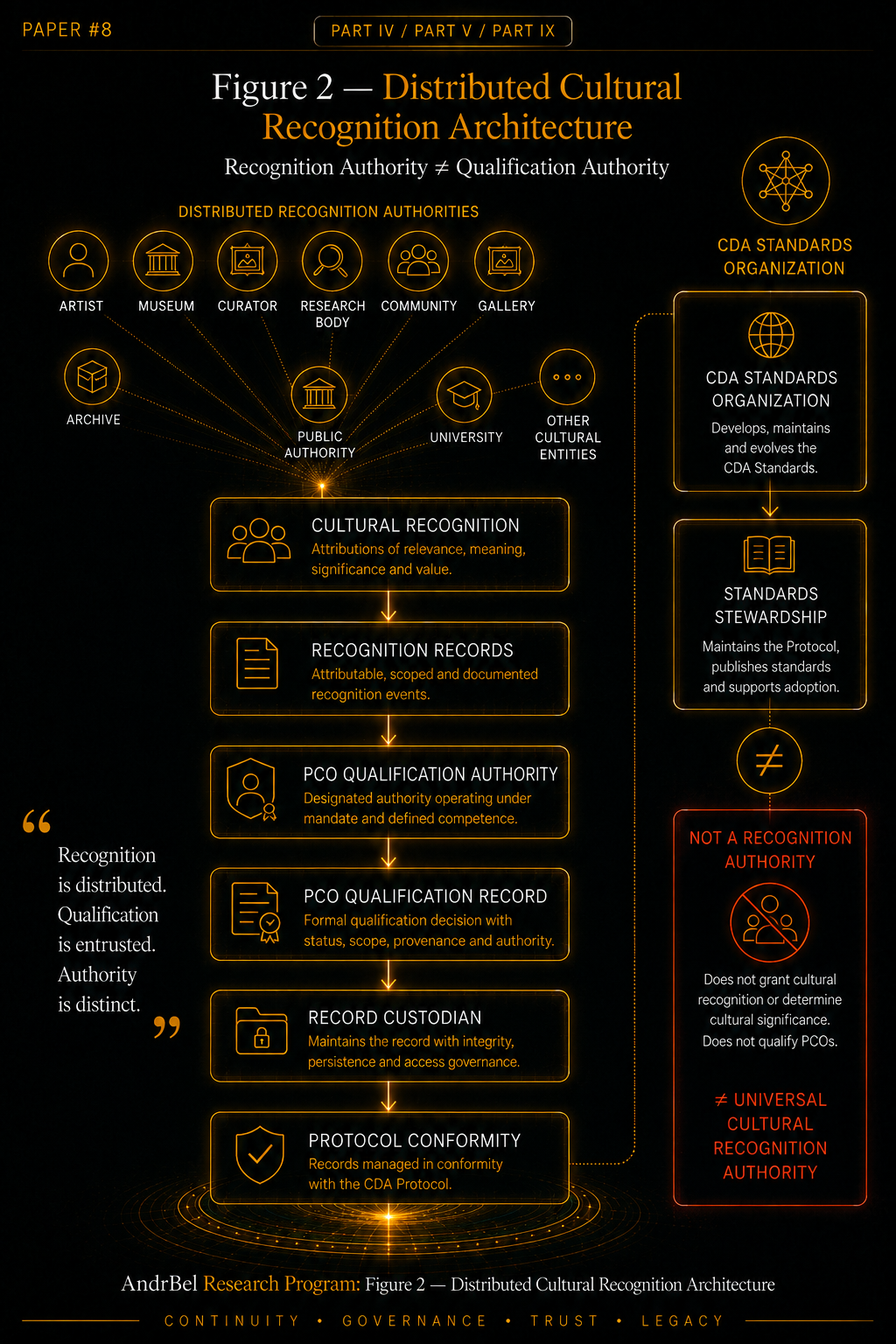
PART V
Structural Qualification: PCO Qualification Architecture
From Cultural Evidence to a Traceable Physical Cultural Object Qualification
Publication Metadata
Research Program: ANDRBEL Research Program
Framework Context: ADAS Framework Series
Research Type: Foundational Ontological Investigation
Protocol Function: Physical–Digital Ontology and Cultural Qualification Foundation
Future Standard Context: CDA Protocol v1.0
Institutional Context: CDA Standards Organization
Publication Position: PAPER #8 (DAP #0A)
Version: 1.0
Citation
Support independent artistic research in Cognitive Structuralism, conceptual painting, and long-term cultural infrastructure development.
[Support Research]
This publication forms part of the Demonstration and Validation Project (DAP) Research Series within the ANDRBEL Research Program.
The DAP Research Series provides the research and validation foundation for the development of the CDA Protocol and the future standards of the CDA Standards Organization.
All research models, validation methodologies, ontological classifications, diagrams, conceptual systems, terminologies, and written materials presented herein form part of the intellectual work of AndrBel.
© AndrBel, 2025–Present. All rights reserved.
For academic reference, citation is permitted with proper attribution.
Commercial implementation, derivative standards, or commercial reuse of the presented research requires prior written permission.