Work process
Cognitive Structuralism and ANDRBEL Research Program
AndrBel
Contemporary Conceptual Artist | Cognitive Structuralism AndrBel
ARTHALL BEL4224
Artist Legacy Infrastructure:
Why an Artist Needs More Than an Archive
Abstract
Contemporary artistic practice increasingly operates through complex conceptual systems, yet the structural model governing the long-term existence of artworks remains largely unchanged. The prevailing paradigm continues to treat artworks as isolated objects, supported by fragmented mechanisms of documentation, market circulation, and institutional engagement.
This paper introduces the concept of Artist Legacy Infrastructure as a structural framework designed to sustain artistic practice beyond the moment of production. Moving beyond the limitations of archival logic, the proposed model integrates production, documentation, market governance, institutional positioning, and long-term legacy into a unified system.
The paper argues that value in contemporary art should be understood not as a purely market-driven outcome, but as a structural consequence of system coherence, controlled scarcity, and institutional alignment. It further proposes a shift in the role of the artist—from creator of objects to designer of long-cycle systems capable of sustaining meaning, value, and continuity over time.
Keywords
Artist Legacy Infrastructure
Structural Model of Artistic Practice
Contemporary Art Systems
Cultural Asset Formation
Art Market Structure
Conceptual Art Practice
Provenance Systems
Institutional Art Framework
1. Introduction — The Problem of Artistic Legacy
Contemporary art production has reached a level of conceptual, material, and technological complexity unprecedented in the history of artistic practice. Artists today operate across multiple domains—painting, digital systems, generative processes, narrative structures, and hybrid media environments—yet the structural model governing their long-term presence remains largely unchanged.
The dominant paradigm continues to rely on a fragmented sequence:
studio → gallery → collector → secondary market
This model is effective in facilitating circulation. It is not effective in securing legacy.
Artworks are produced, distributed, and occasionally institutionalized, but the system that ensures their long-term coherence, valuation, and contextual integrity is often absent. As a result, artistic practices that are conceptually rigorous and systemically complex risk being reduced to isolated objects within a dispersed market environment.
The problem is not the absence of archives.
The problem is the absence of structure.
Most artists, even those operating at a high conceptual level, develop:
- bodies of work
- series
- conceptual frameworks
- documentation
But they do not construct a unified system that governs how these elements persist, interact, and evolve over time.
This leads to a fundamental contradiction:
Art is increasingly produced as a system,
but maintained as a collection of fragments.
In this condition, legacy becomes unstable.
Works may survive.
Recognition may emerge.
But the integrity of the artistic system is not guaranteed.
The question, therefore, is not whether art can endure.
The question is:
Under what structural conditions can an artistic practice exist coherently beyond the moment of its production?
This paper proposes that the answer lies not in improving existing archival methods, but in redefining the underlying model.
2. The Limitations of the Archive Model
The archive has long been considered the primary mechanism through which artistic legacy is preserved. It documents, categorizes, and stabilizes the past. It provides provenance, supports scholarship, and ensures traceability.
However, the archive operates under a fundamentally passive logic.
It records.
It does not govern.
This distinction is critical.
An archive can preserve:
- images
- dates
- materials
- ownership records
But it cannot:
- regulate production
- control market circulation
- define scarcity
- maintain conceptual integrity
- ensure institutional positioning
In other words:
The archive secures memory, but not structure.
This limitation becomes increasingly evident in contemporary practices where artworks are not isolated objects but elements within broader conceptual systems. In such cases, the meaning and value of individual works depend on their position within a larger architecture.
Without an active structural framework:
- series become fragmented
- conceptual systems lose coherence
- pricing becomes inconsistent
- secondary markets operate without alignment
- institutional narratives weaken
The result is a gradual erosion of both intellectual clarity and market stability.
Even well-documented practices can experience this fragmentation.
A comprehensive archive may exist, yet:
- works circulate without contextual control
- collectors engage with isolated pieces rather than systems
- institutions encounter incomplete narratives
This reveals a fundamental inadequacy:
Archiving is necessary, but not sufficient.
To sustain an artistic practice over time, something more is required:
- a system that not only records, but organizes
- not only preserves, but directs
- not only documents, but structures relationships between works, market, and institutions
The transition required is conceptual:
from archive to infrastructure
3. From Artwork to System
The transition from artwork to system marks a fundamental shift in how artistic practice is conceived, produced, and sustained.
Traditionally, the artwork has been treated as a self-contained entity:
- a painting
- a sculpture
- an object with material, authorship, and provenance
- aesthetic quality
- historical context
- market validation
- institutional recognition
However, in contemporary conceptual practice, this model becomes insufficient.
When an artist develops:
- interconnected series
- conceptual frameworks
- cross-media structures
- narrative or cognitive systems
the individual artwork no longer functions as an isolated unit.
Instead, it becomes:
a node within a larger structure
3.1 The Artwork as a Node
In a system-based practice, each work carries meaning not only through its internal composition but through its position within a network.
This network may include:
- other works within the same series
- conceptual subsystems
- theoretical frameworks
- temporal sequences
- digital extensions
- archival references
- relational
- contextual
- dependent on structural placement
Its meaning is not fixed.
It is activated through its connections.
3.2 Systemic Meaning vs Isolated Meaning
An isolated artwork communicates through:
- form
- color
- composition
- symbolism
- position within a conceptual architecture
- interaction with other works
- participation in a larger narrative or model
This distinction is critical.
Without the system:
- meaning collapses into surface interpretation
- conceptual depth becomes inaccessible
- the work is reduced to an aesthetic object
- meaning expands
- interpretation becomes layered
- the work functions as part of a cognitive or conceptual mechanism
3.3 The Artist as System Architect
This shift transforms the role of the artist.
The artist is no longer only:
- a maker of objects
- a producer of images
The artist becomes:
an architect of structures
This includes:
- designing conceptual systems
- defining relationships between works
- establishing internal logic
- controlling how meaning evolves over time
- system design
- theoretical modeling
- structural composition
3.4 Implications for Value and Interpretation
When artworks function as nodes within a system, their value cannot be evaluated solely on individual criteria.
Instead, value emerges from:
- system relevance
- conceptual centrality
- structural role within the practice
- foundational works
- transitional works
- experimental works
- peripheral works
But institutions do.
And over time, markets tend to align with institutional logic.
3.5 System Dependency and Risk
There is, however, a critical consequence:
A system-based artwork depends on the survival of its system.
If the system is:
- undocumented
- weakly defined
- poorly maintained
- not institutionally supported
- relationships between works dissolve
- meaning fragments
- value becomes unstable
- context
- relevance
- positioning
3.6 The Need for Structural Continuity
To sustain a system-based practice, continuity must be ensured across:
- time
- production
- documentation
- market circulation
- institutional engagement
It requires:
a governing structure
One that defines:
- how works are produced
- how they are classified
- how they are positioned
- how they circulate
- how they are preserved
- studio activity
- documentation
- archiving
Transition
If the artwork becomes a node,
and the practice becomes a system,
then the central question is no longer:
How do we preserve artworks?
but:
How do we sustain the system that gives them meaning?
This question leads directly to the next step:
4. Artist Legacy Infrastructure
If the artwork is no longer an isolated object,
and the artistic practice operates as a system,
then the central requirement shifts:
from preservation of objects
to maintenance of structure
This shift defines the concept of Artist Legacy Infrastructure.
4.1 Definition
Artist Legacy Infrastructure can be understood as:
an integrated structural framework that governs the production, organization, circulation, and long-term continuity of an artistic practice.
It is not a tool.
It is not a platform.
It is not an archive.
It is:
a system that sustains the internal logic of an artist’s work over time.
4.2 From Archive to Infrastructure
The distinction between archive and infrastructure is fundamental.
Archive Infrastructure
Records the past Organizes continuity
Stores information Governs relationships
Passive Active
Descriptive Operative
An archive answers:
What exists?
An infrastructure answers:
How does it continue to exist?
4.3 Core Components of the Infrastructure
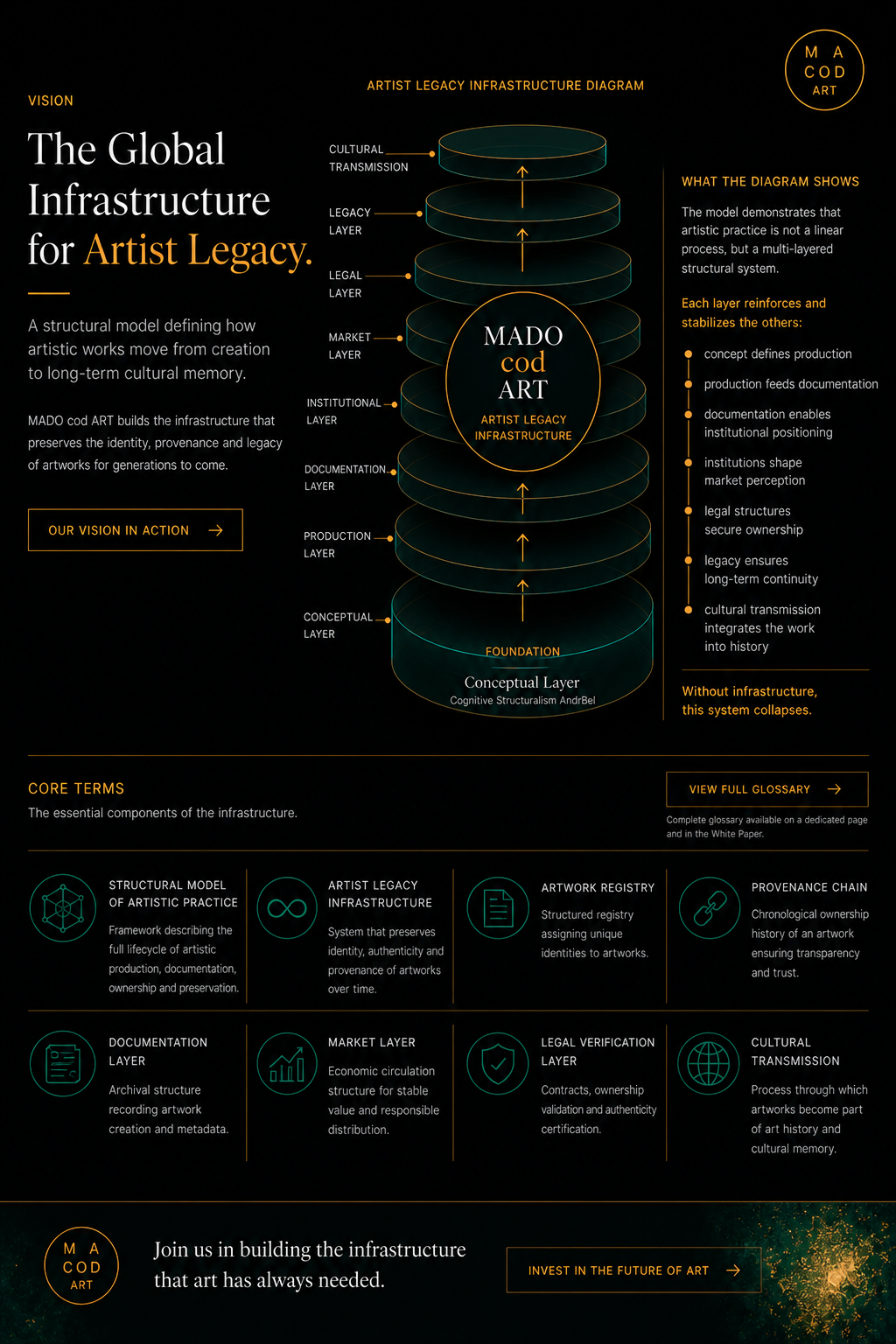
An Artist Legacy Infrastructure is composed of interdependent layers.
Each layer performs a distinct function, but none operates independently.
1. Production System
Defines:
- how works are created
- how many works exist
- how series are structured
- how new work relates to existing work
controlled production and structural scarcity
2. Identification & Archive Layer
Includes:
- artwork identification systems
- cataloguing
- documentation
- provenance tracking
not the center, but the reference system
3. Market Governance Layer
Defines:
- pricing logic
- release strategy
- collector positioning
- resale conditions
- scarcity enforcement
- markets fragment
- value destabilizes
the practice maintains economic coherence
4. Institutional Layer
Includes:
- exhibitions
- curatorial frameworks
- institutional partnerships
- long-term positioning
how the system is interpreted externally
5. Legal & Rights Layer
Defines:
- ownership structures
- intellectual property
- resale conditions
- contractual relationships
continuity beyond the artist’s direct control
6. Legacy Layer
The most critical and least developed in traditional practice.
This layer governs:
- post-production continuity
- long-term archive control
- intergenerational transmission
- structural preservation of the system
What happens when the artist is no longer present?
4.4 Structural Integration
These layers do not function sequentially.
They operate as a single system.
Production affects market.
Market affects institutional positioning.
Institutional positioning affects legacy.
Legacy reinforces value and meaning.
This creates:
a feedback structure
Without integration:
- the practice disperses
- value becomes inconsistent
- interpretation weakens
the practice becomes self-reinforcing
4.5 Infrastructure as Continuity Mechanism
The purpose of Artist Legacy Infrastructure is not only preservation.
It is:
- continuity of meaning
- continuity of value
- continuity of structure
- a sequence of outputs
a long-cycle system
4.6 Temporal Scale
Traditional artistic models operate on short to mid-term cycles:
- production
- exhibition
- sale
10–50 years
It considers:
- long-term positioning
- institutional embedding
- controlled evolution
- historical integration
4.7 The Role of Control
A critical aspect of infrastructure is control.
Not in the sense of restriction,
but in the sense of:
- coherence
- alignment
- structural integrity
- overproduction occurs
- pricing collapses
- conceptual systems fragment
With control:
the system maintains identity over time
4.8 From Artist to System Designer
At this stage, the role of the artist changes definitively.
The artist becomes:
- creator of works
- architect of systems
- designer of continuity
This is not an expansion of artistic practice.
It is:
a transformation of its structure
Transition
If artistic practice requires infrastructure,
and infrastructure determines long-term existence,
then the final question is:
How does this translate into value?
Not only cultural value,
but also economic and institutional value.
Artist Legacy Infrastructure Diagram
5. Structural Scarcity and Value Formation
If artistic practice is understood as a system,
then value can no longer be interpreted as a purely market-driven outcome.
It must be understood as:
a structural consequence
5.1 Beyond Market Price
In traditional models, value is often explained through:
- demand
- visibility
- reputation
- market speculation
These factors remain relevant.
But they do not explain stability.
They explain fluctuation.
5.2 Scarcity as Structure, Not Condition
Scarcity has long been associated with value.
However, in most cases, scarcity is:
- accidental
- inconsistent
- externally imposed
Within an infrastructure-based practice, scarcity becomes:
a designed structural parameter
This distinction is critical.
Scarcity is no longer:
- a result of limited output
It becomes:
a controlled relationship between production, system relevance, and temporal distribution
5.3 Structural Scarcity
Structural scarcity emerges when:
- the number of works is defined within a system
- the role of each work is differentiated
- the expansion of the system is regulated
- internal hierarchy
- conceptual weighting
- positional significance
And this inequality is not arbitrary.
It is:
structurally defined
5.4 Hierarchy Within the System
Within a structured practice, works can be understood across different levels:
- foundational works
- transitional works
- experimental works
- peripheral works
- serves a different function
- occupies a different position
- carries a different weight
the role of the work within the system
not from isolated perception.
5.5 Controlled Circulation
Structural scarcity is reinforced through controlled circulation.
This includes:
- selective release of works
- defined acquisition frameworks
- conditions on resale
- institutional placement strategies
- works disperse randomly
- relationships between them weaken
- value becomes inconsistent
circulation becomes part of the system itself
5.6 Temporal Scarcity
Scarcity is not only quantitative.
It is also temporal.
This involves:
- when works become available
- how frequently they are released
- how long they remain within primary control
- anticipation
- structural rhythm
- long-term positioning
but by when and how it enters the system.
5.7 Conceptual Weight and Value
In a system-based practice, value is also tied to:
- conceptual centrality
- theoretical relevance
- structural importance
- carries more weight
- anchors interpretation
- stabilizes meaning
Such works function as:
conceptual anchors
Their value is not only economic.
It is:
- structural
- interpretative
- institutional
5.8 Institutional Alignment
Over time, institutions tend to recognize:
systems rather than isolated works
structures rather than individual outputs
When an artistic practice presents:
- defined hierarchy
- controlled scarcity
- conceptual coherence
it becomes:
legible to institutions
This legibility is a key factor in long-term value formation.
5.9 Value as a Long-Cycle Outcome
Within an infrastructure-based model, value does not emerge immediately.
It develops across:
- production
- positioning
- interpretation
- institutional engagement
This creates:
a long-cycle value structure
Short-term fluctuations become less significant.
Long-term alignment becomes central.
5.10 From Object Value to System Value
At this stage, value shifts:
from:
- individual artwork value
to:
system value
This includes:
- coherence of the practice
- stability of positioning
- continuity of meaning
- institutional integration
The artwork remains important.
But it is no longer the only unit of value.
Transition
If value is structured,
and scarcity is designed,
then the final dimension must be addressed:
How is this system sustained over time, beyond the artist’s immediate presence?
This leads to the final section:
6. Case Model — Toward an Infrastructure-Based Practice
The concept of Artist Legacy Infrastructure is not purely theoretical.
Its relevance becomes evident when examined through practices that already operate beyond object-based production and toward systemic organization.
Such practices do not simply produce works.
They construct:
- conceptual architectures
- internal hierarchies
- controlled production frameworks
- integrated documentation systems
- defined modes of circulation
In these cases, artistic activity begins to resemble:
a structured environment rather than a sequence of outputs
6.1 From Practice to System Implementation
An infrastructure-based practice emerges when the following conditions are met:
- artworks are positioned within a defined conceptual framework
- production is aligned with structural logic
- documentation is integrated from the outset
- circulation is regulated rather than incidental
- institutional engagement is embedded in the system
This alignment transforms the practice into:
a coherent operational model
rather than an accumulation of independent elements.
6.2 Institutional Representation as Structural Operator
Within such a model, the role traditionally occupied by galleries becomes insufficient.
Representation shifts from:
- transactional mediation
to:
structural operation
An institutional entity assumes responsibility not only for:
- exhibition
- sales
but also for:
- system coherence
- pricing logic
- collector positioning
- long-term market alignment
- registry and documentation continuity
In this configuration, representation becomes:
an active component of the infrastructure
rather than an external service.
6.3 Integration of Layers
A defining characteristic of an infrastructure-based practice is the integration of layers that are typically separated:
- production
- archive
- market
- institutional context
- legal structure
- legacy planning
When these layers operate independently, fragmentation occurs.
When they are integrated:
the system becomes self-consistent
This integration enables:
- continuity of meaning
- stability of positioning
- alignment between concept and market
- preservation of structural relationships
6.4 Controlled System Expansion
Infrastructure does not imply rigidity.
It implies regulated evolution.
New works, series, or conceptual developments are introduced within defined parameters:
- in relation to existing structures
- without disrupting internal hierarchy
- without diluting conceptual coherence
This ensures that growth strengthens the system rather than destabilizing it.
6.5 Long-Term Governance
A critical component of infrastructure-based practice is governance.
This includes:
- decision-making protocols
- control over production volume
- conditions of circulation
- rights management
- post-sale frameworks
Governance provides:
continuity beyond immediate artistic activity
It ensures that the system remains coherent even as:
- time passes
- ownership changes
- institutional contexts evolve
6.6 Toward a New Model of Artistic Practice
When these elements are present, the artistic practice operates not only within the art world, but as a structured entity within it.
The implications are significant.
The practice becomes:
- legible to institutions
- stable within the market
- coherent in its conceptual development
- sustainable over extended timeframes
This suggests a broader shift:
from artist as producer
to artist as system designer within a governed structure
6.7 Framework Application
One contemporary implementation of this model can be observed in practices that combine:
- defined conceptual systems
- structured artwork hierarchies
- integrated archival protocols
- controlled circulation strategies
- dedicated institutional representation
Within such frameworks, artistic production is directly linked to:
- long-term positioning
- collector architecture
- institutional programming
- legacy continuity
The result is a practice that operates simultaneously across:
- conceptual
- economic
- institutional
- temporal dimensions
6.8 Infrastructure as Cultural Position
At this stage, infrastructure becomes not only a functional necessity but a cultural position.
It reflects an understanding that:
- artistic meaning is relational
- value is structural
- continuity is constructed
The practice no longer depends solely on:
- visibility
- market momentum
- critical reception
Instead, it is supported by:
a designed system capable of sustaining its own evolution
This model suggests that contemporary artistic practice can be understood not only as cultural production, but as a form of structural design within the broader ecosystem of art.
Conclusion — From Preservation to Construction
The traditional model of artistic legacy is based on preservation.
Works are created, collected, archived, and occasionally institutionalized.
This model assumes that value and meaning will persist over time.
However, contemporary artistic practice reveals that:
persistence is not automatic
It must be constructed.
Artist Legacy Infrastructure proposes a different approach:
- not preservation, but organization
- not accumulation, but structure
- not fragmentation, but integration
Under this model, artistic practice becomes:
a long-cycle system designed for continuity
The artwork remains central.
But it is no longer sufficient.
It exists within:
- a conceptual framework
- a production system
- a governance structure
- an institutional context
- a legacy architecture
This transformation does not replace art.
It redefines:
the conditions under which art continues to exist
Support independent artistic research in Cognitive Structuralism, conceptual painting, and long-term cultural infrastructure development.
[Support Research]
For academic reference, citation is permitted with proper attribution.
Suggested citation:
AndrBel, “Artist Legacy Infrastructure: Why an Artist Needs More Than an Archive,” ARTHALL Papers #1, ARTHALL BEL4224, 2025.
Artist Legacy Infrastructure
Version 1.0
May 2025
Author: AndrBel
This paper is published within the ARTHALL BEL4224 institutional research framework.
The concepts presented, including Artist Legacy Infrastructure and related structural models, form part of the intellectual property of AndrBel and ARTHALL BEL4224.
Unauthorized commercial use, replication, or derivative development of these concepts is strictly prohibited.
Support independent artistic research in Cognitive Structuralism, conceptual painting, and long-term cultural infrastructure development.
[Support Research]
Cognitive Structuralism — AndrBel
Ongoing Artistic Research Framework
© AndrBel, 2025–Present
Cognitive Structuralism is an original conceptual and theoretical framework developed by AndrBel.
No part of this concept, including its terminology, structural models, or theoretical formulations, may be reproduced, distributed, or adapted without prior written permission from the author.
This material is protected as intellectual property within the AndrBel artistic and research practice.
This publication is part of the ARTHALL BEL4224 Research Program.
No part of this publication may be reproduced, distributed, or transmitted in any form or by any means without prior written permission from the author and ARTHALL BEL4224, except in the case of brief quotations for academic or curatorial purposes.