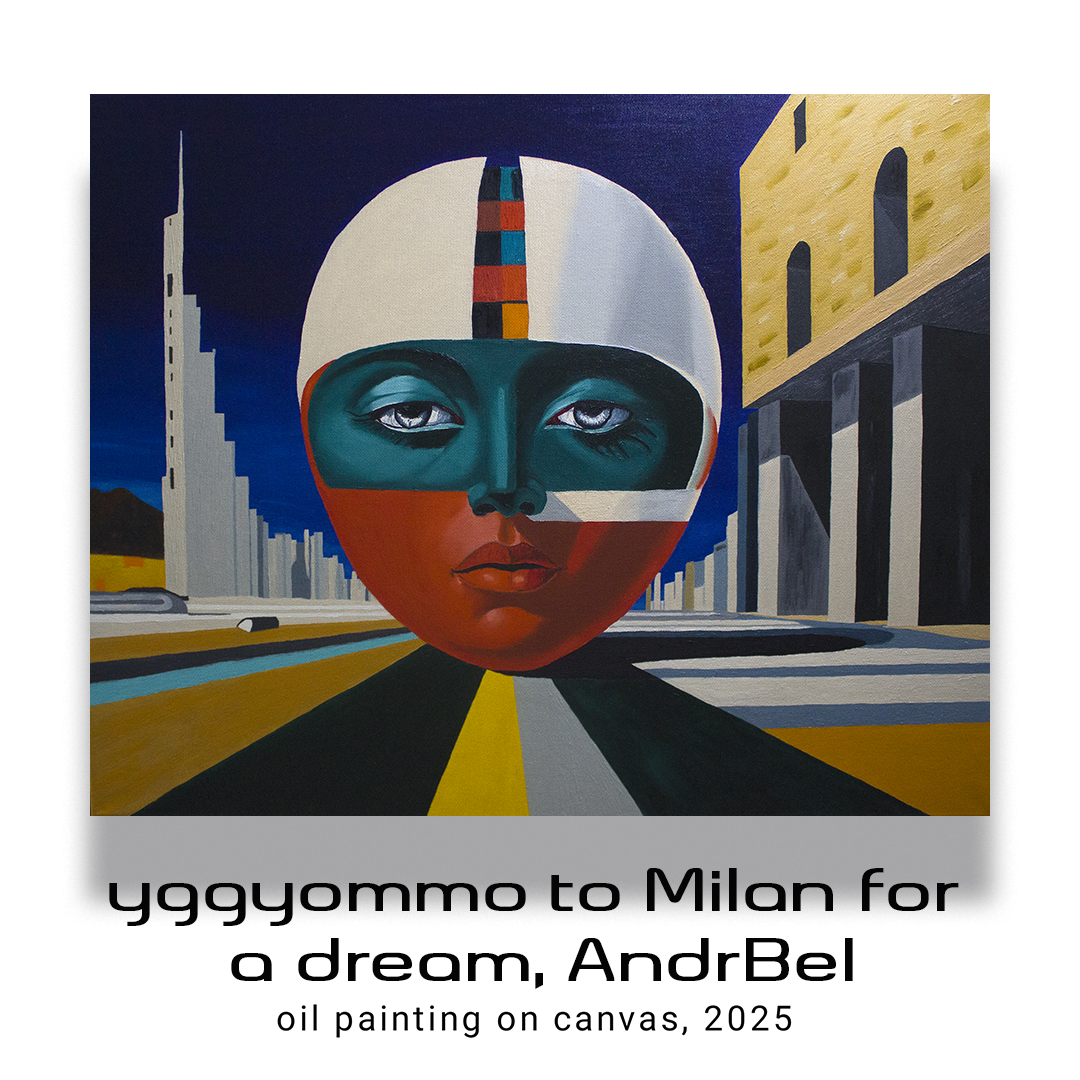
yggyommo to Milan for a dream (2025)
Oil on canvas
Artist: AndrBel
Title: yggyommo to Milan for a dream
Year: 2025
Medium: Oil on canvas
Dimensions: 39.37 × 31.5 in (100 × 80 cm)
Series: Relhi — mio GESES – Relhi – GOTER
Status: Core Institutional Work (1 of 7 Anchor Paintings)
Price:mail@andrbel.art or Singulart
*Institutional Artwork Numbering System
Registry Number: ARTHALL-BEL4224 / Relhi – GOTER / 2025 / 001
Conceptual Position
yggyommo to Milan for a Dream explores the symbolic geography of aspiration.
Within AndrBel’s conceptual language, Relhi represents perceptual landscapes shaped by internal emotional states and cognitive narratives.
The work presents a structured visual environment in which color fields and spatial rhythm evoke the psychological movement toward a dream or imagined destination.
“Milan” in the title operates both as:
- a geographic reference
- a metaphorical destination representing artistic ambition and cultural dialogue
Through this dual meaning, the painting reflects the journey between internal imagination and external realization.
“yggyommo to Milan for a dream” (Italian: yggyommo a Milano per un sogno) introduces the figure of yggyommo—a conceptual anthropomorphic subject representing the human condition in perpetual movement toward aspiration. Yggyommo is not an individual, but a symbolic aggregate identity: “this is us,” a cognitive traveler across geography, time, and desire.
The journey to Milan functions as both a literal and symbolic axis: Milan as a global center of art, fashion, capital, and mythic success. The painting frames movement itself as existential structure—dreams exist only in motion, and identity is defined by the trajectory toward them.
Within the Relhi narrative, yggyommo embodies the perpetual becoming of the self, suspended between origin and destination, between present reality and imagined future.
The work situates aspiration as a spatial and temporal vector. Dreams are not static goals but dynamic forces that generate movement, displacement, and identity reconstruction.
Cognitive Structuralism: Dream as System
Within AndrBel’s practice, Cognitive Structuralism treats mental phenomena as organized structures - structured systems, rather than abstract emotions, emotional states.In this framework:
- dreams function as directional vectors
- perception reorganizes around future projections
- identity evolves through cognitive architecture
The painting therefore operates as a diagram of aspiration, becomes a diagram of thought in motion.
It reveals how the human mind constructs future environments before they exist in physical reality.
Role within the GESES Conceptual System
The GESES system developed by AndrBel examines how individuals construct meaning through symbolic perception.
Within this system:
- Relhi functions as a conceptual terrain
- GOTER represents moments of directional intention
Thus the painting becomes a visual representation of the human impulse to move toward imagined futures.
Institutional Role
This work represents a foundational piece within the Relhi – GOTER cycle.
Its registry classification confirms its role as:
- the first documented work within this conceptual subsection
- a reference painting for future developments within the GESES system
Collector Positioning
Collectors acquiring works from the earliest stages of a conceptual cycle often become part of the historical narrative surrounding that system’s development.
Within AndrBel’s practice, these works represent early structural elements of a broader artistic research program.
Strategic Context
The controlled circulation of the 7 core paintings establishes a scarcity structure similar to early institutional positioning observed historically in artists whose foundational works defined the market architecture of their practice.
Market Framework
The acquisition is accompanied by a structured framework designed to protect long-term value:
• Minimum holding period before resale: 2 years
• Artist Right of First Refusal on resale
• 8% artist participation on secondary market transactions
• Institutional exhibition loan opportunities within ARTHALL BEL4224
“I am not interested in depicting the world as it appears.
I am interested in how the mind constructs it.” — AndrBel

Partners





 .
.